
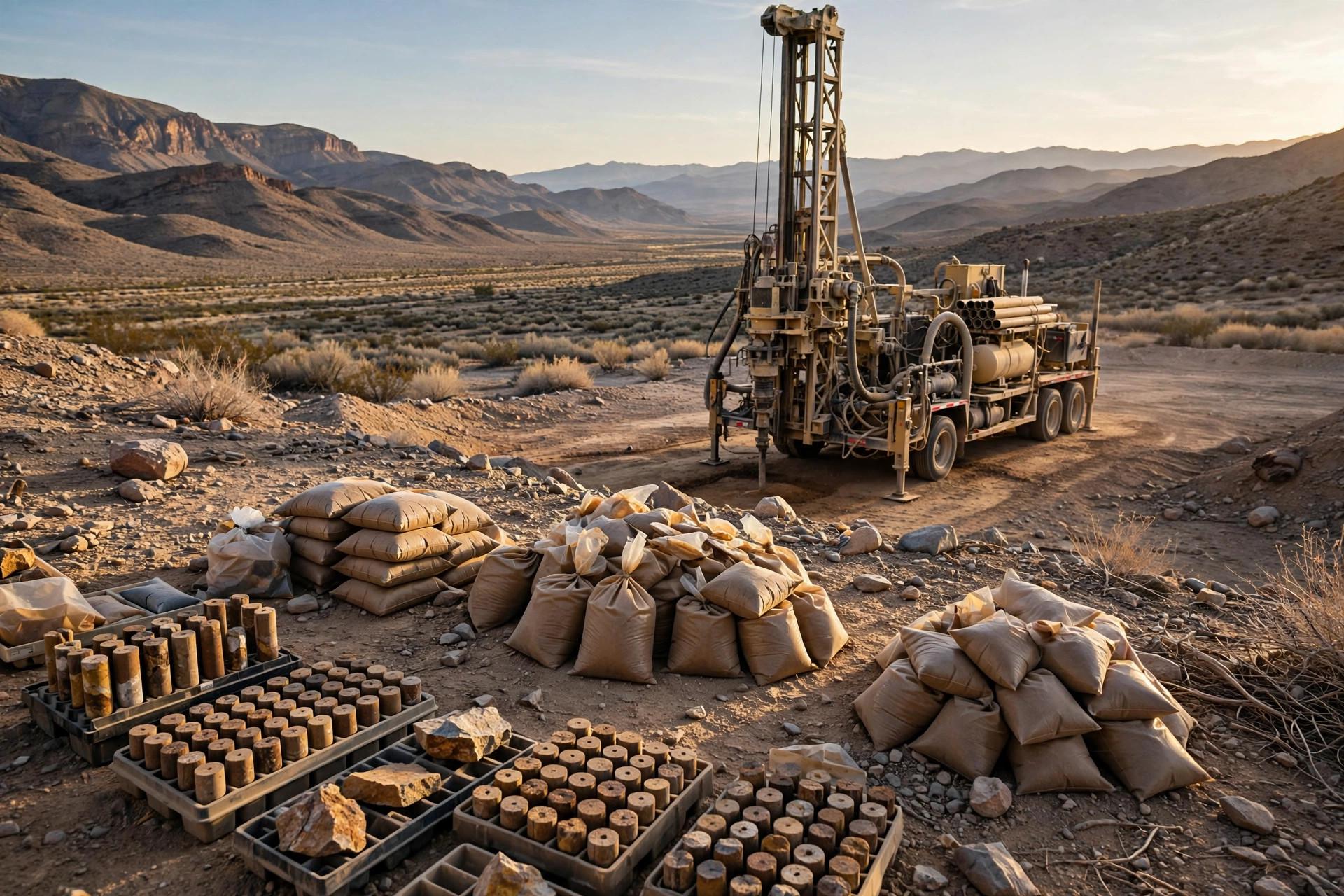
The first reverse-circulation hole of the 2026 season at the SSD Target has returned gold in four separate zones — from surface to nearly 190 metres down. Westward Gold Inc. (CSE: WG) (OTCQB: WGLIF) (FSE: IM50) announced on November 25 assay results for hole T2603 at its Toiyabe Hills Property in Lander County, Nevada, in the Cortez Trend area.
- The four zones in T2603 (vertical RC hole, 396.2 metres total depth; intervals calculated at a 0.14 g/t gold cutoff): 9.1 metres at 0.34 g/t gold from surface in the Roberts Mountains Thrust Fault; 25.9 metres at 0.65 g/t from 42.7 metres; 7.6 metres at 1.97 g/t from 79.2 metres, including 3.1 metres at 4.33 g/t; and 21.3 metres at 0.33 g/t from 167.7 metres. Individual samples graded up to 5.96 g/t gold.
- The host: the strongest intercept sits in variably decalcified, carbonaceous silty limestone of the Wenban Formation, in a fault zone with breccia; the higher-grade subinterval coincides with a decalcified, silicified zone with calcite and quartz stringers.
- What the hole did not do: T2603 did not fully test its intended targets in the Wenban and upper Roberts Mountains formations due to drilling complications. Subsequent RC holes at SSD faced similar issues and were cased for core-tail completions in 2027.
- Still to come: results from six SSD holes are pending at the assay lab, and drilling remains ongoing at the El Segundo Target — one of three target areas drilled in 2026. The 2026 season is expected to conclude in early December as winter conditions intensify.
- Widths: all intervals are drill-hole lengths; true thicknesses are currently unknown and estimated at 70–90% of reported thicknesses.
- The lab work: samples to ALS Limited in Elko for preparation, with fire assay and multi-element analysis; QA/QC frequency at a minimum of 14%, including standards, blanks and duplicates, all deemed acceptable for disclosure. Technical content was reviewed by Robert Edie, Vice President Exploration, a Qualified Person under NI 43-101.
A complex target, tested in pieces
T2603 also underlined why SSD is slow work. Moving downhole, the hole re-entered discrete zones of upper-plate siliciclastic rock beneath lower-plate carbonates — structural complexity the company interprets as a possible duplex, thrust ramp or thrust zone, with quartz-veined, anomalously gold-bearing siliciclastics in the hole's last 6.1 metres. Testing below that feature is now one of the 2027 questions, alongside the core tails planned for the cased RC holes and the northern step-outs where no legacy drilling exists.
The honesty box
Toiyabe Hills has no mineral resource or reserve stated in this release. T2603 is a single hole, its four zones are drill-hole lengths at a 0.14 g/t cutoff with internal dilution of up to 6.7 metres below cutoff allowed, and the hole admittedly did not fully test its intended targets. Six SSD holes are unreported, and the El Segundo and Campfire results are still to come. This post reports the November 25 results exactly as released.
What to watch
The six pending SSD assay sets; El Segundo results as that drilling wraps in early December; whether the cased holes get their planned 2027 core tails; and the northern step-out results the company says will be particularly informative because no legacy drilling exists there.