
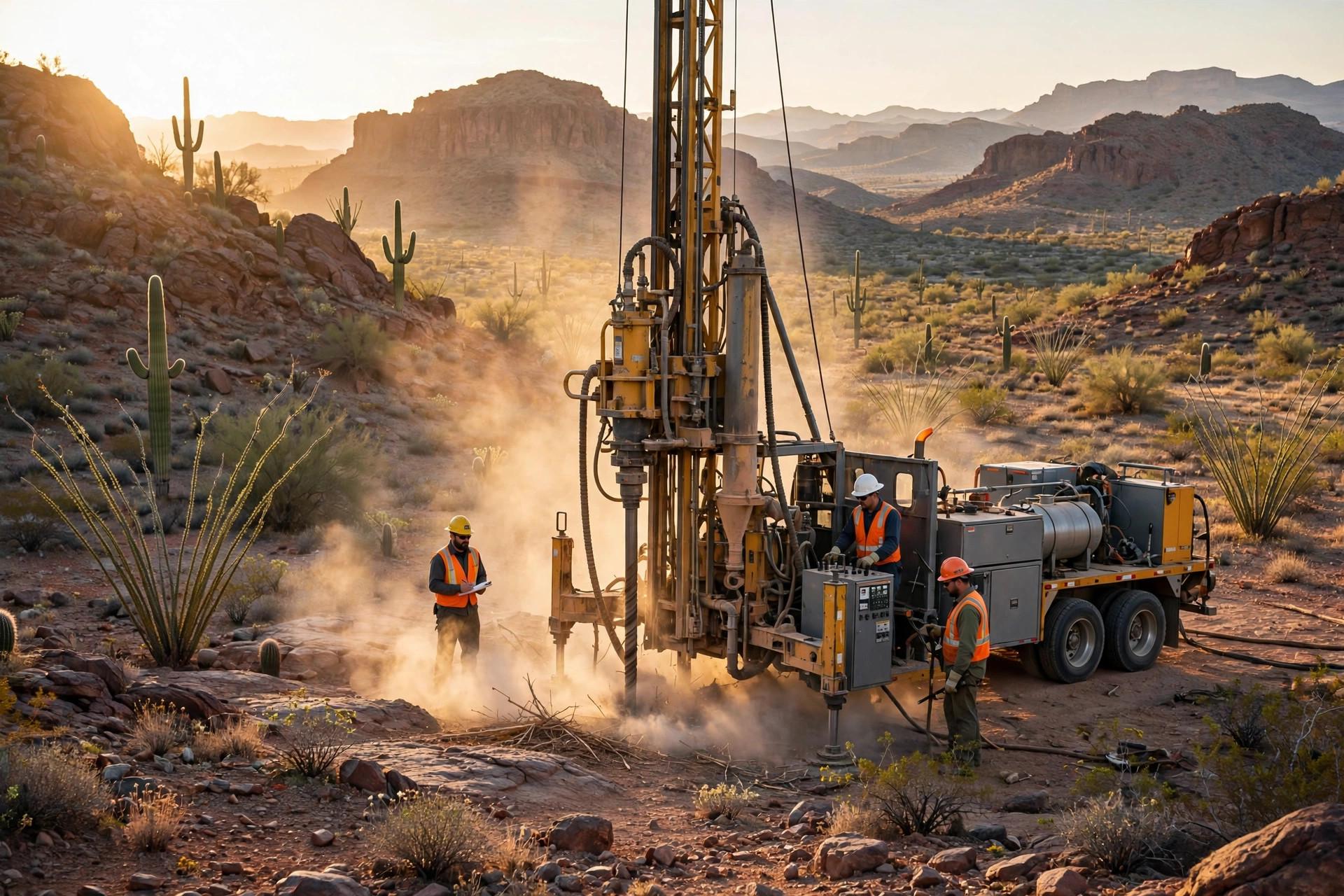
Gold Chain has had 30,000 metres of drilling in its entire history. West Point Gold Corp. (TSXV: WPG) (OTCQX: WPGCF) (FSE: LRA0) just started another 30,000. The company announced on November 17 that its fully funded drill program is underway at its flagship Gold Chain Project in Arizona, with one rig already on site and two more expected before year-end.
- The program: 30,000 metres, peaking at three rigs — two reverse circulation rigs and one diamond core rig. One rig is currently drilling; the other two are expected before year-end. The program is described by the company as fully funded.
- The scale: only 30,000 metres have been drilled at Gold Chain to date, so this single program represents a potential doubling of all drilling on the project.
- The money: West Point reported working capital of C$25.1 million at June 30, 2026, and C$4.7 million in warrant exercises since then. All warrants expiring in 2026 have now either been exercised or expired.
- The targets: expand known mineralization at Tyro (Northeast Tyro and Tyro Main), and advance the satellite targets Black Dyke, Sheep Trail and Bull 8, plus the large concealed Frisco Graben target.
- The resource timing — changed: the maiden mineral resource estimate for Tyro Main Zone and Northeast Tyro is now expected in Q1 2027. West Point attributes the revision to delayed duplicate assay results required by its independent technical consultant as part of QA/QC procedures, and to a decision — recommended by its geology team and the consultant — to incorporate several key early drill holes from the current program into the estimate.
- The QP: Robert Johansing, M.Sc. Econ. Geol., P. Geo., Vice President, Exploration, reviewed and approved the technical content of the release.
Where the metres will go
Northeast Tyro has produced the project's best results to date and remains the priority. Drilling in 2026 expanded the shallow zone along strike and at depth; the next phase pushes mineralization deeper, below some of the most recent high-grade holes, and northeast toward the Frisco Mine fault, where the Tyro vein system intersects the fault — a setting West Point considers very prospective, marked by strong kaolinite alteration and magnetite destruction along the vein projection.
Tyro Main is also expected to contribute to the maiden resource. Recent drilling showed weakening gold grades with depth, but the company says the alteration in those holes resembles what is typically seen above a low-sulphidation epithermal gold zone rather than below it — so the plan is to keep testing to depth, stepping down below the 2026 intercepts and pushing southwest beneath the current mineralized zone.
The satellites are earlier-stage, and the release reports their previously announced results as context, not as new assays:
- Black Dyke, about 4 km west of Tyro Main, is a shallow-dipping, largely oxidized zone defined for at least 200 metres along strike and about 250 metres down-dip, beginning at or near surface. Initial drilling included 36.6 m at 1.04 g/t Au from surface (GC26-095), 21.3 m at 0.92 g/t Au (GC26-098) and 12.2 m at 1.09 g/t Au (GC26-101). It will not be in the maiden resource.
- Sheep Trail, about 600 metres south of Tyro Main and historically the highest-grade mine in the Katherine (North Oatman) District, has returned broad shallow intercepts including 32.0 m at 1.05 g/t Au from 9.1 m (GC26-106) and 19.8 m at 1.42 g/t Au from 51.8 m (GC26-111), within a structural corridor traceable for more than a kilometre.
- Bull 8, about 6 km northwest of Tyro on the Union Pass Fault Corridor, saw six RC holes totalling 856 m in 2026, with gold in every hole; the standout was 21.4 m at 1.01 g/t Au from 71.6 m (GC26-136).
- Frisco Graben, immediately northeast of Northeast Tyro, is the district-scale swing: a concealed low-sulphidation epithermal target roughly four kilometres long and up to 750 metres wide at the intersection of the Tyro corridor and the Frisco Mine Fault. Prior drilling hit broad oxidized alteration and anomalous gold with elevated mercury, and the company interprets those holes as having stayed in the upper, steam-heated part of the system — the prospective boiling zone, if present, would sit deeper and remains largely untested.
President and CEO Derek Macpherson put the program plainly in the release: "While we have had significant success at Gold Chain to date, it remains early days. This 30,000m program will roughly double the metres drilled at Gold Chain. It is fully funded, and its goal is simple: expand Tyro and test the satellite targets."
The honesty box
Gold Chain has no mineral resource estimate yet — the Q1 2027 maiden resource is the project's first, it covers only Tyro Main and Northeast Tyro, and its timing has already moved once, for QA/QC duplicate-assay delays the company says are industry-wide. The satellite intercepts quoted above are previously reported drill results repeated in this release for context, not new assays from the program that started this week, and Black Dyke, Sheep Trail, Bull 8 and Frisco Graben are exploration targets at very different levels of maturity — Frisco Graben in particular is a conceptual, concealed target where no gold-bearing boiling zone has yet been intersected. "Fully funded" is the company's characterization of its balance sheet against the planned program; exploration programs expand, contract and reprioritize with results.
What to watch
Arrival of the second and third rigs before year-end; first assay results from the new program at Northeast Tyro and Tyro Main; and delivery of the maiden resource in Q1 2027 — the number that will put the first compliant tonnage and grade on Gold Chain.