
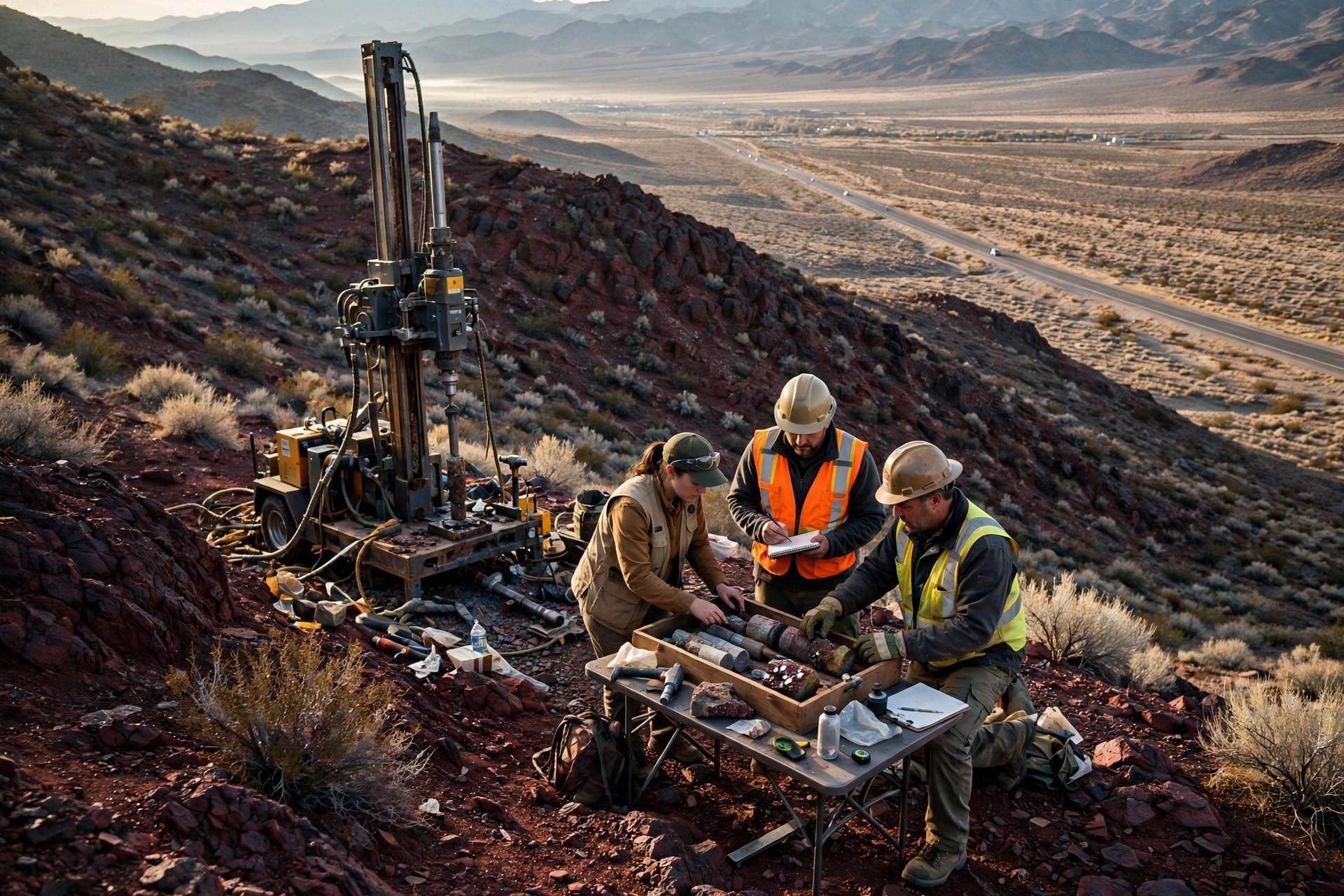
One very long hole made the case; now the follow-up program has to test it in three directions at once. VR Resources Limited (TSX.V: VRR) (OTCQB: VRRCF) announced on November 19 that the follow-up drill program at its New Boston copper-moly-tungsten-silver porphyry-skarn project in west-central Nevada is now underway — the program Pulse flagged on October 21, when the Bureau of Land Management approved the expanded drill permit that cleared it to proceed.
- The program: four to six holes planned, each expected to take three to four weeks, with results expected through Q1 2027. Earth work on site was completed last week and the rig is drilling.
- The hole being followed up: NB26-003, completed in June, intersected 317 metres at 0.77% CuEq starting at surface, above 419 metres at 0.48% CuEq, within 2,892 feet (881 metres) of continuous polymetallic stockwork veining carrying molybdenum, copper, tungsten and silver — and it did not bottom the system. Those figures are from the company's August 26, 2026 release.
- Three tests in one program: (1) the eastward continuation of the tungsten-bearing upper interval for 400–500 metres of strike; (2) the depth potential of a system still mineralized at the bottom of an 881-metre hole; and (3) the down-dip extent of sheeted-vein mineralization north of NB26-003, against the north-dipping Triassic limestone host.
- The room to work: all planned holes are collared in mineralized stockwork veins exposed at surface, and VR can choose from 16 permitted drill sites under its BLM Notice of Intent, spanning about 800 metres of strike eastward from NB26-003 at the Jeep Mine, in the western half of a porphyry-skarn system exposed over 3–4 kilometres of strike. Mineralized sheeted veins strike 2,100 metres east–west across Jeep Mine through the East Zone, and the 2023 DCIP survey shows chargeability of 15–21 mV/V at Jeep Mine.
- The QP: technical information was reviewed by President and CEO Dr. Michael Gunning, PhD, P.Geo., identified by the company as a non-independent Qualified Person. The release refers readers to the August 26 release for the CuEq methodology and QA/QC protocols.
Why this start matters more than a program announcement usually does
New Boston's problem has never been a lack of system — an 881-metre hole of continuous veining, collared in mineralization at surface, in a 3–4-kilometre skarn and porphyry trend with historic roads to virtually every permitted site, is a large system by any measure. Its problem is distribution: a single hole, however long, says nothing about whether grade holds together laterally, and the tungsten that makes the upper interval strategically interesting sits in exactly the part of the system this program tests first, 400 to 500 metres east along strike. The three stated tests map cleanly onto the three questions NB26-003 left open — strike, depth, and down-dip — and the 16 permitted sites give VR the flexibility to chase whichever answer comes back best, rather than being locked to a fixed pattern. Three years of surface work and geophysics went into the targeting, per CEO Michael Gunning; the next two quarters of assays are where that preparation either converts into a multi-hole system or stays a one-hole story.
The honesty box
There are no new assay results in this release — it announces that drilling has started. Every grade figure in it is carried over from the single NB26-003 hole reported in August, and one hole does not establish continuity, volume, a mineral resource or economic viability; New Boston has no mineral resource estimate. The CuEq figures are the company's own copper-equivalent calculation combining molybdenum, copper, tungsten and silver — they are not copper grades, and readers should use the methodology in the August 26 release to judge them. The hole counts, timings and Q1 2027 results schedule are forward-looking plans, and each hole taking three to four weeks means the program's news flow runs well into the new year. The Qualified Person is the company's own president and CEO and is non-independent, as the company discloses.
What to watch
The first follow-up hole's result — in particular whether the tungsten-bearing upper interval persists east of NB26-003; any hole that tests below 881 metres and whether the system is still veined at depth; and the cadence of results through Q1 2027 against the three-to-four-week-per-hole schedule the company has set out.