
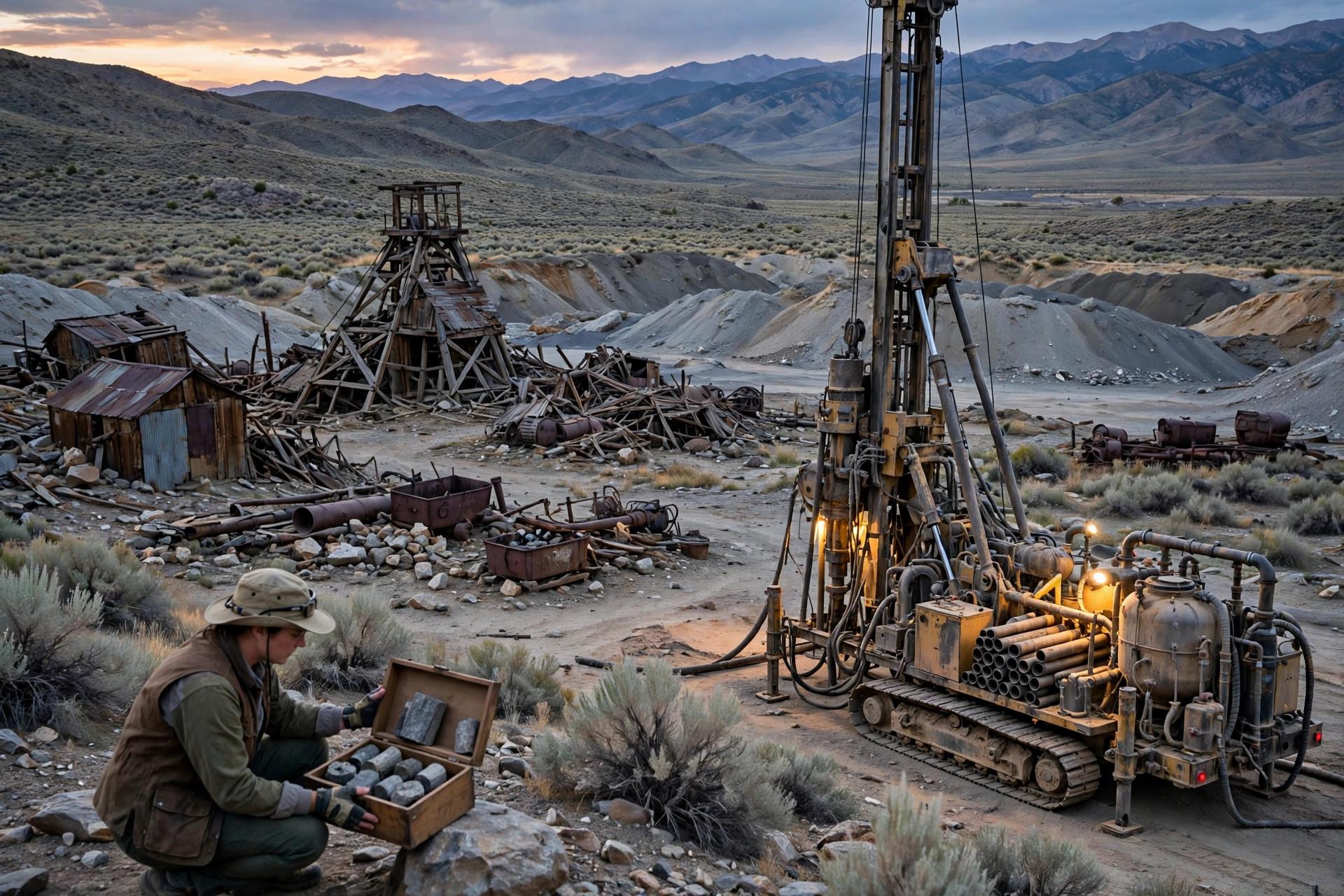
Linka's maiden drill program is finished, and its third assay batch is its best yet. Viking Mines reported on November 12 that nine further holes at Linka Main, at its Linka Tungsten Project in Nevada, have returned skarn-hosted scheelite mineralization in seven of them — confirming tungsten from near surface and, importantly, below the historic workings of a mine that produced in the 1940s and 1950s — while a single shallow sample returned the highest tungsten grade drilled on the project to date.
- The headline hole: LKRC0016 returned 9.9 metres at 0.51% WO3 from 58.7 metres, including 3.8 metres at 0.77% WO3, with a peak sample of 1.10% WO3. Estimated true width is 8.1 metres. Viking notes the intercept is higher grade than the surrounding historical drill holes.
- Down-dip confirmation: LKRC0009 returned 3.8 metres at 0.79% WO3 from 57.9 metres, including 1.5 metres at 1.10% WO3, about 30 metres down-dip from historic mining, confirming mineralization continues below the historic 150-foot level. LKRC0017 returned 12.2 metres at 0.20% WO3 from 48.8 metres immediately below the historic development, and LKRC0015 extended the envelope a further roughly 70 metres down-dip with 1.5 metres at 0.17% WO3 from 110.5 metres, leaving the system open at depth.
- The record sample: LKRC0007, drilled into the crown pillar above the historic stopes, returned 7.6 metres at 0.33% WO3 from 18.3 metres, including 0.8 metres at 1.86% WO3 — the highest-grade sample drilled at Linka to date. LKRC0011 also hit crown-pillar mineralization, 2.3 metres at 0.30% WO3.
- Program complete: the maiden RC program totals 48 holes for approximately 3,491 metres; the rig has been demobilised, assays have been received for fourteen holes at Linka Main, all remaining samples are at the laboratory, and results are expected through December, including visible scheelite intervals in LKRC0021 and LKRC0022 expected in late November to early December. Assays are by ALS Laboratories.
- Re-assays raised two earlier holes: after certified reference materials in an original batch fell outside tolerance, samples from LKRC0005 and LKRC0006 were re-assayed higher — LKRC0005 is now 18 metres at 0.47% WO3 (was 0.42%) and LKRC0006 is now 13 metres at 0.53% WO3 (was 0.46%) — superseding the September 24 results. Exploration results were compiled by Managing Director & CEO Julian Woodcock, MAusIMM (CP), the announcement's Competent Person.
A restart story, tested below the old workings
Linka is a brownfields bet: a historically producing tungsten mine — Linka, Conquest and Hillside — where Viking is testing whether scheelite mineralization continues above, below and along strike from where miners stopped in the 1950s. This batch speaks to each of those directions. The crown-pillar holes show high-grade material the historic miners left behind above their stopes; LKRC0009, LKRC0016 and LKRC0017 show the skarn continuing below the 150-foot level; and LKRC0012 extended mineralization south along strike with multiple narrower intervals.
Woodcock framed it as grade confirmation: results such as 9.9 metres at 0.51% WO3 and individual samples above 1% WO3 "reinforce the opportunity Viking has to define a quality tungsten project in the heart of Nevada." The near-term work is unglamorous and necessary: finish logging, report the remaining visual intercepts, receive the December assay batches, re-analyse mineralized intervals with an XRF ore-grade finish, update the 3D geological model, and continue metallurgical and ore-sorting testwork.
The honesty box
No mineral resource or reserve has been defined at Linka — under the JORC Code or otherwise. These are exploration results from a maiden program, and whether they support a future Exploration Target or resource estimate, and whether historical drilling data can be validated for such use, are assessments Viking says it will make once all assays are in; historical results referenced in the announcement have not been verified by the company. Intervals are downhole lengths; estimated true widths in the announcement's table are narrower (for example, 8.1 metres true for LKRC0016's 9.9 metres, and 3.1 metres true for LKRC0009's 3.8 metres). The 1.86% WO3 figure is a single 0.8-metre sample, not an interval grade. Two of the nine holes in this batch returned no significant assays, and one hole, LKRC0010, hit a 3.0-metre void at its target — historic workings, not mineralization. The re-assay episode also cuts both ways: the company's QA/QC caught a laboratory issue that had under-reported tungsten in two holes, and Viking states the extent of any bias in other reported results remains under evaluation, with ore-grade re-analysis of mineralized intervals still to come. Any restart of historic production would require resource definition, studies, financing and approvals that do not yet exist.
What to watch
The late-November/early-December assays for LKRC0021 and LKRC0022; the remaining December batches for the full 48-hole program; the XRF re-analysis of mineralized intervals and whether it moves any reported grades; the updated 3D model; and whether Viking converts the validated drilling into a JORC Exploration Target or maiden resource estimate.