
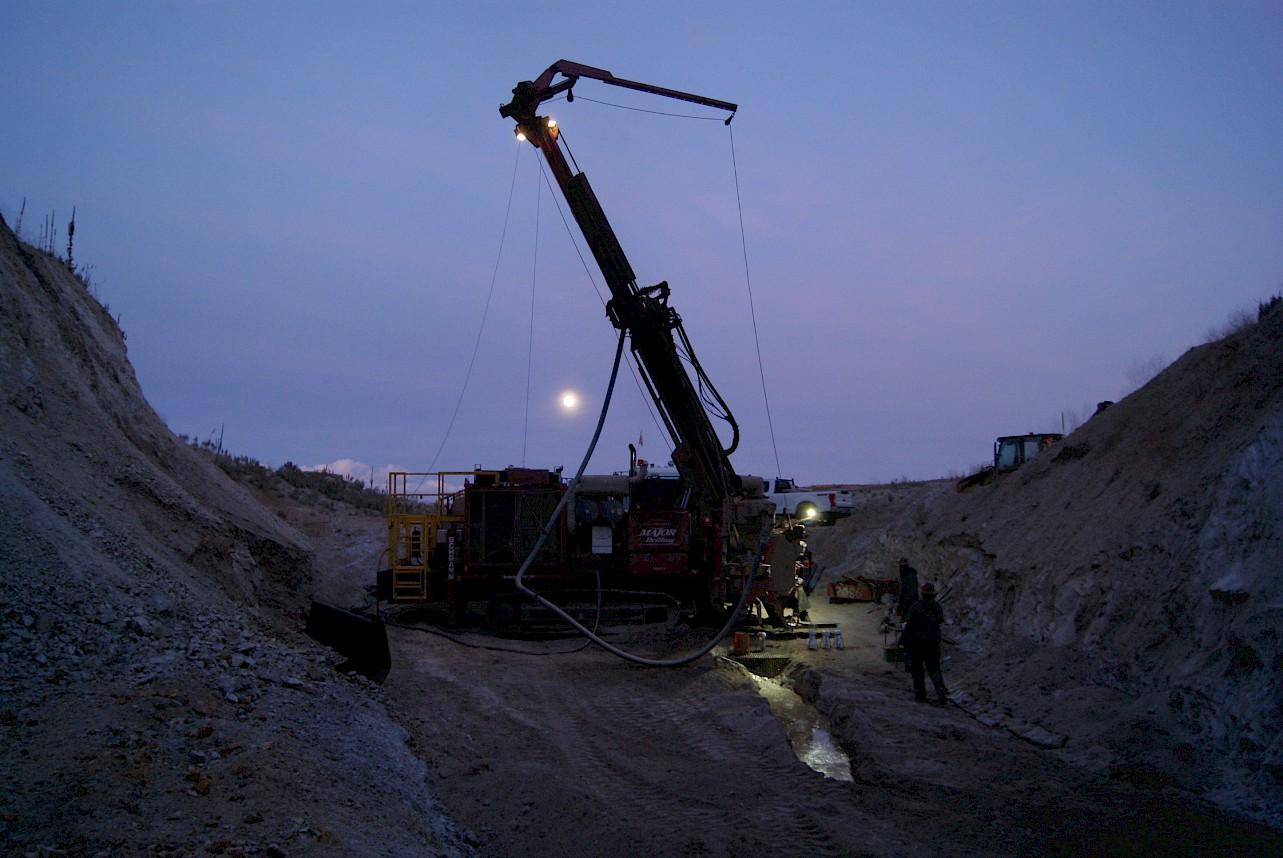
Treasure Hunter Chronicles. Every company in our purview has a story. This is Golden Trove's.
- 30,000 ounces — at least, by US Bureau of Mines records: the Neal Mining District's reported gold production, with most of it coming from this one property
- 1889 to 1941 — the underground years: the Hidden Treasure, the Homestake and the Daisy mines working the veins of what is now the Golden Trove ground
- Five veins known — a high-grade, gold-dominant vein system in the Trans-Challis fault country, most of the veins parallel, striking northeast
- 208 holes, 47,655 feet — Centennial Mining's 1989–90 reverse-circulation program, the first extensive drill test of the property, which identified the five vein zones
- 13,900 tons at 0.132 ounces per ton — the 2015 open-cut bulk sample, still stockpiled on site. A historical sample, not a resource — the distinction matters, and this Chronicle will keep it
- Fully permitted — an operating permit issued April 20, 2017, covering exploration drilling, underground development and shipping ore off site. The rarest line on this page
- 25 minutes — the drive from Boise, Idaho's largest city, over 20 kilometres of improved gravel and dirt road from Interstate 84
- 5 patented claims and 7 unpatented — roughly 55 acres of private ground and 130 acres of Forest Service lode claims
- US$1.25 million — the purchase price for the patented claims: five yearly payments of US$250,000 to Daisy Mining & Land LLP, running 2024 to 2028, with a 3% NSR that extinguishes the day the last payment lands
- Zero — the current mineral resource at Golden Trove. There isn't one. Everything else on this page is the argument for why there could be
The Hills Behind Boise
Boise is a state capital that gold built. The Boise Basin rush of the 1860s, in the mountains northeast of the city, out-produced almost everything else in the West for a stretch, and the city that grew up to supply it never entirely stopped being a mining town — it just paved over the fact. Drive southeast out of Boise today, past the suburbs and up into the Danskin Mountains, and within twenty-five minutes the pavement gives out, the sagebrush takes over, and you are in older country: ranch land, dry hills, and the Neal Mining District.
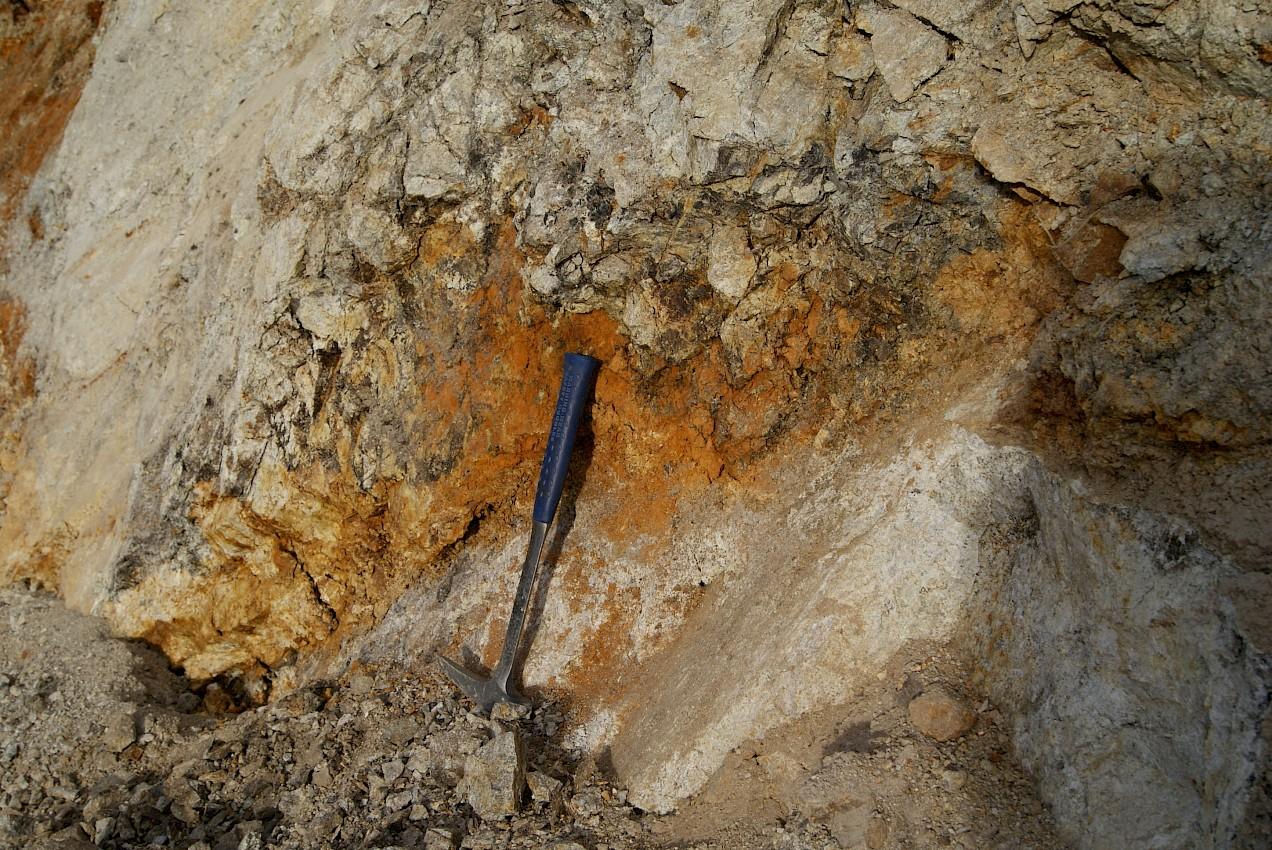
The ground here is the southern margin of the Atlanta Lobe of the Idaho Batholith — a Cretaceous biotite granodiorite, fairly uniform, cut by a regionally extensive fault system probably related to the great Trans-Challis fault zone. Along those faults, gold-bearing veins: quartz, white mica and clay, running northeast in parallel sets with moderate dips to the south. Near surface, where the old-timers worked, the gold rides with iron oxides left behind as pyrite weathered away; at depth, the pyrite is still there, and so is the gold. Tertiary dikes of lamprophyre and rhyolite intrude the same faults — a signature this district shares with other Idaho gold mines.
It is not a big property. Five patented claims and seven unpatented ones, about 185 acres all in. But a small underground gold mine works on strike about four miles to the southwest, the ranchers share the hills with the ghosts, and the property at the centre of it — Golden Trove, the old Neal Project — was, in its day, the most productive gold producer in the district.
Galleon Gold Corp. (TSX-V: GGO; OTCQX: GGOXF) is the company that has come to give it a second day.
The District That Paid for Five Decades
The Neal District's recorded life runs from 1889 to 1941 — fifty-two years of underground gold mining in the hills behind a growing state capital. The production came mainly from three mines on what is now the Golden Trove property: the Hidden Treasure, the Homestake and the Daisy. The names alone are a small museum of nineteenth-century mining optimism, and for once the optimism was not misplaced. US Bureau of Mines records put the district's reported production at at least 30,000 ounces of gold, most of it from this ground.
Thirty thousand ounces is not a Bunker Hill or a Boise Basin placer fortune, and this Chronicle will not pretend otherwise. What it is, is proof of the only kind that cannot be argued with: the veins on this property were mined, underground, at a profit worth recording, for half a century, by men whose only assay office was the mint. The ore was there. The grades underground were there. What the district never got — what almost no small Idaho gold camp of its era got — was a second life under modern methods. The workings stopped in 1941, as wartime America reordered its mines toward the metals of war, and the Neal District went quiet.
The quiet lasted nearly fifty years.
The Long Quiet, and the Paper Trail It Left
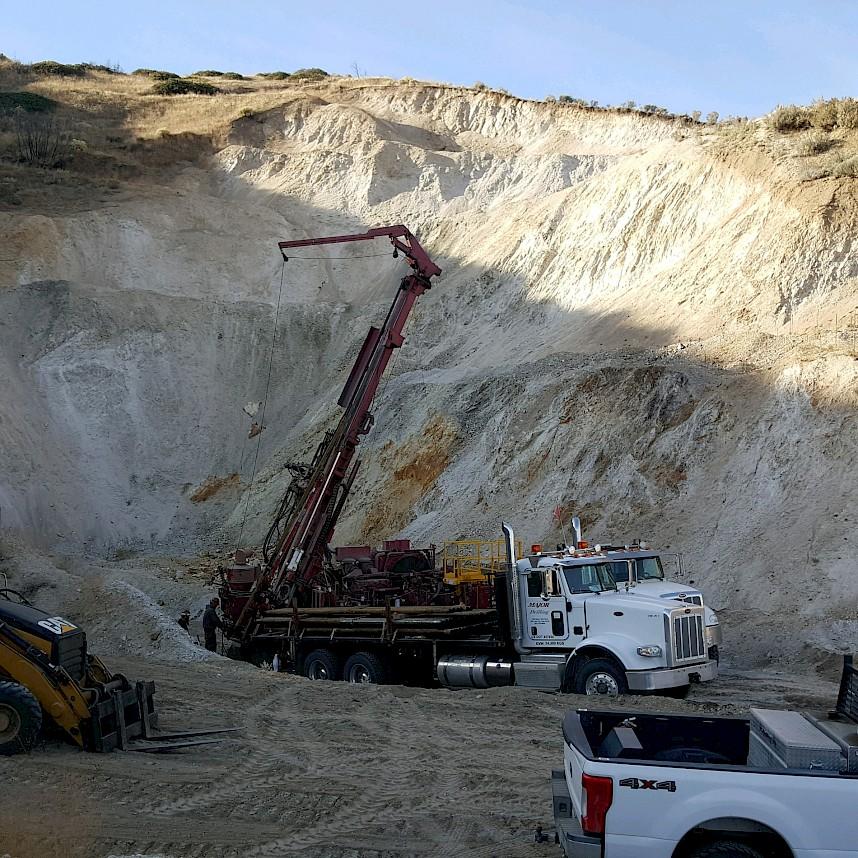
When the district finally drew a modern explorer, it drew a thorough one. In 1989 and 1990, Centennial Mining drilled 208 reverse-circulation holes — 190 vertical, 18 angled, 47,655 feet in all — hunting the near-surface oxide gold above the old veins. It was the first extensive program ever run at Neal with a modern purpose: define a resource for a contemplated open-pit heap leach operation. The program found what it was looking for — five vein zones, and near-surface oxide potential above the historic workings. Between 2007 and 2013, Aquasolum Consultants followed up the best of Centennial's intercepts with detailed trenching, better defining the vein and stockwork mineralization and pulling samples for metallurgical and mine-development studies.
Then came the chapter that makes Golden Trove different from a hundred other old Idaho camps. In 2015, under the previous operator, an open cut was dug into the top of the historic vein zones — ground where test mining took the near-surface stockwork veining the old operators had left behind — and produced a bulk sample of 13,900 tons of gold-mineralized material averaging 0.132 ounces per ton. The stockpile is still sitting on site today. And on April 20, 2017, the project received its environmental reclamation plan approval — the document that becomes the operating permit — with a surety bond of $87,500 posted. The permit allows exploration drill programs, underground development, and shipping ore off site.
Read that again, because in the modern American West it is the rarest sentence in this Chronicle: a past-producing, high-grade gold mine, on patented claims, already permitted to drill, develop underground, and ship ore. Permitting is where American gold projects go to spend their decades. Golden Trove's permit is already in the drawer.
A Timmins Captain Buys an Idaho Mine
Galleon Gold is not an Idaho company, and Golden Trove is not its flagship — the ledger section below will be plain about what that means. Galleon is a Toronto-based gold developer whose centre of gravity is Timmins, Ontario, and whose chief executive is a man who has already built a mine in that camp.
R. David Russell, President, CEO and Chairman, is a mining engineer out of Montana Tech whose career runs through Hecla Mining and LAC Minerals — Barrick — before he founded Apollo Gold and brought the Black Fox mine, near Timmins, into production. He is, in the taxonomy of this series, a captain of the old school: an engineer who has taken a deposit the whole distance, from paper to poured gold.
Galleon's Idaho position was assembled patiently. The company held the Neal ground under a lease from 2019; in July 2023 it converted the lease into a purchase. A new Idaho company, Golden Trove LLC, controlled by Galleon, agreed to buy the patented claims from Daisy Mining & Land LLP — the Daisy name being, not incidentally, one of the three historic mines on the property — for five yearly payments of US$250,000, from May 1, 2024 to May 1, 2028. While the payments run, Daisy receives $3.00 for every ton of material removed and a 3% net smelter return royalty on any ore processed; the day the full US$1.25 million is paid, the royalty and the tonnage fee extinguish, and Golden Trove is 100% Galleon's.
"We are very pleased to have come to an agreement with Daisy to simplify the further development and operation of the Golden Trove Project." — R. David Russell, President and CEO, Galleon Gold (July 18, 2023)
The project was renamed in the same stroke: the Neal Project became the Golden Trove. And then — this is the part that tells you the company's priorities — Galleon went back to Timmins and raised money for the flagship. Which brings the story to the people, and then to the other mountain.
The People
A Chronicle names its captains. Golden Trove's is the man at the top of the company.
R. David Russell, President, CEO and Chairman of Galleon Gold — the captain of this hunt. Montana Tech mining engineer; senior roles at Hecla and at LAC Minerals/Barrick; founder of Apollo Gold, which acquired the Black Fox mine and brought it into production in Ontario. His name is on the Daisy purchase, on the company's technical direction, and on the decision that an old Idaho camp belonged in a Timmins company's portfolio.
The technical information on the Golden Trove project itself carries a Qualified Person's signature, as NI 43-101 requires: Thomas H. Chadwick reviewed and approved the technical disclosure on the project — the geology, the drilling history and the bulk-sample figures this Chronicle draws on. On the investor side, the company's door is Graham Farrell, Investor Relations — the man a shareholder, or a journalist, reaches first.
It is a lean crew for a two-front company: an engineer-chairman who has built a mine before, a QP standing behind the Idaho file, and the whole apparatus pointed, for now, mostly at Ontario.
More Than One Mountain
Golden Trove is the second front. The first is one of the great addresses in Canadian gold.
West Cache, thirteen kilometres west of Timmins, Ontario — seven kilometres from Pan American Silver's Timmins West mine, fourteen from Newmont's Hollinger — is Galleon's flagship: a 2022 resource of 1.56 million ounces of gold, an approved 86,500-tonne underground bulk sample, and an updated preliminary economic assessment in preparation, with some 36,000 metres of drilling planned for 2027 on top of the 19,400 metres drilled in 2026. In November 2026 the market underwrote the plan: Galleon closed a $30 million bought-deal financing and a concurrent $7 million non-brokered placement, with Pan American Silver itself participating in the latter — a producing major buying a seat beside the junior's flagship. The company ended that month worth roughly C$146 million on the market.
That is the honest frame for the Idaho story. Golden Trove was bought, cheaply and patiently, by a company whose money, rigs and headlines are committed to Ontario. What Idaho gets, for now, is the methodical front end of the work — and what it has that Timmins cannot give it is a permit, a stockpile, and a fifty-two-year production record twenty-five minutes from a state capital.
Where It Stands
Honesty is the house rule in this series, so here is the ledger, straight.
There is no current mineral resource at Golden Trove — not a small one, not an inferred one — and the company says so itself, in so many words: sufficient work has not been done to classify the 2015 bulk-sample figure as a current resource or reserve, and Galleon is not treating it as one. The 13,900 tons at 0.132 ounces per ton is a bulk sample from an open cut, not a resource. The 1989–90 drilling is historical data which the company has not done sufficient work to verify to modern standards — relevant, by Galleon's own assessment, for early-stage evaluation, and nothing more. The 30,000 ounces is a Bureau of Mines historical record of a district, not an audited reserve statement for a property. Anyone who reads this Chronicle as "ounces in the bank" has misread it.
The purchase is also unfinished. Of the five US$250,000 payments, the schedule runs to May 1, 2028; until the last one lands, Daisy Mining holds its $3-a-ton fee and its 3% NSR, and Galleon's clean 100% ownership is a destination, not a fact. And the permit, real as it is, has edges: the posted $87,500 surety covers drilling, underground development and ore shipment, and any additional mining of the open pit requires a further $87,500 to be posted by the operator.
Then there is the priority question, and it deserves a straight answer. Galleon's treasury was rebuilt in November 2026 — roughly $37 million raised — and the stated purpose of that money is West Cache. Golden Trove's own published next steps are deliberately modest: organize and assess the exploration data of past operators, complete an updated geologic map, run a surface sampling program, and combine the historic data with new surface work to better define underground vein targets. No drill program at Golden Trove has been announced. A reader pricing this Idaho project as though Timmins money were about to pour into it is ahead of the company itself.
Set against all of that: a vein system that paid underground for fifty-two years and was never tested at depth by modern drilling below the old workings; five vein zones defined by the one extensive program ever run; a bulk sample that says the near-surface stockwork carries real grade; patented claims — the strongest form of mineral tenure in America — twenty-five minutes from Boise; and an operating permit that most juniors would trade a drill season for. The project's problem has never been the gold. It has been that nobody with a mine-builder's résumé owned it outright. That is the thing now being fixed, US$250,000 a year at a time.
What Happens Next
The near calendar at Golden Trove is unglamorous and exactly right. First, the data room: a century of the district's paper — Bureau of Mines records, Centennial's 208 holes, Aquasolum's trenches, the 2015 bulk-sample work — organized and assessed into one modern file. Then boots: an updated geologic map of the property and a surface sampling program, marrying the historic record to fresh geochemistry. Out of that work come the defined underground vein targets — the places where a drill, when it finally turns, tests the veins below the weathered surface the old-timers mined and the oxide cap Centennial drilled.
Behind the field calendar runs the financial one: the yearly payments to Daisy Mining, each May 1 through 2028, converting a purchase in progress into clean ownership, royalty extinguished. And behind that, the Timmins calendar — the bulk sample, the updated PEA, the 2027 drill program — because Golden Trove's second act is funded, ultimately, by whether Galleon's first act succeeds.
But the larger story is the ground itself. In the hills behind Boise there is a mine that produced gold for fifty-two years, closed the year America went to war, and then waited — through the heap-leach era that drilled it once and moved on, through the decades when Idaho gold meant other districts entirely — holding a permit nobody else in its position has, a stockpile nobody has shipped, and five veins nobody has followed down. The old-timers of the Hidden Treasure and the Homestake proved the gold was there with picks and mint receipts. The question Golden Trove has waited eighty-five years to have asked properly is simply how much of it there is.
The treasure, as always, was never the point. The hunt was. This hunt starts twenty-five minutes from a state capital, on patented ground, with the permit already in the drawer — and the first tool out of the truck is a map.