
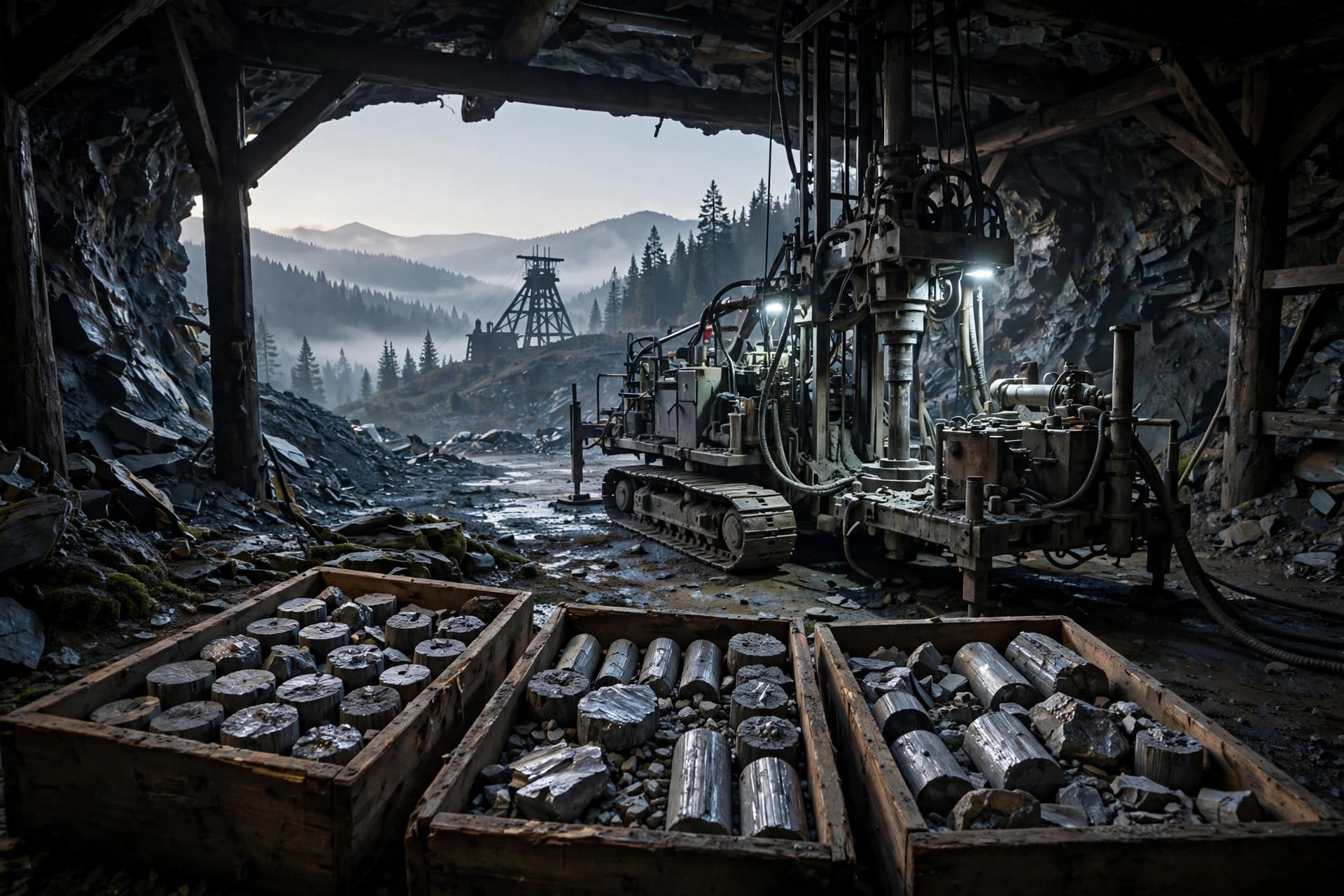
Infill drilling is the unglamorous work that turns a famous mine into an engineered one. Sunshine Silver Mining & Refining (NYSE: SSMR) finished that work at the Sunshine Mine on November 5 — and the final batch of results from Idaho's Silver Valley carries the grades the district is known for.
- The program, complete: approximately 51,250 metres in 218 holes, including approximately 20,930 metres in 73 holes drilled on the 2300 and 3100 Levels between July and October 2026. Three rigs continue underground drilling.
- NY Boy Vein (FS-31110): 7,069 g/t silver (7,632 g/t AgEq) over 1.00 metre true width, including 12,103 g/t silver (13,066 g/t AgEq) over 0.58 metres.
- F-Vein (FS-3133): 1,522 g/t silver (1,682 g/t AgEq) over 4.47 metres, including 4,663 g/t silver over 0.87 metres — and, in the same hole, 1,067 g/t silver (1,211 g/t AgEq) over 4.50 metres in a newly identified vein, including 8,263 g/t silver over 0.43 metres.
- F-Vein (FS-31207): 5,496 g/t silver (6,043 g/t AgEq) over 1.06 metres, including 18,103 g/t silver (19,901 g/t AgEq) over 0.26 metres — the highest-grade sub-interval in the release.
- Vein06 (FS-3117): 1,359 g/t silver (1,450 g/t AgEq) over 2.49 metres, including 4,629 g/t silver over 0.66 metres. Reported widths in the release's table are estimated true widths.
- The runway: results feed an updated Mineral Resource Estimate expected in Q1 2027, which underpins a Feasibility Study targeted for Q2 2027 and a planned return to production in late 2028.
Two jobs, one program
The program was built to do two things: upgrade resource classification in the central area expected to support the initial mine plan, and test near-mine growth in the Upper Country, the historically under-mined upper part of the mine. The July 2026 results covered the second job, including the new 10 Vein. The results reported November 5 are the downshaft drilling for the first job — and they extended known mineralization on the Copper and D-Veins into previously undefined areas, better defined the F-Vein's extent, and confirmed continuity in the zones the initial plan depends on.
CEO Heather White called completing the program "an important milestone on our path to production," noting the team delivered it safely and on time and that the results "confirm high-grade mineralization across multiple veins, which we expect will anchor our anticipated initial mine plan."
The existing resource the infill work is refining is already large and unusually high-grade: an Indicated Mineral Resource of 103.9 million ounces of silver at 1,022 g/t and an Inferred Mineral Resource of 159.8 million ounces at 776 g/t, as stated in the company's Technical Report Summary. On the company's Initial Assessment, a roughly 1,000-tonne-per-day operation would produce an average of about 6.7 million ounces of silver per year in its first five years and about 5.8 million ounces a year over a 24-year mine life — study figures, not yet a feasibility result.
The honesty box
The headline intercepts are narrow, very high-grade vein intervals — several of the most spectacular numbers run over 0.26 to 1.06 metres of true width, which is the nature of Silver Valley veins, not a bulk-tonnage result. The Q1 2027 resource estimate, Q2 2027 feasibility study and late-2028 production return are company targets, not completed milestones. The production and mine-life figures come from an Initial Assessment, the lowest-confidence class of study; the feasibility study due next year is the document that will test them. Silver-equivalent grades combine silver with copper, lead and antimony on the company's stated basis.
What to watch
The Q1 2027 updated resource estimate — whether infill drilling converts Inferred ounces to Indicated at the grades reported here; the Q2 2027 Feasibility Study, the first engineered mine plan for the restart; and the three rigs still turning underground, including follow-up on the new vein cut in FS-3133.