
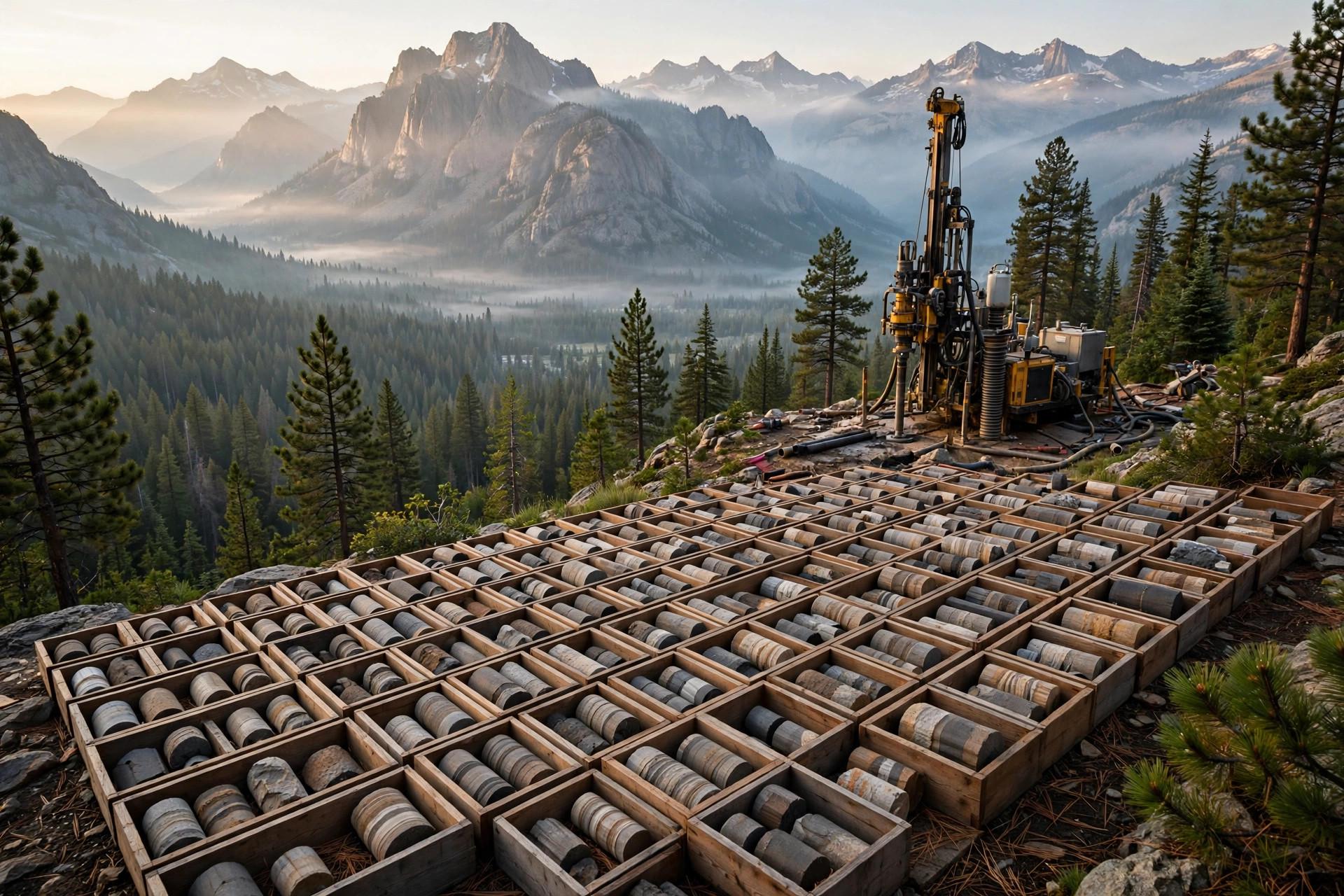
Golden Gate North's second assay batch does a different job than its first. Where October's holes established the zone's outline, the three holes Resolution Minerals Ltd (ASX: RML) reported on November 18 were drilled between earlier intersections in the south-central part of the prospect — and all three came back mineralized from at or near surface for more than 230 metres, with the higher-grade intervals lining up into what the company now describes as a continuous central zone at its Horse Heaven antimony-tungsten-gold-silver project in central Idaho, immediately adjacent to Perpetua Resources' permitted Stibnite project.
- HH-GG26-034C: 272.2 metres at 0.55 g/t gold from surface, including 7.4 metres at 1.26 g/t from 114 metres, 23.1 metres at 1.38 g/t from 167.1 metres and 32.1 metres at 1.01 g/t from 215 metres.
- HH-GG26-035C: 264.9 metres at 0.59 g/t gold from surface, including 18.7 metres at 2.19 g/t gold — the strongest higher-grade interval of this batch.
- HH-GG26-033C: 234.8 metres at 0.62 g/t gold from 18.3 metres, including 33.3 metres at 1.53 g/t gold from 213.5 metres.
- The zone as now defined: about 500 metres of strike in a northeast–southwest direction, an estimated true width of about 200 metres, intersected to roughly 300 metres vertical depth — and still open to the northeast, southwest and at depth.
- Most of the program is still out: assays are pending for 30 of the 42 holes drilled in the 2026 campaign (42 diamond holes for 12,236 metres across Golden Gate North and South). Tungsten assays will be reported separately — the company notes the tungsten method is a more complex two-step process.
- The next milestones: Resolution plans to build its first Golden Gate mineral resource model from the full results, with the work expected to be released in Q1 2027. Permitting is under way for the 2027 program, which would test the two-kilometre corridor between Golden Gate North and South and drill Antimony Ridge for the first time, alongside infill.
Continuity is the result
None of the three headline averages is a high grade — 0.55 to 0.62 g/t gold is bulk-tonnage territory, and Pulse said the same about October's first batch. What changed with this batch is the internal architecture. The October holes (324 metres at 0.49 g/t in HH-GG26-032C among them) proved long runs of mineralization at the zone's edges; the November holes, fanned through the middle, carry repeated higher-grade intervals — 1.0 to 2.19 g/t over widths of 7 to 33 metres — at comparable positions, which is the pattern a resource geologist needs before drawing a higher-grade core inside a much larger low-grade envelope.
Craig Lindsay, Resolution's CEO of US Operations, framed the geology in the release: "The assay results continue to strengthen the case for a major zone of gold mineralisation at the Golden Gate North deposit. Increasingly, we are seeing the characteristics of reduced intrusive related gold deposits at Golden Gate. This aligns with our long held view that the neighbouring Stibnite deposit is a valid analogue for Golden Gate North, Golden Gate South and Antimony Ridge, as related components of a single large mineralised system."
That analogue claim is the company's interpretation, and it is doing real work in the story: Stibnite, next door, is a permitted gold-antimony project with a construction-stage owner. Horse Heaven is years behind it — but it is being drilled as a four-metal system (gold, antimony, tungsten, silver) in the same district, which is why the still-pending tungsten assays and the untested Antimony Ridge matter to the project's shape, not just its gold grade.
The honesty box
Every interval here is a downhole length. The one true-width figure in the story — about 200 metres for the zone — is the company's estimate for the mineralized zone's geometry, not a measured width for any single hole, and individual hole true widths are not established. There is no mineral resource estimate at Golden Gate: the Q1 2027 model would be the project's first, its timing is stated as subject to completing the analysis, and 30 of 42 holes — more than 70% of the program, including all of Golden Gate South's contribution — have yet to report, so the zone's final shape is not yet knowable from public data. The company's SEC filing summary also notes lower core recovery in some fault zones, which can affect sample quality in exactly the broken ground where continuity matters most. And the Stibnite analogue is an exploration model, not evidence: similar deposit characteristics in early drilling do not establish that Golden Gate will carry Stibnite's grades, metallurgy or economics.
What to watch
The remaining 30 assay releases, Golden Gate South's first reported holes among them; the separate tungsten assay batch; permitting for the 2027 corridor and Antimony Ridge program; and the Q1 2027 maiden resource model — the first compliant number that will test whether 230-to-270-metre runs at half a gram hold together as tonnes.