
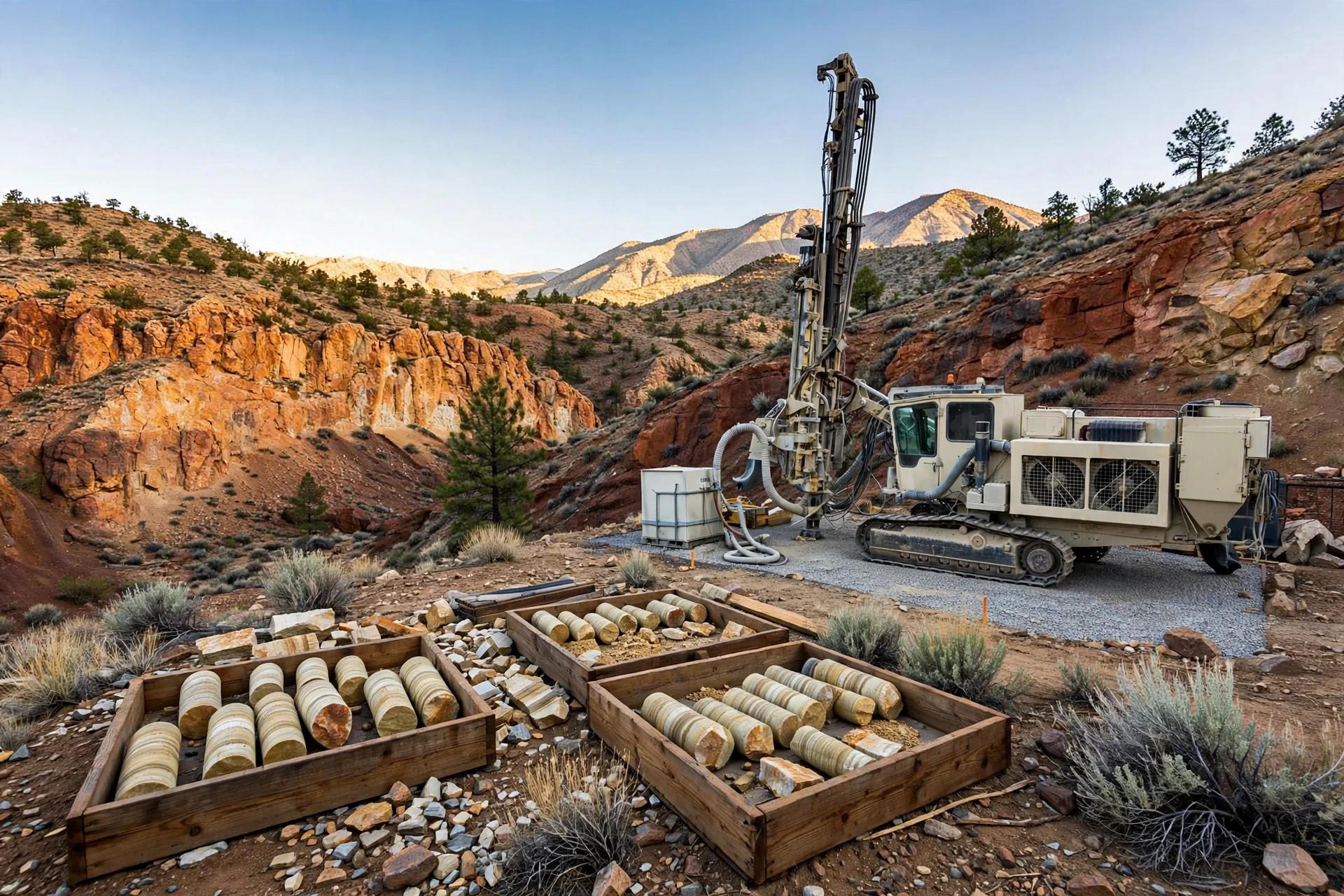
The first drill holes into a 2.1-kilometre gold soil anomaly in central Nevada have come back with near-surface oxide gold — and a high-grade sweetener. Phenom Resources Corp. (TSXV: PHNM) (OTCQX: PHNMF) (FSE: 1PY0) announced on November 25 initial results from its 2026 core drilling program at the Dobbin Gold Project, 140 kilometres south of Eureka in the Monitor Range.
- The headline hole: DDH26-02 returned 3.59 g/t gold over 15.24 metres (50 feet) from 12.2 metres downhole, including 18.20 g/t gold over 1.22 metres. The intercept begins about 12.2 metres below surface in an oxidized shear zone; the company says the DDH26-02 intercept is considered about 80% of true width.
- The second hole: DDH26-01 returned 3.31 g/t gold over 4.57 metres, including 4.78 g/t over 3.05 metres. DDH26-03 returned 0.65 g/t over 13.72 metres. Phenom interprets the DDH26-01 and DDH26-02 intercepts and nearby trench results as lying on the same shallow-dipping oxidized shear zone.
- The program: eleven diamond drill holes totalling 2,690 metres were completed in 2026 before weather suspended drilling; resumption is expected in spring 2027. Drilling tested about 650 metres of the 2.1 km by 200 metre northeast-trending gold soil anomaly. Results for eight of eleven holes are pending.
- The wider system: an interpreted 114–130 metre thick zone of intense bedding-replacement alteration, described as characteristic of Carlin-type systems, was traced across the full 650-metre drilled strike length in ten of eleven holes and remains open.
- Ownership and funding: Dobbin is held by a Nevada LLC in which Phenom's subsidiary Copper One USA, Inc. owns 85% and an affiliate of SSR Mining Inc. owns 15%; Copper One is manager. Phenom plans to resume drilling with funds remaining from SSR's initial US$4 million funding of the joint venture company.
- The lab work: HQ core, typical recoveries above 90%, samples to ALS Global in Elko for fire assay and multi-element ICP, with certified reference materials, blanks or duplicates inserted every 20 samples. Technical disclosure was reviewed by President and CEO Paul Cowley, P.Geo., a Qualified Person under NI 43-101.
A shear zone first, a system behind it
Dobbin's first results describe two things at once. Near surface, a roughly 30-degree-dipping oxidized shear zone carries the reported gold grades in DDH26-01 and DDH26-02 and in surface trenches near DDH26-01 — one trench returned 4.55 g/t gold over 8.0 metres, including 10.35 g/t over 2.0 metres. Deeper in the same holes, the company traces a much thicker altered unit — brecciated, decalcified limestone with sooty sulfides — across the drilled strike length, with the more intensely altered part intersected in the northeastern half of the tested area, where assays are still pending.
The honesty box
Dobbin has no mineral resource or reserve stated in this release. These are the first three holes of an eleven-hole first program, covering about 650 metres of a 2.1-kilometre anomaly; eight holes are unreported. The company itself cautions that similarity to Carlin-type systems is not indicative of the presence or grade of mineralization at Dobbin. Reported intervals are drill-hole lengths with the true-width qualifications the company gives above, and the spring 2027 resumption is a plan dependent on weather and the remaining joint venture funds. This post reports the November 25 results exactly as released.
What to watch
Assays for the remaining eight holes, including the northeastern holes in the more intensely altered ground; the fuller geological interpretation Phenom says will follow once all results are in; and the spring 2027 drill resumption and any infill plan for the 650-metre shear-zone strike length.