
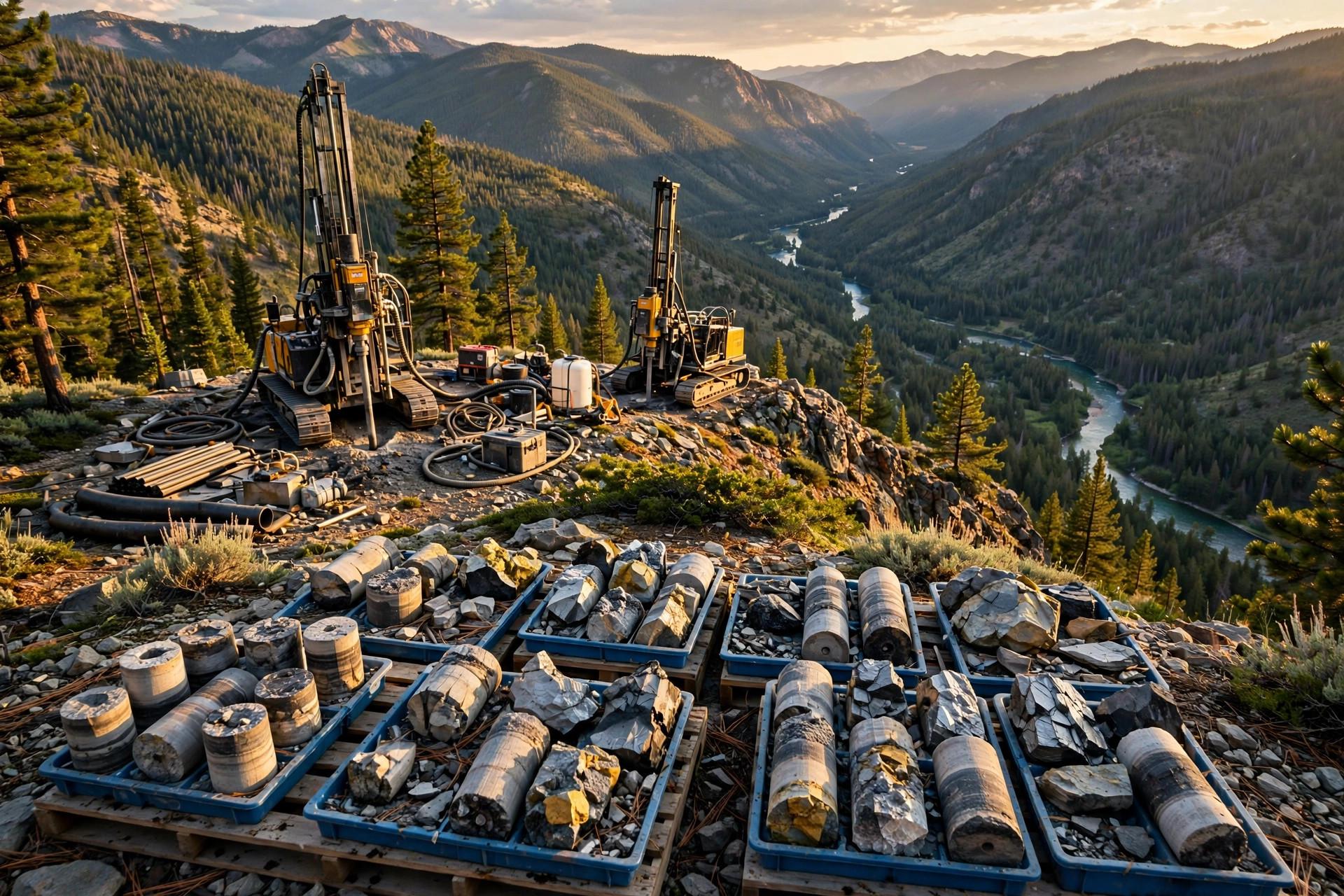
Stibnite keeps growing past its own mine plan. Perpetua Resources Corp. (Nasdaq: PPTA) (TSX: PPTA) has closed out its 2026 exploration drilling program at the Stibnite Gold Project in central Idaho — over 16,000 metres of core drilling — with a new discovery south of the permitted Yellow Pine pit and another set of near-surface high grades on the pit's eastern edge.
- The discovery hole — SB633 (Fiddle): 109.7 metres grading 3.2 g/t gold and 1.1% antimony from 189 metres downhole. Perpetua calls it one of the broadest continuous intervals of gold and antimony mineralization returned to date at Stibnite, at grades more than double the project's life-of-mine average.
- The setting: Fiddle sits approximately 750 metres south of the permitted Yellow Pine pit along the Meadow Creek Fault Zone, the district's main ore-controlling structure. Drilling to date has traced the mineralized structure along approximately 600 metres of strike and more than 300 metres of vertical extent.
- Follow-up at Fiddle: SB637 returned 37.4 metres grading 0.7 g/t gold and 0.1% antimony from 93.8 metres, extending mineralization 110 metres north; SB643 returned 7.2 metres grading 1.7 g/t gold and 0.5% antimony from 96.7 metres. 21 additional holes totalling 6,188 metres were drilled along strike; holes SB665 and SB671 are drilled and awaiting assay, with core logging showing similar-style mineralization including abundant stibnite and sulfides.
- Clark Tunnel Fault Zone (CTFZ): SB606 cut 25.4 metres grading 4.5 g/t gold from 13 metres and SB605 cut 25.0 metres grading 2.3 g/t gold from 18 metres — near-surface, on the eastern end of the Yellow Pine pit, partly within the permitted pit limit. Antimony and tungsten assays for these holes are still pending. The CTFZ is now defined over a 200-metre strike length to 50 metres depth, with four more holes pending assay.
- Program status: the 2026 exploration program is complete at over 16,000 metres; staff continue to log and process core ahead of a significant quantity of assays expected over the coming months.
Two targets, two different jobs
Fiddle and the CTFZ were prioritized for the same reason — proximity to Yellow Pine — but they do different work in the story. Fiddle is a new target area added to the project's in-pit and near-pit resource base, built from historical underground drilling and sampling data that pointed to stacked mineralized lenses along the Meadow Creek structure, akin to Hangar Flats on trend.
The CTFZ is about early feed. Its high-grade, near-surface mineralization sits partly inside the permitted Yellow Pine pit, and Perpetua frames it as having the potential to supplement the production profile in the first years of production. The November results follow the zone's August debut — SB580's 6.4 metres of 16.2 g/t gold and 1.7% antimony from surface, and SB597's new gold-tungsten zone of 21.3 metres at 3.2 g/t gold and 0.9% tungsten from 24 metres — both previously reported, not new in this release.
President and CEO Jon Cherry: "At Fiddle, our initial hole returned broad, continuous mineralization at significant gold and antimony grades which confirm it as an important new discovery. Meanwhile, drilling continues to reinforce the CTFZ as a near-surface, high-grade target on the eastern extent of the Yellow Pine pit."
The honesty box
"Discovery" here rests on one assayed discovery hole. SB633 is a single, very strong intercept; the step-out holes returned materially lower grades (0.7 g/t and 1.7 g/t gold), and there is no mineral resource or reserve estimate for Fiddle — the release itself cautions that the core-logging observations in the unassayed holes are not a substitute for assay results and may not repeat SB633's grades or widths. All intervals are reported down-hole lengths; the release does not present them as true widths. The CTFZ gold grades are reported without their antimony and tungsten assays, which are pending, so the zone's full metal picture is not yet in. Any resources eventually defined outside the currently permitted project scope would face additional environmental review and permitting, as the release's own forward-looking disclosure notes.
What to watch
Assays from SB665, SB671 and the 21 on-strike Fiddle holes, which will show whether SB633 is a centre or an outlier; the pending CTFZ antimony and tungsten results and its four unreported holes; and whether either target is carried into an updated Stibnite resource estimate alongside construction of the permitted project.