
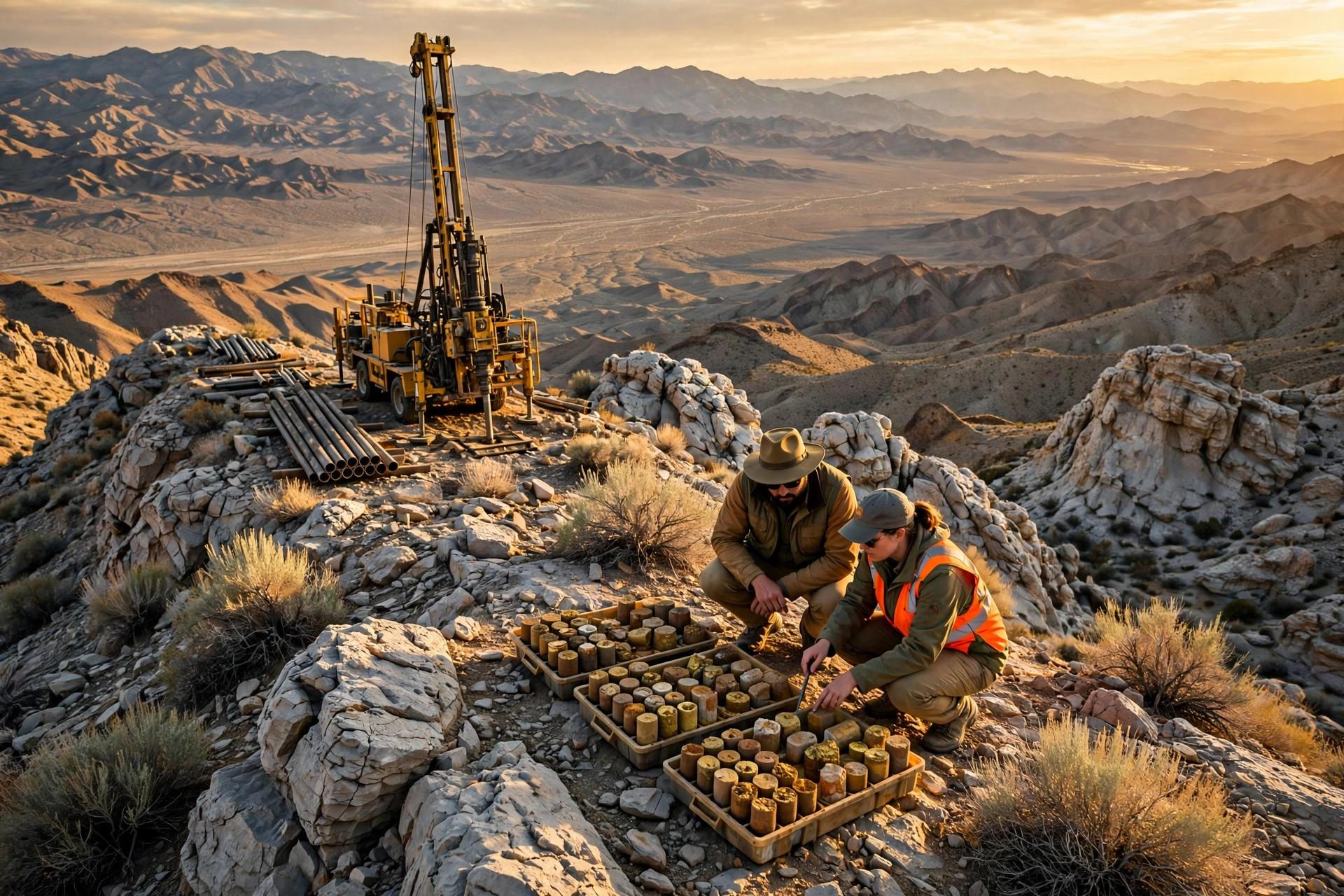
Limo Butte's eastern side keeps delivering. NevGold reported on November 12 that hole LB26-009 — drilled on the eastern side of the Resurrection Ridge resource at its Limousine Butte Project in Nevada — is the strongest hole of the company's 2026 program so far, and that new assays continue to expand oxide gold-antimony mineralization both inside and outside the pit shell drawn around the mineral resource estimate released on July 15, 2026.
- The headline hole, lower zone: LB26-009 returned 8.28 g/t oxide gold over 3.0 metres within 1.73 g/t gold over 45.7 metres, within a broader 82.3-metre interval grading 1.04 g/t gold from 167.6 metres. The highest single sample in the hole graded 14.50 g/t gold over 1.5 metres.
- The same hole, upper zone: 0.45% antimony over 10.7 metres within 0.18% antimony over 50.3 metres from 7.6 metres, including 3.0 metres at 1.19% antimony — shallow antimony above the deeper gold zone.
- The second hole: LB26-017 returned 3.13 g/t gold equivalent (AuEq) over 12.2 metres (1.19 g/t gold, 0.50% antimony) within 1.27 g/t AuEq over 48.8 metres, expanding mineralization inside and outside the 2026 pit shell. LB26-019 also returned 105.2 metres at 0.39 g/t AuEq.
- Program standing: 70 holes and approximately 16,000 metres completed of a targeted 20,000 metres, on schedule and under budget, with assays pending from 54 additional holes. The company reports more than $42 million in treasury.
- What is next: metallurgical testwork is ongoing, early permitting has commenced, and a preliminary economic assessment (PEA) is targeted for completion in Q1 2027. Technical information was reviewed and approved by Greg French, CPG, VP Exploration and Qualified Person. Samples were analysed by American Assay Labs in Reno using 30-gram fire assay and ICP-OES, with duplicates, blanks and standards inserted.
The model the drilling is testing
NevGold's geological thesis at Resurrection Ridge is structural. The Devonian Pilot Shale is the principal host to Carlin-type gold-antimony mineralization at Limo Butte, and earlier explorers assumed that shale had been eroded east of the known resource, so they did not test in that direction. NevGold's updated model holds that older dolomite was thrust over the Pilot Shale, preserving the favourable host at depth and creating a fluid trap — and the preserved shale extends more than one kilometre east of prior drilling.
The 2025–2026 programs have been drilled to validate exactly that: holes collared in dolomite pass through the upper thrust plate and intersect gold and antimony at multiple horizons in the underlying shale. LB26-009 and LB26-017 are the latest confirmations on the eastern side, which is why the company frames them as growth on the current resource rather than isolated hits.
CEO Brandon Bonifacio put it plainly: the program is "expanding mineralization beyond the boundaries of the current resource" and supporting the objective of "growing both the scale and quality of the 2026 MRE."
The honesty box
These are downhole lengths. The release states true width is approximately 70% to 90% of downhole thickness, depending on hole dip. Gold equivalents are calculated, not measured: AuEq uses assumed prices of US$3,000 per ounce of gold and US$40,000 per tonne of antimony, with assumed recoveries of 80% for gold and 75% for antimony — actual recoveries will come from the metallurgical testwork still under way. The 14.50 g/t figure is a single 1.5-metre sample, not an interval grade. Mineralization inside and outside a resource pit shell is not a resource update: no new mineral resource estimate is reported in this release, the July 2026 estimate is unchanged by these assays until it is formally updated, and a PEA targeted for Q1 2027 is a preliminary study whose results, if and when published, will carry the usual PEA cautions, including that it may include inferred resources. With 54 holes still pending, the eastern expansion picture is incomplete by the company's own count.
What to watch
Assays from the 54 pending holes; whether the eastern step-outs hold together as a continuous zone in an updated resource estimate; metallurgical results for both gold and antimony; and the Q1 2027 PEA, the first economic study to test what the enlarged footprint might support.