
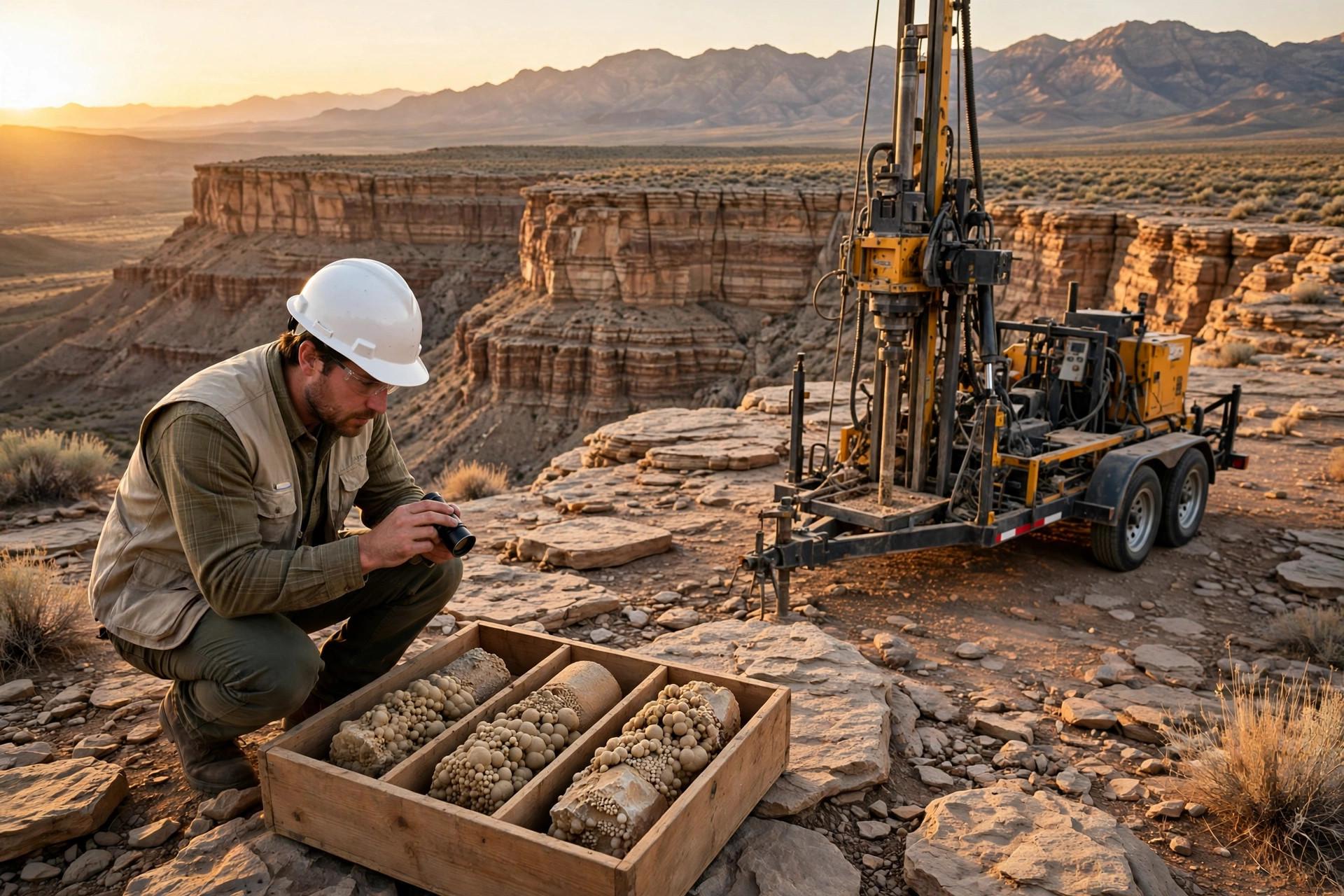
Murdock Mountain's phosphate horizon keeps walking west. Nevada Organic Phosphate reported on November 11 that two more holes have intersected the target Meade Peak Member at apparent thicknesses close to 40 metres, pushing confirmed continuation of the trend past 4.5 kilometres — up from the more than 3 kilometres reported earlier in the 2026 program.
- The two intersections: hole MM26-14 intersected 39 metres (128 feet) and hole MM26-15 intersected 38 metres (124.67 feet) of the target Meade Peak Member, with oolitic zones typical of the Upper Phosphate Zone noted during core logging in both holes.
- The step-out: MM26-14 is the farthest west hole drilled to date and confirms continuation of the trend to over 4.5 kilometres. MM26-15 was drilled approximately midway between MM26-14 and the previously noted MM26-12.
- What is next: the drill is currently moving to MM26-16 to fill in a gap in data coverage. In the collar table, MM26-14 was drilled vertically to 128.78 metres total depth and MM26-15 vertically to 70.40 metres.
- The project frame: the company describes an organic certifiable sedimentary raw rock phosphate bed 6.6 kilometres long in northeast Nevada, with additional applications extending potential strike to over 30 kilometres, close to the main highway to Montello/Elko and a rail head. It describes the project as the only known large-scale organic certifiable sedimentary phosphate project in North America.
- The technical sign-off: interpretive technical information was reviewed and approved by Garry K. Smith, P.Geo., a director and Qualified Person under National Instrument 43-101.
Continuity, measured one hole at a time
CEO Robin Dow framed the result as a consistency test passed: the intersections "continue to demonstrate the consistency and scale of the phosphate-bearing horizon across the project area," with analytical results still to come. Director Garry Smith, P.Geo., made the same point from the geology side — logging identified visual oolitic textures throughout portions of the phosphate-bearing interval in each hole, consistent with earlier drilling, further improving understanding of the horizon's continuity and geometry.
That is the exploration logic at Murdock Mountain, and it has not changed: a near flat-lying sedimentary bed is tested by systematic step-outs and infill, each hole confirming or trimming strike, thickness and geometry. MM26-14 extends the western end; MM26-15 tightens the spacing between it and MM26-12; MM26-16 is a gap-fill. The program is building a geological model, hole by hole.
The honesty box
There are no phosphate grades in this release. The 39- and 38-metre figures are apparent thicknesses from geological logging, not assayed intervals — the release states explicitly that true thickness and the phosphate content of the Upper Phosphate Zone will be confirmed by assay, and those assays have not been reported. Visual oolitic texture is an encouraging logging observation, not a grade. Continuity of the Meade Peak Member over 4.5 kilometres establishes that the host horizon persists along strike; it does not by itself establish phosphate grade, recoverability, or economic viability across that strike, and no mineral resource estimate for these new holes is reported in this release. The 6.6-kilometre bed length and the over-30-kilometre potential strike are the company's descriptions of the project and its applications, not compliant resource figures.
What to watch
Laboratory assays for MM26-14 and MM26-15 — the first actual phosphate grades for the western extension; results from the MM26-16 gap-fill hole; and whether the accumulating drill grid supports a compliant resource estimate for Murdock Mountain.