
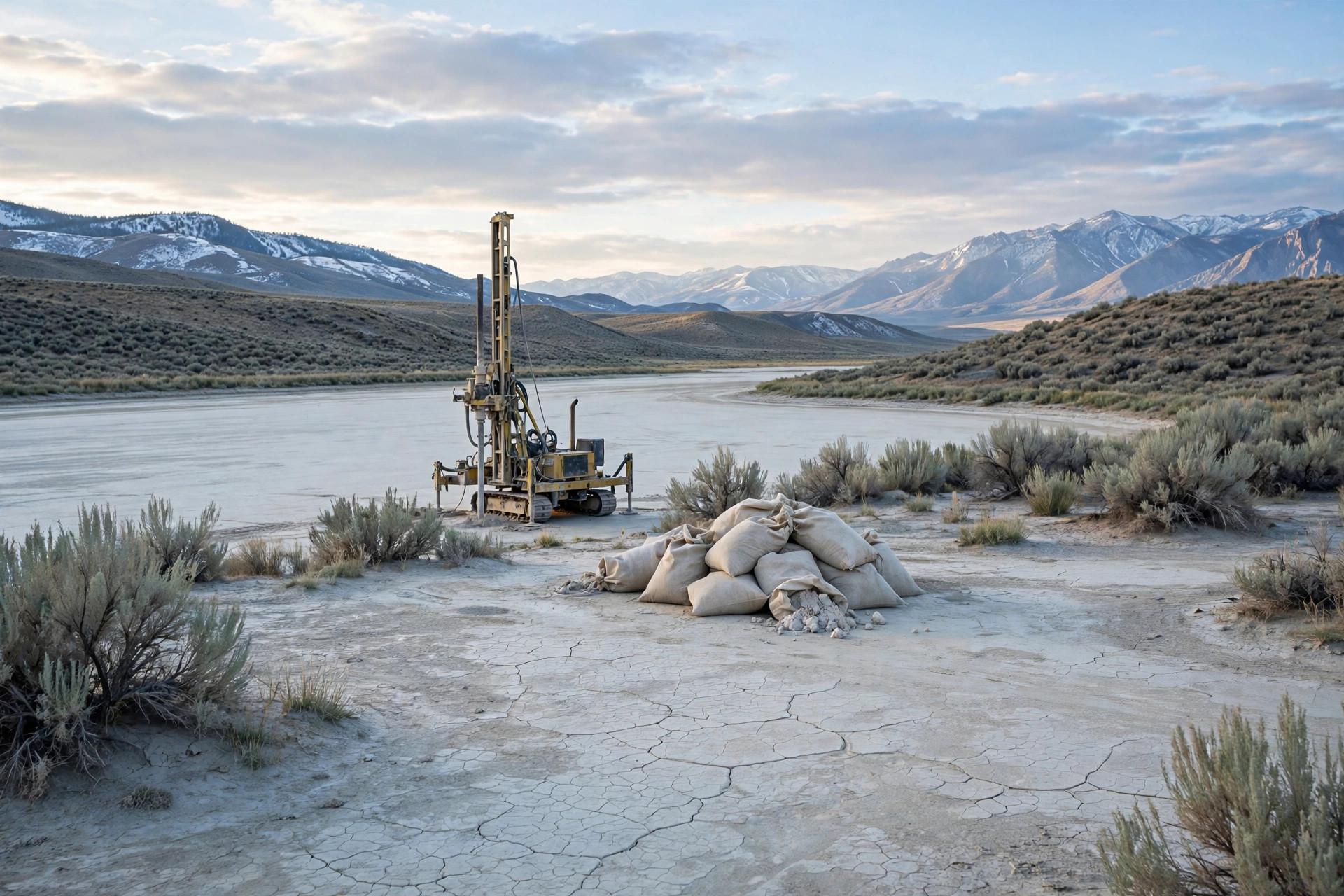
Nevada's next lithium mine now has the document every lender and regulator will read first. Lithium X2 Mining Inc. (TSXV: LIXX) (OTCQX: LIXMF) — formerly Surge Battery Metals — announced on November 16 that it has filed the independent NI 43-101 technical report for the 2026 pre-feasibility study (PFS) of its Nevada North Lithium Project in Elko County, north of Wells, Nevada. The filing contains no material differences from the PFS results announced on October 2 — what is new is that the full engineering case, and the project's first mineral reserve, are now on the public record.
- First reserve: Proven and Probable Mineral Reserve of 218.3 Mt at 3,928 ppm Li, containing 4.56 Mt of lithium carbonate equivalent (LCE), effective July 28, 2026. The PFS mine plan is based solely on this reserve and includes no Inferred resources.
- The resource underneath it: pit-constrained Measured and Indicated Resource of 657.5 Mt at 3,007 ppm Li (10.5 Mt LCE) and Inferred Resource of 271.3 Mt at 2,160 ppm Li (3.1 Mt LCE), effective July 20, 2026 at a 1,250 ppm Li cut-off; resources are reported inclusive of reserves. The updated estimate adds cesium and rubidium as accessory metals — neither is in the reserve or the economics.
- The operation: a conventional open pit with filtered tailings, on-site beneficiation and sulfuric acid leaching, producing 3.87 Mt of battery-grade lithium carbonate over a 42-year life — about 92,250 tonnes per year on average, at an overall lithium recovery of 84.9%. Waste-to-ore ratio is 0.88:1 and the material is expected to be free-digging.
- The economics (100% project basis): after-tax NPV at 8% of US$9.81 billion and IRR of 23.6% at a US$24,000/t lithium carbonate price; operating cost of US$4,719/t, 10% below the 2025 preliminary economic assessment; after-tax payback of 4.2 years; undiscounted life-of-mine after-tax cash flow of US$56.3 billion.
- The build cost: Phase 1 capital of US$2.77 billion and Phase 2 of US$2.35 billion — US$5.12 billion in total, plus US$1.65 billion of sustaining capital. The plant is built in two phases, each a processing train of roughly 55,900 tonnes per year.
- Ownership and authorship: the project is held by Nevada North Lithium LLC, owned 67.5% by Lithium X2 and 32.5% by Evolution Mining Limited. The PFS was led by Fluor Enterprises with Independent Mining Consultants and RESPEC; the report is dated November 16, 2026 with an effective date of October 2, 2026.
What a PFS filing actually changes
A pre-feasibility study is the first level of study that is allowed to declare a mineral reserve — the portion of a resource judged economically mineable under stated assumptions. Until this filing, Nevada North was a large resource with a preliminary economic assessment. It is now, on paper, a reserve-backed project with a mine plan, a processing route and a price deck that third-party engineers have signed. President and CEO Greg Reimer framed it that way: "Filing the Technical Report completes the pre-feasibility stage at Nevada North and is the first major milestone we report as Lithium X2... With our joint venture partner Evolution, our focus now turns to the feasibility study, pilot plant testing and permitting required to reach a final investment decision."
The location does real work in that plan: the project sits about 74 kilometres north of Wells and 140 kilometres northeast of Elko, in the most concentrated hard-rock mining labour market in the United States, with U.S. Highway 93 access.
The honesty box
Every headline number above is a study output, not a result. The NPV and IRR rest on a US$24,000-per-tonne lithium carbonate price assumption; lithium prices have swung violently in recent years, and the study's own sensitivity work is the honest companion to the headline — the company notes the after-tax NPV stays positive across a ±30% range in every variable tested, which is another way of saying the margin for error is being measured against a price nobody controls. The accuracy class matters too: Phase 1 capital and operating estimates are AACE Class 4 (±25%), and the Phase 2 capital figure is a planning-level estimate derived from Phase 1. The US$5.12 billion construction bill is not financed, no feasibility study exists yet, permitting and pilot-plant testing lie ahead, and a final investment decision has not been made. Mineral resources that are not reserves do not have demonstrated economic viability — the 657.5 Mt resource is context for the 218.3 Mt reserve, not an addition to it. The company itself states there is no certainty the PFS results will be realized.
What to watch
The feasibility study scope and timetable; pilot-plant metallurgical results; the permitting path with federal and Nevada agencies; and how a US$5 billion-plus build gets financed — by the joint venture partners, by strategic or government capital, or not at all.