
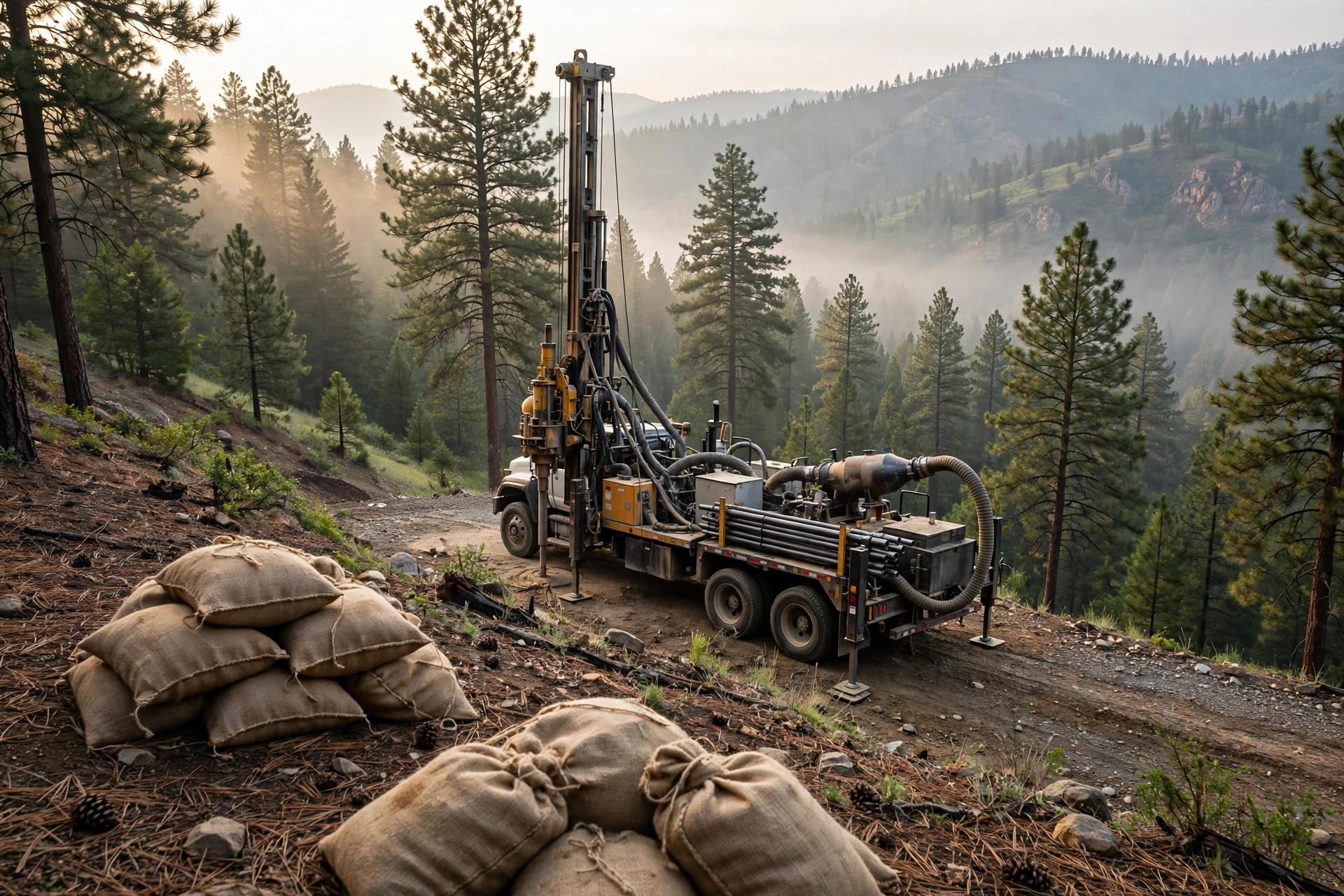
The Main Zone at Baner is now more than a kilometre long, and the property's far northwest corner has gold in its first-ever drill hole. Legacy Gold Mines Ltd. (TSXV: LEGY) reported on November 19 assay results from two core holes and two reverse-circulation holes from its 2026 drill program at the Baner Gold Mine Property in Idaho County, Idaho, in the historic Orogrande and Elk City gold districts — and said geological, metallurgical and engineering work toward an initial mineral resource estimate is now under way.
- Main Zone extended 80 metres north, to 1,080 metres (3,543 feet), and still open: RC hole LG26-049 returned 0.38 g/t gold over 21.3 metres from 4.6 metres downhole, beginning only 3.2 metres vertically below surface, including 1.0 g/t over 1.5 metres. LG26-052 returned 0.35 g/t gold over 41.1 metres from 30.5 metres, including 1.1 g/t and 1.6 g/t gold over separate 1.5-metre samples.
- First-ever NW Zone hole hits gold: core hole LG26-001, the first hole ever drilled in the NW Zone, intersected 0.37 g/t gold over 8.9 metres from 62.8 metres, including 1.5 g/t over 0.3 metres — about 1,200 metres (nearly 4,000 feet) from the closest Main Zone drilling, on a gold-in-soil anomaly that extends a further 500 metres beyond the hole, with soil values up to 1.0 g/t gold along the trend.
- NE Zone mirrors the Main Zone: core hole LG26-012A cut four mineralized horizons, including 0.51 g/t gold over 6.5 metres, 0.17 g/t over 23.9 metres and 0.19 g/t over 18.2 metres, confirming the same stacked, flat-lying zone geometry as the Main Zone, up-dip from previous NE Zone drilling.
- A 350-metre gap is the next target: the company's magnetotelluric (MT) survey suggests the Main Zone and NE Zone may connect across an untested 350-metre gap the company intends to drill in 2027; the MT survey also shows a large conductor beneath the NW Zone hole.
- Program scale: about 32,000 feet of drilling completed to date — 11 core holes plus 38 of a planned up-to-53 RC holes. The rig has been demobilized for winterization and is planned to return as work toward the initial resource continues; assays for a number of holes remain pending.
- The money: a previously announced financing is expected to close in the coming weeks and, per the company, will fund 2027 step-out exploration and the technical studies, alongside a broader look at the historic Elk City district.
- The QP and the labs: Mike Sutton, P.Geo., Director and VP Exploration, is the Qualified Person. RC samples were assayed by Skyline Assayers & Laboratories in Tucson, Arizona; core was prepared by Scout Drilling in Coeur d'Alene, Idaho and assayed by PhotonAssay at Paragon Geochemical in Reno, Nevada. Composites use a 0.2 g/t gold cut-off with 10 metres of internal dilution.
Why a first hole 1.2 kilometres away matters more than the extension
The northern extension is useful, incremental work: near-surface, thick, low-grade mineralization continuing in the direction the model predicted, in a zone whose previous northernmost hole (LG26-005, released August 5) ran 0.86 g/t gold over 45.7 metres. It lengthens the body the initial resource will be built on. LG26-001 is a different kind of result. The NW Zone existed before November 19 only as an interpretation — gold in soils, magnetic highs and IP conductors resembling the Main Zone's signature, never drilled. One hole does not make it a zone of the Main Zone's scale, but it converts the interpretation into observed mineralization in the ground, 1.2 kilometres from the nearest drilling, with the soil anomaly running another 500 metres past it and a large MT conductor underneath. If the NW trend holds up under follow-up, Baner stops being a single kilometre-long body with a satellite and becomes a district-scale system with at least three mineralized centres along the Orogrande Shear Zone — the 100-to-200-metre-wide structure the release identifies as the belt's control.
The honesty box
The grades are low-grade and near-surface — the headline composites run 0.35 to 0.51 g/t gold, and whether rock at those grades is ore depends entirely on tonnage, recovery and cost work that has not yet been published. Baner has no mineral resource estimate; the initial resource is a stated objective of work now under way, not a delivered document, and there is no reserve and no economic study. True widths are unknown until zone dips are proven, per the release's own table notes — and the release flags a specific geometric caution in the NW Zone, where surface veins dip east at about 57 degrees while the MT conductor dips west, raising the possibility that LG26-001 was drilled sub-parallel to the zone it hit. LG26-001 also carried eleven other anomalous zones at only 0.04 to 0.11 g/t gold. The Main–NE Zone connection is a geophysical interpretation, untested across the 350-metre gap. Legacy holds Baner under an option to acquire a 100% interest — it does not yet own the property outright — and the financing that funds the 2027 program has been announced but, per this release, has not yet closed.
What to watch
The pending assays from the balance of the 2026 program; the winterized rig's return and the first holes into the 350-metre Main–NE gap in 2027; follow-up drilling in the NW Zone, including pending hole LG26-002 on the soil anomaly west of it; the closing of the announced financing; and the delivery of the initial mineral resource estimate the technical work is aimed at.