
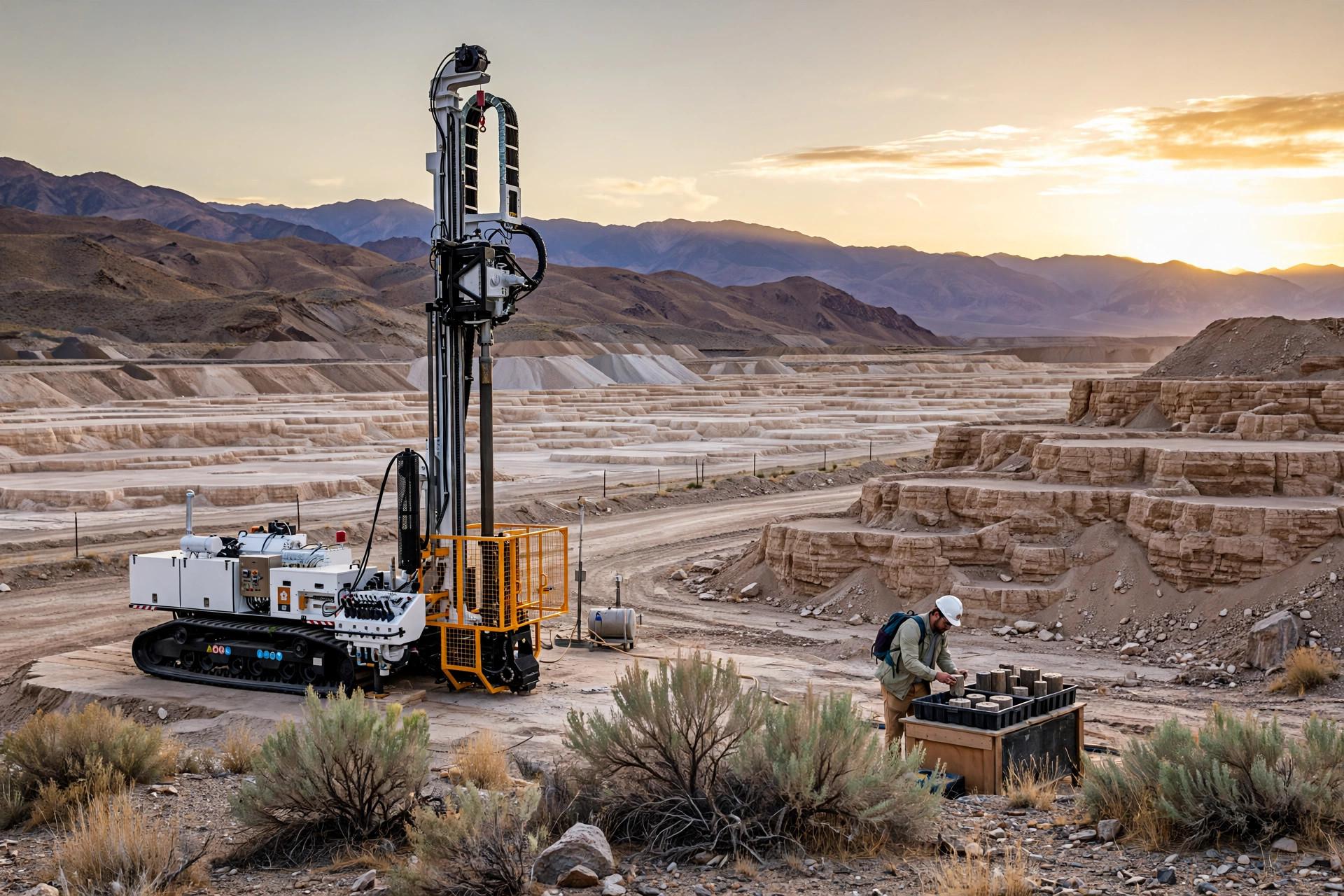
Some of the gold at Santa Fe was already mined once — it just never left the property. Lahontan Gold Corp. (TSXV: LG) (OTCQB: LGCXF) (FSE: Y2F) announced on November 17 the final results from its 2026 sonic core drilling program on Heap Leach Pad Two ("HLP Two") at the Santa Fe Mine Project in Mineral County, Nevada. Sixteen new holes, added to ten previously reported, confirm consistent residual gold and silver throughout the historic pad — at grades modestly better than the mine's own production records predicted.
- The full HLP Two dataset: 26 sonic drill holes totalling 435.5 metres and more than 570 individual assayed intervals, all on Heap Leach Pad Two. The 16 holes reported November 17 complete the program; the first ten were reported September 15, 2026.
- The grade: a weighted average of 0.34 g/t Au and 2.4 g/t Ag (0.36 g/t Au Eq) across all samples — 17% higher than anticipated on a gold-only basis. Historic records had predicted a residual grade of about 0.29 g/t Au and 2.5 g/t Ag (0.32 g/t Au Eq).
- What was loaded on the pad originally: 3.76 million tonnes grading 0.55 g/t Au and 2.9 g/t Ag (0.58 g/t Au Eq), placed by Corona Gold as run-of-mine (uncrushed) rock from the Santa Fe open pit in the late 1980s and early 1990s. Reported recoveries at the time were 47% for gold and 13% for silver — which is why material remains.
- Recoverability is the open question: cyanide-soluble gold analyses ranged from 5% to 82% of the corresponding fire-assay gold values, averaging approximately 40%. Lahontan says a portion of the residual gold is cyanide-soluble and that crushing the historic run-of-mine material may further enhance recovery — both subject to further metallurgical evaluation.
- What happens next: results from HLP Two, combined with sonic drilling of Santa Fe's three other historic heap leach pads, will feed an NI 43-101-compliant mineral resource estimate for the historic pads. Subject to resource definition, metallurgical results and economic evaluation, Lahontan plans to incorporate the pad material into an updated mine plan and schedule it for processing during the early years of Santa Fe operations.
- The lab and the QP: all samples went to American Assay Laboratories in Sparks, Nevada (30-gram fire assay with ICP finish). Technical disclosure was reviewed by Brian J. Maher, M.Sc., CPG-12342, Lahontan's Senior Vice President, Mine Development & Exploration.
Why a heap leach pad gets drilled at all
A heap leach pad is not waste in the ordinary sense. Ore — in Santa Fe's case, uncrushed run-of-mine rock — was stacked on the pad and irrigated with cyanide solution, which dissolved a portion of the gold and silver and carried it out for recovery. With reported gold recovery of 47%, more than half of the gold that went onto HLP Two stayed on HLP Two.
That arithmetic is the whole thesis, and Lahontan's chief executive made the cost point directly in the release: reprocessing historic pad material eliminates stripping, blasting, loading and haulage compared with newly mined material. Founder, Chair, CEO and President Kimberly Ann said: "The final results from sonic core drilling at HLP Two are very encouraging, confirming that the residual gold grade is higher than anticipated based on historic production records. The weighted average gold grade of 0.34 g/t is approximately 17% higher than the historically predicted residual grade of 0.29 g/t."
Sonic drilling is the tool for the job because a heap leach pad is loose, stacked material — it returns a continuous core through the pad without the disturbance that would make grade distribution harder to read. Lahontan cautions, in the release itself, that pads, dumps and tailings lack the systematic geologic controls of in-situ mineralization, so grade variability is expected.
Santa Fe in context
Santa Fe is Lahontan's flagship and its restart target. The past-producing open pit and heap leach operation produced 359,202 ounces of gold and 702,067 ounces of silver between 1988 and 1995 (Nevada Bureau of Mines figures cited in the release). The current NI 43-101 resource for the in-situ deposits — separate from the heap pads — stands at an Indicated Resource of 1,195,000 oz Au Eq (47,532,000 tonnes at 0.72 g/t Au and 5.55 g/t Ag, together 0.78 g/t Au Eq) and an Inferred Resource of 1,190,000 oz Au Eq (60,605,000 tonnes at 0.59 g/t Au and 2.40 g/t Ag, together 0.61 g/t Au Eq), all pit-constrained.
The October 2026 preliminary economic assessment outlined an 11-year mine life averaging 91,900 Au Eq ounces a year, a post-tax NPV at 5% of US$820.0 million and an IRR of 40.1% at US$3,600/oz gold and US$49/oz silver, with pre-production capital of US$172.0 million. Lahontan is advancing permitting with a construction objective in 2027. The heap pads, if they convert to a resource and then into the mine plan, would be early-years feed sitting already mined on surface — that is their strategic value, not their grade alone.
The honesty box
The heap leach pads have no mineral resource estimate yet — the 0.34 g/t figure is a weighted average of drill samples from HLP Two, not a resource grade, and no tonnage for the pads has been published in this release. The 17% beat is against a residual grade predicted from historic production records and reported recoveries, not against a prior drilled estimate. And the metallurgy cuts both ways: cyanide-soluble gold averaging about 40% of fire-assay values means a majority of the residual gold, on these tests, did not dissolve in a two-hour cyanide tumble test — whether crushing and full leach cycles recover materially more is exactly what the ongoing metallurgical work has to prove. The in-situ resource and PEA figures above are the company's compliant estimates under their stated assumptions; the PEA is preliminary in nature.
What to watch
Publication of the NI 43-101 resource estimate covering all of Santa Fe's historic heap leach pads; metallurgical results on crushed pad material; and whether the updated mine plan that follows actually schedules pad reprocessing in the early production years.