
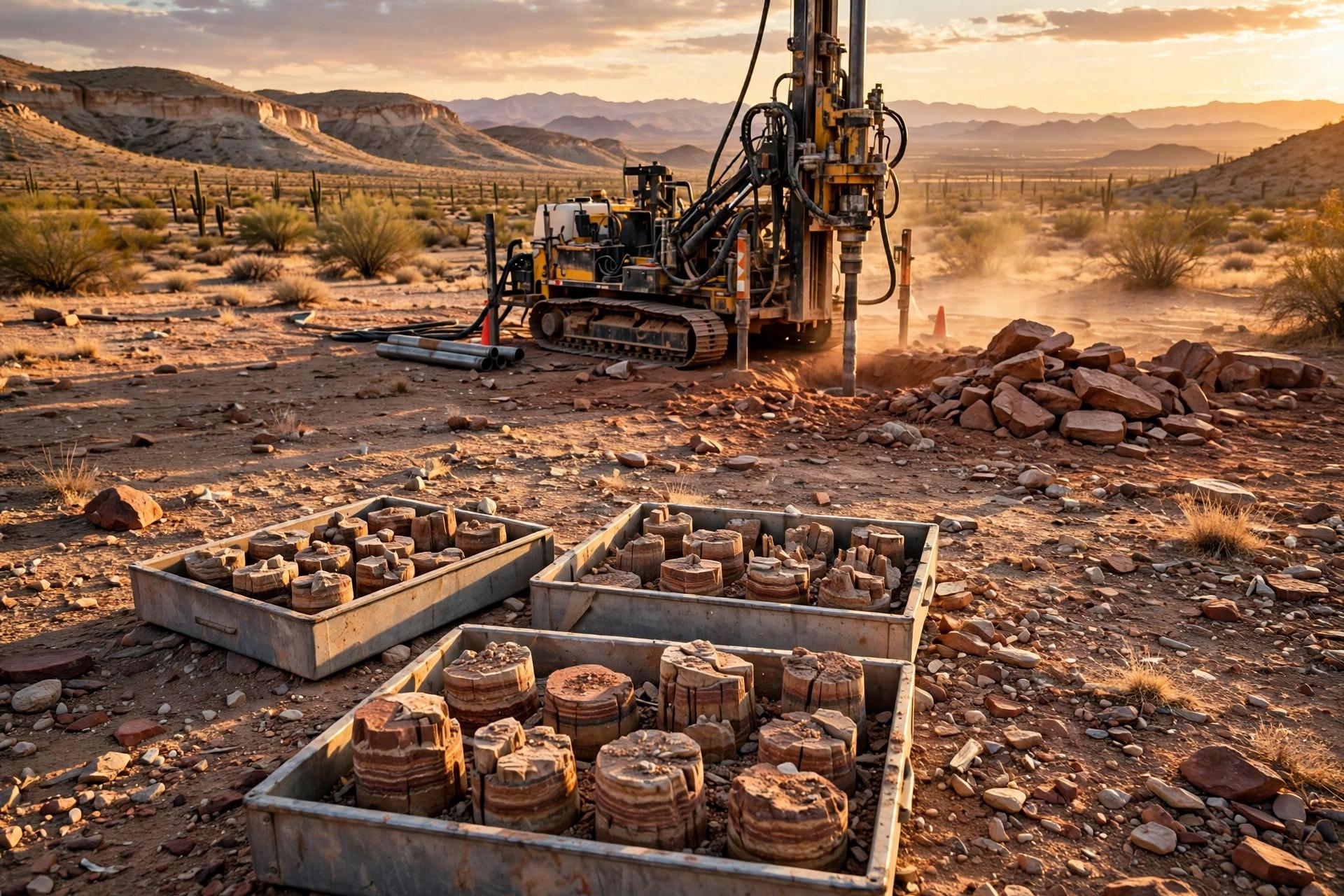
Ivanhoe Electric came to Gleeson looking under cover, and the first eleven holes found a system. Ivanhoe Electric Inc. (NYSE American: IE) (TSX: IE) reported on November 19 the discovery of copper-gold-silver mineralization in the first drill holes on private land at its Gleeson Copper-Gold Project in the historic Courtland-Gleeson Mining District in southeastern Arizona, 28 miles north of the Bisbee Mining District — two separate mineralized domains sitting below low-angle faulting, neither of them visible from surface.
- CGD26-TR-003 — the headline hole: 123.60 metres at 0.91% copper, 0.44 g/t gold and 5.27 g/t silver from 601.70 metres, including 71.03 metres at 1.38% copper, 0.52 g/t gold and 6.73 g/t silver from 640.32 metres. A 1.13-metre sample within it graded 6.92% copper, 8.88 g/t gold and 17.25 g/t silver.
- CGD26-TR-008 — the long hole: 381.66 metres at 0.34% copper, 0.29 g/t gold and 1.07 g/t silver from 587.85 metres, including 16.20 metres at 1.04% copper and 41.51 metres at 0.38% copper and 1.23 g/t gold.
- The upper domain: copper-gold-silver breccia logged across about 500 by 500 metres, from 600 metres depth, pinching out to the east and broadening to over 380 metres of downhole thickness to the southwest. It remains open in multiple directions.
- The deeper domain: below 1,000 metres, intrusive- and carbonate-replacement-hosted copper-gold-silver-zinc mineralization logged over 800 metres north to south and 600 metres east to west, with a strong vector to the west. Holes CGD26-TR-008 and CGD26-TR-009 cut visible carbonate-replacement sulfides from about 1,250 metres — assays pending, expected before the end of 2026.
- The rest of the assayed set: CGD25-TR-001 returned three broad intervals including 385.34 metres at 0.33% copper, 0.22 g/t gold and 6.29 g/t silver in the deeper domain; CGD26-TR-006 cut 275.83 metres at 0.26% copper in the breccia. Complete assays are in hand for seven holes, partial results for two, with four more pending or in progress.
- The ground: Ivanhoe Electric began acquiring rights in 2024 and now controls 19,606 acres of mineral rights and 2,033 acres of private surface rights; all current and planned drilling is on private land it controls. The company calls Gleeson its highest-priority exploration project and plans to complete 16,000 metres of drilling by the end of 2026, with two rigs active; drilling began in November 2025.
- The QP and the lab: technical disclosure was reviewed by Shawn Vandekerkhove, P.Geo., a company employee and therefore non-independent. Samples went to ALS Laboratories (preparation in Tucson, Arizona; analysis in North Vancouver).
Why two stacked domains change the district conversation
Bisbee, 28 miles south, mined for 133 years — from 1880 to 2013, over 207 million tonnes of ore yielding about 8.2 billion pounds of copper, 2.8 million ounces of gold and 105 million ounces of silver, per the release — from exactly the rock package Gleeson is now drilling: breccias, carbonate-replacement bodies and intrusive-hosted mineralization in limestones. Gleeson's first holes have found the same two styles stacked at depth in the next district north, under a low-angle fault that hid them from the historic miners who worked the Courtland-Gleeson district's surface showings. That is the whole significance of the geometry: this is not a surface prospect drilled down, it is a blind system whose upper breccia alone spans half a kilometre square before it has been stepped out, with a second, deeper system underneath it that the drilling has only begun to outline — and the company's own senior vice-president of exploration, Alex Neufeld, called the initial holes the most impressive he has seen in a 20-year career at an early-stage project. The neighbour noticed within a day: Intrepid Metals, whose Corral Copper Project is contiguous to the east, put out its own update on November 20 noting the discovery sits roughly 150 metres west of its boundary.
The honesty box
This is a discovery announcement, not a resource. Gleeson has no mineral resource estimate, no metallurgical testwork and no economic study, and the release's copper-equivalent figures assume 100% recovery of copper, gold and silver — the company itself states the CuEq values are for comparison only and may not represent recoverable metal. All intervals are downhole lengths; true widths are unknown. The system is deep: the breccia starts at about 600 metres and the deeper domain below 1,000 metres, so any eventual mine here would be an underground proposition whose economics cannot be judged from discovery grades. The Bisbee production figures are historic production from a different district, included in the release as geological context — the release itself cautions that Bisbee mineralization is not indicative of Gleeson's potential. Visual sulfide observations in the pending holes are explicitly not a substitute for assays. Finally, the superlatives — "highest priority," "best exploration project in the United States" — are the company's characterizations of its own discovery, reported here as its stated position, not as findings.
What to watch
The pending assays, above all the deep carbonate-replacement intervals in CGD26-TR-008 and CGD26-TR-009 expected before the end of 2026; whether step-out drilling extends the breccia southwest and west beyond the current 500-by-500-metre footprint; the balance of the 16,000-metre 2026 program; and the investor call the company says it will host once further results are in.