
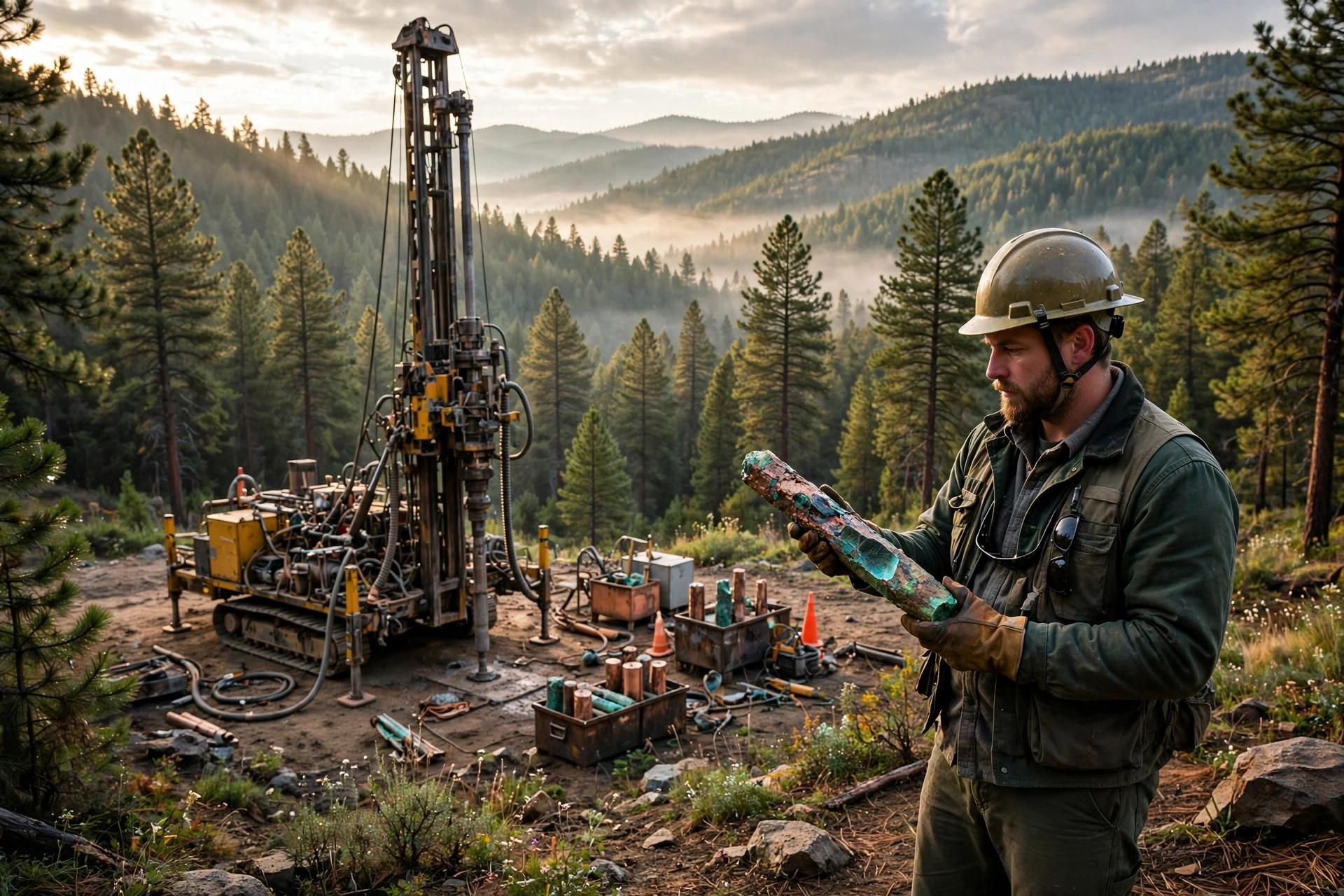
The first hard numbers from Freeze's 2026 season are in. IDEX Metals has released initial assay results from its Freeze Property in Washington County, western Idaho — the copper-gold porphyry project in the Idaho Copper Belt — and they do two things at once: they extend the best copper grades of the program to date at the Kismet Target, and they report the first drill evidence from a new target, Shiver, nearly 3 kilometres to the north-northeast.
- The headline interval: hole KSMT26012 at Kismet returned 92.97 metres grading 0.39% copper, 308 ppm molybdenum and 2.04 g/t silver (0.67% CuEq) from 247.05 metres, including 25.40 metres at 0.96% copper (1.38% CuEq) and a higher-grade core of 6.97 metres at 1.50% copper, 430 ppm molybdenum and 11.04 g/t silver (2.00% CuEq). The hole was drilled to 502.62 metres and targeted the Kismet Breccia Complex deeper than previous drilling; the main interval coincides with the top of a potassic-altered breccia body, and the company says mineralization remains open to the north, east-southeast and at depth.
- Tungsten alongside the copper: 50.27 metres grading 526 ppm tungsten (0.066% WO3) overlaps the main KSMT26012 copper zone, and hole KSMT26010 returned the highest tungsten grades of the 2026 program so far, including 5.00 metres at 3,104 ppm tungsten (0.39% WO3) from 223.00 metres, within a broad 129.08 metres at 0.23% copper (0.28% CuEq) from 101.00 metres.
- The Shiver first test: hole KSMT26020, the first drill test at Shiver, encountered porphyritic granodiorite — the same intrusive host identified at the Solstice porphyry discovery — at 55 metres depth, with QSP-altered granodiorite and D-type quartz-pyrite veins logged from 189.4 to 196.0 metres. No assays are reported for Shiver; the observations are visual.
- The corridor: Shiver lies about 2.8 kilometres north-northeast of Kismet and 1.6 kilometres north-northeast of Solstice. The three targets now align along a north-northeast corridor most of which, the company notes, has never been drilled.
- Still pending: assays from holes KSMT26013 through KSMT26018, including KSMT26016, the Solstice porphyry discovery hole reported on visual logging on October 22. At North Breccia, KSMT26008 returned a more modest 26.98 metres at 0.14% copper (0.15% CuEq) from 241.00 metres, which the company interprets as testing the periphery of the Solstice system.
Why this batch matters
Until this release, Freeze's 2026 story was largely visual: every Kismet hole had intersected visible oxide copper, and Solstice was a porphyry discovery made on logging alone, with grades unknown. KSMT26012 changes the footing at Kismet — it is an assayed, deep, broad interval with a genuinely higher-grade core, drilled into the breccia complex below the shallower oxide work, and it carries molybdenum, silver and tungsten credits alongside the copper.
Shiver is the opposite kind of news: no grades at all, but a geological signal. Finding the same porphyritic granodiorite host at Shiver that hosts the Solstice intrusion, with the alteration and vein types the company associates with proximity to a magmatic-hydrothermal system, is what extends the interpreted system to a nearly 3-kilometre corridor. Whether that corridor is one system, and whether it carries grade at Shiver or Solstice, is precisely what the pending assays will start to answer.
The honesty box
Copper equivalents are company calculations. The CuEq figures in this post are as reported by IDEX; the summary consulted for this post does not reproduce the metal prices or recoveries behind them, so they should be read as the company's equivalent grades, not as measured copper grades — the measured copper grade for the headline interval is 0.39%. The Shiver result is preliminary visual logging, not assay data: the company itself cautions that the QSP alteration and D-type vein observations are not a substitute for laboratory analysis, and no grade, width or economic significance has been established there. The same caution still applies to Solstice, whose discovery hole assays are pending. Freeze has no compliant mineral resource estimate — these are early-stage exploration results on a property where most of the interpreted corridor is undrilled, and there is no certainty that further exploration will define a resource. Intervals are as reported in the release; true widths are not stated in the summary consulted.
What to watch
Assays for KSMT26016 at Solstice — the first grades from the porphyry intrusion itself; the Shiver assays for KSMT26020; the rest of the KSMT26013–KSMT26018 batch; and whether IDEX follows the corridor north with 2027 drilling or pauses to model what 2026 has found.