
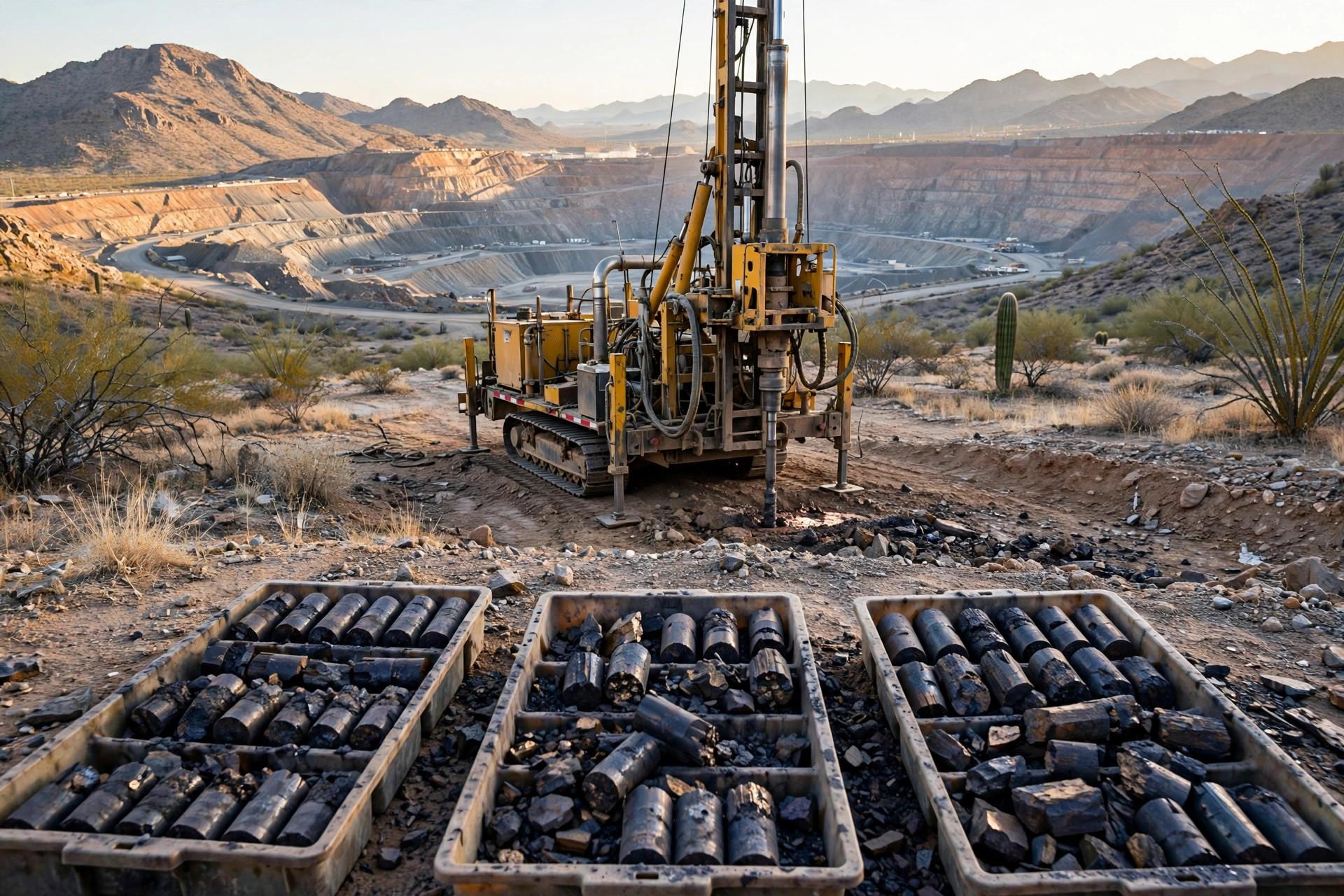
The first assays from Gunnison Copper's big 2026-2027 drill program are in, and the headline hole is at the satellite, not the flagship. Gunnison reported on November 10 that hole SHM-2 at Strong & Harris cut a high-grade massive sulfide interval that confirms the high-grade zone already carried in the deposit's resource model — while two holes at the main Gunnison Project returned the long, lower-grade copper intervals the flagship is built on.
- The high-grade hit: hole SHM-2 intersected 311 feet grading 1.39% copper, 2.29% zinc and 6.41 g/t silver from 525.0 to 836.0 feet, including 40 feet grading 5.15% copper, 11.99% zinc and 16.38 g/t silver from 576.0 to 616.0 feet. The company reports an estimated true thickness of 269.3 feet for the full interval and 34.6 feet for the included high-grade zone.
- The flagship intervals: at the Gunnison Project, hole NSM-18 intersected 790.3 feet grading 0.46% copper and hole NSM-22 intersected 738.3 feet grading 0.43% copper; hole NSM-17A returned 389.2 feet at 0.53% copper and a separate 475.0 feet at 0.35% copper.
- The other Strong & Harris holes: SHM-1 returned 127.0 feet at 0.30% copper and 0.29% zinc plus 78.0 feet at 0.49% copper and 0.34% zinc; SHM-3 returned 68.0 feet at 0.31% copper and 0.47% zinc.
- Program scale and progress: 27,953 feet across 25 holes completed — about 20% of the planned approximately 138,000-foot, 120-hole 2026-2027 program spanning resource, metallurgical, expansion and exploration drilling at Gunnison and Strong & Harris.
- The metallurgy push: testing across seven laboratories is evaluating heap leaching, sulfide leaching, material sorting, flotation and solvent extraction; flotation testing at FLSmidth is assessing a potential concentrator route for sulfide material, including recovery of zinc into a saleable concentrate and silver as a payable byproduct.
- The laboratory work: split PQ core samples are prepared on site in Arizona and sent to ALS Global in Reno, Nevada for total copper and sequential copper analyses, with standards, blanks and duplicates inserted at regular intervals; Qualified Person Dr. Roland Goodgame, the company's Senior VP of Project Development, reviewed the release and reported no significant QA/QC issues detected.
A satellite with its own grade
Strong & Harris sits approximately 1.9 miles from the Gunnison processing facilities and is included in the mine plan. President and CEO Craig Hallworth said the initial results "reinforce the significant potential of our Gunnison district, particularly at Strong & Harris, where we have confirmed the high-grade copper-zinc-silver mineralization in our resource model," and that the next priority is recovery: flotation testing for a concentrator route on sulfides, run in parallel with the heap-leach program for the flagship's oxide copper.
The district context the company carries is the Cochise Mining District in southern Arizona, where Gunnison says it controls 12 known deposits within an 8 km radius, including South Star and eight other potential satellite feeders, alongside the Johnson Camp mine — now in production, funded by Nuton LLC, a Rio Tinto venture, with capacity of up to 25 million pounds of finished copper cathode annually.
The resources and study already on the books
The release restates the compliant figures, separate from these drill results. The Gunnison Project's main pit carries a Measured and Indicated Mineral Resource of over 846 million tons at 0.33% total copper containing 5.19 billion pounds of copper (Measured: 192 million tons at 0.37%, 1.42 billion pounds; Indicated: 655 million tons at 0.31%, 3.77 billion pounds). Strong & Harris hosts an Inferred Mineral Resource of 76 million tons grading 0.49% total copper, 0.56% zinc and 0.12 oz/ton silver, containing approximately 740 million pounds of copper (including 483 million pounds of oxide copper), 856 million pounds of zinc and 9.0 million ounces of silver. A preliminary economic assessment completed in March 2026 for the Gunnison Project reported an NPV at 8% of $2 billion, an IRR of 22.5% and a payback period of 3.9 years for a conventional open pit, heap leach and SX/EW operation producing finished copper cathode on site.
The honesty box
These are drill intercepts, not a resource update and not reserves. SHM-2 confirms a high-grade zone the existing Inferred resource model already represented — the release does not present it as a new discovery or a resource expansion, and Strong & Harris remains an Inferred resource, the lowest-confidence compliant category. Reported grades do not establish metallurgical recoveries, concentrate quality, byproduct payability or suitability for heap leaching — the company says so itself; whether the sulfide material can be concentrated into saleable copper and zinc concentrates with payable silver is what the flotation program is testing, and it has not yet reported results. Intervals are downhole lengths with estimated true thicknesses calculated from hole orientation and interpreted formation dip, as tabled above. The March 2026 PEA is preliminary by definition, includes Inferred resources, and carries no certainty its conclusions will be realized; mineral resources that are not mineral reserves do not have demonstrated economic viability. Roughly 80% of the planned drilling — and the full results the company expects in mid-2027 — is still ahead.
What to watch
Further assay releases as the 120-hole program works through its remaining roughly 110,000 feet; the first flotation results and whether a concentrator route enters the technical work for Strong & Harris sulfides; and any resource update that reclassifies Strong & Harris material out of the Inferred category.