
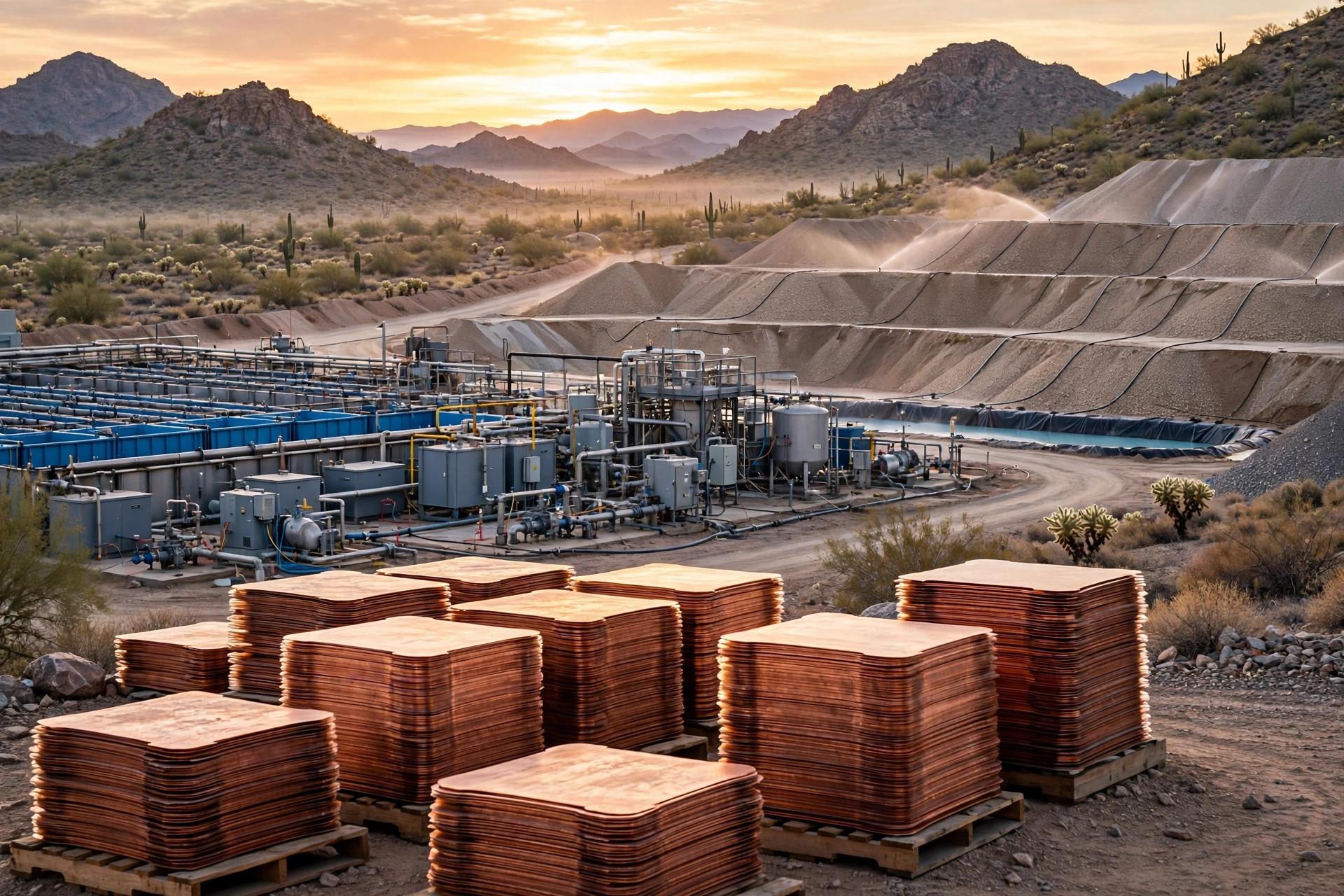
Johnson Camp is a commercial copper mine now, not a restart project. Gunnison Copper Corp. (NYSE American: GUNN) (TSX: GCU) reported on November 13 that its Johnson Camp Mine in Arizona achieved commercial production in September 2026, capping a quarter in which copper cathode production climbed 71% and revenue rose 53% over the prior quarter.
- Commercial production: Johnson Camp achieved commercial production in September 2026, following record monthly copper production in August and sustained operating performance through September.
- Production and sales: copper cathode production increased 71% quarter-over-quarter to approximately 3.42 million pounds (3,423,948 lbs in the quarter; 7,536,846 lbs year to date), while cathode sales increased 46% to approximately 3.31 million pounds at an average realized price of US$6.41 per pound. SX/EW unit costs fell to US$0.56 per pound, from US$0.76 in Q2.
- The quarter's financials: revenue of US$36.1 million (US$79.9 million year to date), up 53% over Q2 and against US$2.9 million in Q3 2025; net income of US$12.7 million, or US$0.03 per share, against a net loss of US$22.9 million in Q3 2025. Cash at September 30 was US$23.5 million.
- Stage 2 expanded: the Johnson Camp Stage 2 mine plan was expanded in partnership with Rio Tinto's Nuton, adding approximately 3 million tons of mineralized material expected to be mined between 2027 and 2029, with an additional US$8 million payment from Nuton to Gunnison, received in October 2026.
- Debt-free, and drilling ahead: the remaining Triple Flag convertible debenture converted on September 30, leaving Gunnison, in its words, a debt-free U.S. copper producer and developer; the flagship Gunnison Project technical study advanced with a district-wide program of up to 120 holes totalling approximately 138,000 feet (42,000 metres), and an application to amend the project's Mined Land Reclamation Plan was submitted in September.
A producer's quarter, with a developer's pipeline behind it
The operating story is Johnson Camp's ramp: 1,948,056 short tons of mineralized material mined in the quarter at a stacked grade of 0.617% copper, against 655,510 tons at 0.356% in Q1 — more tons, at better grade, through the same plant. Gunnison targets nameplate production of 25 million pounds of copper cathode annually by year-end 2026. Behind the mine sits the flagship Gunnison Copper Project in the same Cochise County district — a March 2026 preliminary economic assessment the company is now advancing toward a technical report targeted for the second half of 2028, with the MLRP amendment approval targeted before year-end 2026. The quarter also brought leadership additions the company had already announced — COO Bjorn Meyer in June and CFO Jennifer Hays effective October 12 — and, after quarter-end, the October 26 NYSE American listing under GUNN and an October 20 site visit by U.S. Secretary of the Interior Doug Burgum.
The honesty box
Read the revenue mix. Of the US$36.1 million in Q3 revenue, US$21.3 million came from copper cathode sales and US$14.7 million was deferred mining and processing demonstration service revenue — cathode sales alone are not yet the whole top line. Reported net income also included non-cash fair value adjustments associated with the Nuton Stage 2 payable and copper stream derivative liabilities, so the US$12.7 million is not a clean read on cash earnings from mining. The flagship Gunnison Project's economics rest on a preliminary economic assessment, which is preliminary in nature, includes inferred mineral resources that are too speculative geologically to be categorized as mineral reserves, and carries no certainty its conclusions will be realized; mineral resources that are not mineral reserves do not have demonstrated economic viability. Nameplate production by year-end 2026 and the permitting timelines are company targets, not completed events.
What to watch
Whether Johnson Camp reaches its 25-million-pound annual nameplate rate by year-end 2026; the MLRP amendment decision targeted before year-end; further results from the 120-hole district drilling program; and the split between cathode sales revenue and demonstration service revenue as the Nuton Stage 2 plan runs through 2027–2029.