
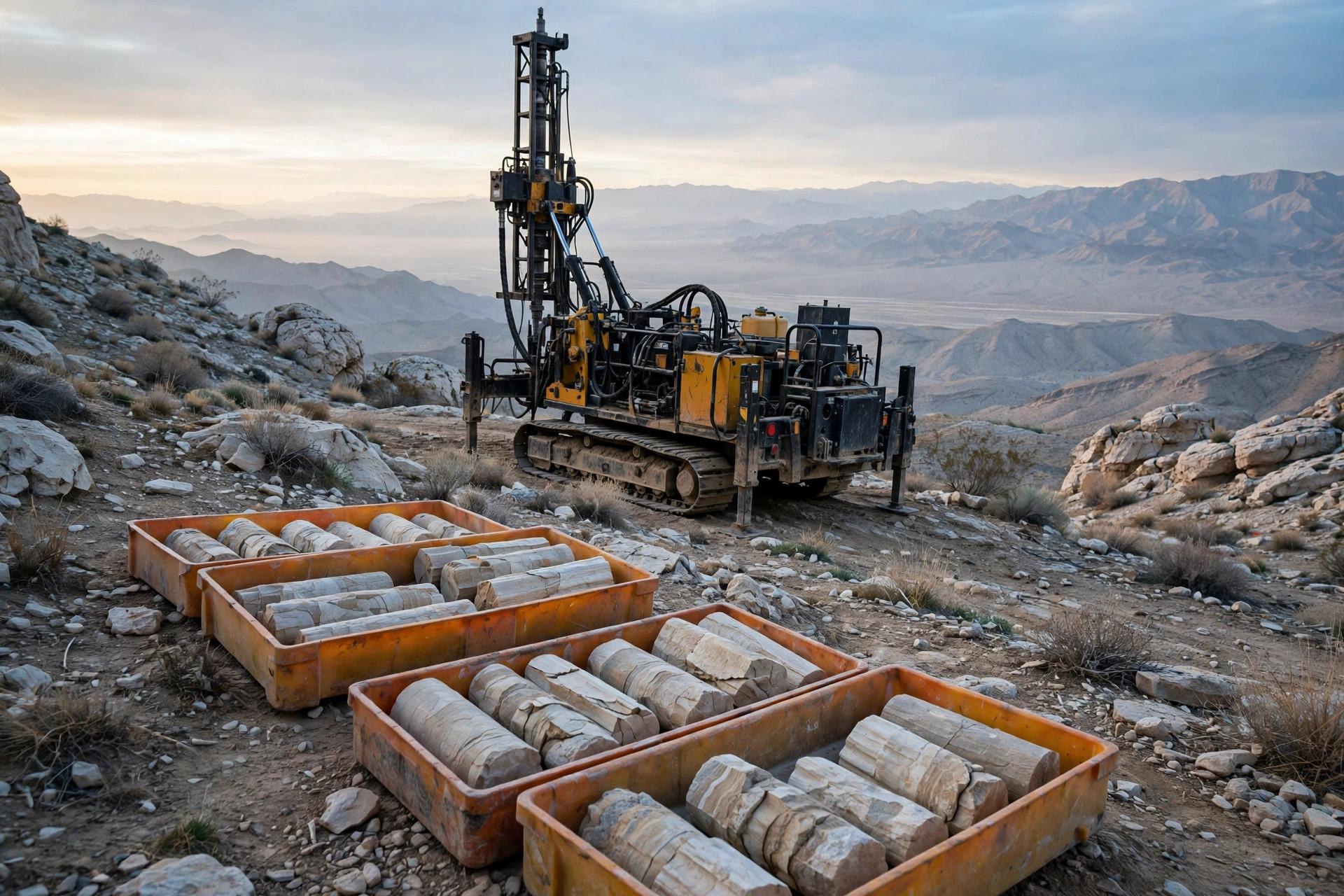
A discovery hole tells you gold is there. Step-outs tell you how far it goes. G50 Corp Limited (ASX: G50) closed out its 2026 White Caps program on November 26 with the final assays from five diamond holes totalling 2,220 metres at the White Caps Gold Project in Nye County, Nevada — and the answer is a mineralised footprint of roughly 900 metres by 500 metres, sitting inside a package of receptive sedimentary units the company puts at about 300 metres thick.
- The new step-outs: WCD26-02, drilled about 600 metres northwest of the discovery hole, returned 2.4 metres at 2.04 g/t gold and 0.7 g/t silver from 36.6 metres, plus 1.3 metres at 0.75 g/t gold from 71.2 metres. WCD26-05, in the western target area, cut 0.5 metres at 26.4 g/t gold and 6.6 g/t silver from 103.1 metres, with broader low-grade gold around it.
- The anchor hole (previously reported): WCD26-01, reported on June 22, 2026, cut 13.5 metres at 7.67 g/t gold and 2.38 g/t silver from 305.5 metres, including 3.93 metres at 23.95 g/t gold and 7.29 g/t silver — high-grade mineralisation about 200 metres down-dip of the historical workings.
- The misses, reported in the same release: WCD26-03 and WCD26-04, drilled on a magnetic-high target, returned no significant gold — though both were anomalous in gold and silver, showed skarn alteration, and confirmed blind intrusions interpreted from aeromagnetic data.
- The setting: White Caps is a historical high-grade gold operation that produced approximately 125,000 ounces at an average grade of roughly 30 g/t gold — a historical production figure, not a current resource.
- Already moving: a follow-up diamond program of five holes for about 1,500 metres has commenced, centred on WCD26-01 with nominal 100-metre step-outs along west-northwest and north-northeast trends to test geometry and continuity.
What the pattern says
The geology the release describes is a limestone-hosted system: the higher-grade gold sits in decalcified and silicified limestone units alongside quartz veins and faulting — the classic Carlin-style recipe of reactive host rock plus structure. WCD26-02 and WCD26-05 put gold-bearing positions substantially west of the discovery hole, which is what stretches the footprint to 900 metres; the two barren magnetic-target holes are the counterweight, showing the system is not uniformly mineralised wherever the geophysics lights up.
The honesty box
No Mineral Resource is defined at White Caps, and G50 says so itself: drill spacing is not yet sufficient to establish the geological and grade continuity a resource estimate requires. All intercepts are downhole lengths, not true widths. The eye-catching numbers need their context kept attached — the 26.4 g/t interval is half a metre wide, the 23.95 g/t interval sits inside a hole reported five months ago, and the historical 30 g/t production grade describes what miners took out a century ago, not what remains. Samples were analysed by ALS Global in Reno with QA/QC disclosed. This post reports the November 26 release as issued.
What to watch
Assays from the 1,500-metre follow-up program and whether the 100-metre step-outs around WCD26-01 connect the high grade into continuous zones; any first resource work once spacing tightens; and G50's parallel Golconda program in Arizona, where core drilling is planned from December.