
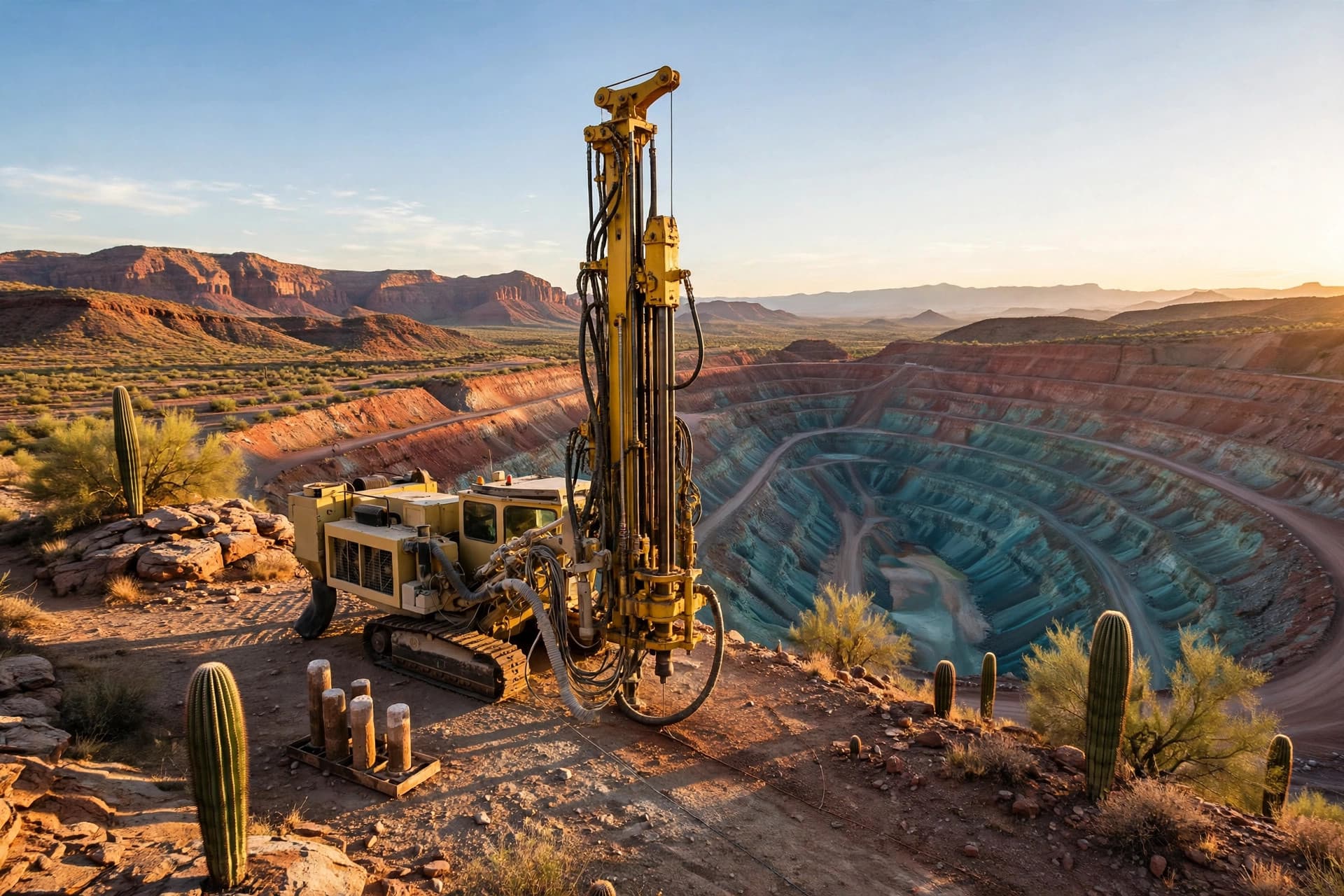
Zonia was an oxide story: a past-producing heap-leach copper deposit in Arizona's Walnut Grove district with a preliminary economic assessment on the shallow, oxidized material. Edge Copper Corporation's (TSX: EDCU) November 5 release changes the shape of the project — every hole the company has drilled through the oxide and into the rock below it has hit a sulfide porphyry system carrying copper, gold, silver and molybdenum.
- Thirteen for thirteen: all 13 holes drilled below the oxide deposit intersected sulfide mineralization along approximately 9,800 feet (2,980 metres) of strike; six were oxide definition holes stopped shortly after entering sulfide, and seven were extended to test the sulfide system at depth.
- ZND0063: 876 feet grading 0.38% CuEq (0.26% CuT, 0.10 g/t Au, 1.29 g/t Ag, 62 ppm Mo) from 1,075 feet to the end of the hole at 1,951 feet — it ended in mineralization, including 80 feet at 0.57% CuEq and 40 feet at 0.70% CuEq.
- ZND0068: 423 feet grading 0.50% CuEq (0.34% CuT, 0.14 g/t Au, 1.04 g/t Ag, 91 ppm Mo) from 469 feet to the end of the hole, including intervals at 0.64% and 0.62% CuEq.
- ZND0058: 775 feet grading 0.34% CuEq from 1,260 feet, including 50 feet at 0.67% CuEq. ZND0019: 416 feet grading 0.41% CuEq from 886 feet to the end of the hole, including 20 feet at 1.01% CuEq.
- The geophysics: IP surveys outline a chargeability footprint approximately 16,400 feet (5,000 metres) long and 3,300 feet wide — drilling has tested about 60% of that strike length, and the system remains open laterally and at depth.
- All intervals are down-hole lengths; true thicknesses have not been determined.
How a definition program became a discovery
The 2026 program — recently increased to 65,000 feet, with 54 holes now reported — was designed to define the oxide deposit, so most holes stopped shortly after entering sulfide. The discovery is what those hole bottoms kept showing: porphyry-style mineralization continuing to more than 2,000 feet down-hole, with the higher-grade zones associated with abundant A-quartz veins and intense potassic alteration — the assemblage the company's Qualified Person, Dr. Patrick Redmond, notes characterizes the high-grade cores of many porphyry copper systems.
Chair and CEO Gil Clausen: "Every hole drilled below the oxide deposit intersected sulfide mineralization, several of the deepest holes ended in mineralization, and the geophysics indicates the system extends well beyond the drilling completed to date."
Next steps split in two. The oxide track finishes drilling by mid-November, with an updated oxide Mineral Resource estimate now expected in Q1 2027 followed by an updated PEA. The sulfide track is geological modelling and IP interpretation now, with systematic deeper drilling planned for 2027 to test the system along the chargeability anomaly.
The honesty box
There is no mineral resource estimate for the sulfide system, and it is not included in the company's 2026 PEA — "discovery" here means repeated drill intersections of porphyry-style mineralization, not a defined deposit. The grades are long, low-grade porphyry intervals (mostly 0.34–0.50% CuEq over hundreds of feet), a different proposition from the oxide heap-leach material above them, and the deepest hole, ZND0063, was drilled down the system's dip, so its down-hole lengths may exceed true thickness. IP chargeability reflects total sulfide content — mainly pyrite — and is not a measure of copper grade; the untested 40% of the anomaly is a geophysical target, not drilled mineralization.
What to watch
Completion of the oxide program and the Q1 2027 oxide resource update; whether the 2027 deep program is funded and how it is laid out along the 16,400-foot anomaly; and step-outs around the higher-grade centres in ZND0068, ZND0013, ZND0063 and ZND0058, which will show whether the localized higher-grade zones connect.