
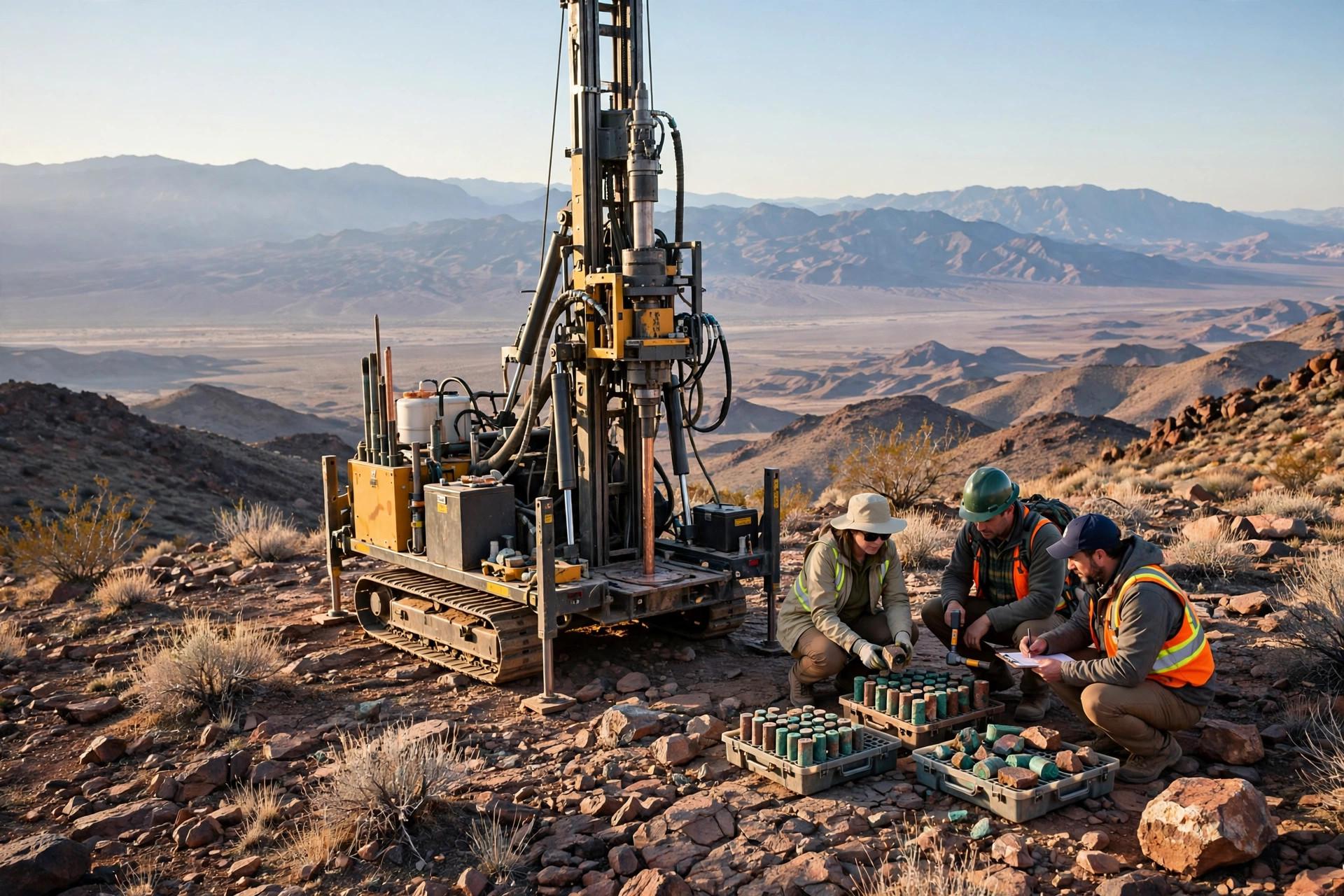
Phase 2 at Majuba Hill now has three holes in the box, and the third one ran the deepest of the program so far. Copper One Resources Corp. (CSE: CEXY) (OTCID: CEXYF) announced on November 13 that MHB-41 reached a final downhole depth of 1,850 feet (564 metres) at the 100%-owned Majuba Hill copper-silver-gold project in Pershing County, Nevada.
- Third Phase 2 hole complete: MHB-41, drilled on a grid azimuth of 075° at an inclination of −50°, is the third hole of the up-to-10,000-foot (3,048-metre) Phase 2 diamond drilling program. MHB-39, MHB-40 and MHB-41 together account for 4,925 feet (1,501 metres) of completed diamond drilling.
- What was seen — visual only: at approximately 580–581 feet, pervasive silicification with fine-grained pyrite and chalcopyrite; tourmaline breccia in core-box intervals of 808.0–817.6 feet and 1,066.7–1,076.3 feet; and fracture coatings of hematite and tenorite at 1,261 feet (384 metres).
- No assays: the release reports no laboratory results for MHB-41 — any material analytical results will be disclosed after receipt, QA/QC review and evaluation by the company's Qualified Person.
- Program shape: HQ/PQ diamond core drilling by Evolve Exploration Nevada, an initial scope of approximately 5,000 feet contracted, two-shift operations running 24 hours a day, seven days a week, with live drilling metrics and core photographs through Evolve's EVX Connect platform.
- The ground: about 9,684 acres (3,919 hectares), roughly 70 miles southwest of Winnemucca and 156 miles northeast of Reno, a past-producing copper mine with more than 95,000 feet drilled to date across more than 100 holes, year-round road access and nearby power and water.
Three holes, three different signals
Each Phase 2 hole has logged a different expression of the system. MHB-39 was extended past plan on persistent silicification and returned visually identified native copper and copper oxides. MHB-40 cut possible porphyry D-type veins in quartz-sericite-pyrite alteration, which the company is evaluating as a possible upper level of the porphyry system. MHB-41 adds tourmaline breccia — a texture associated with the magmatic-hydrothermal plumbing of porphyry systems — at two separate depths, with silicification and sulfides shallower and oxide fracture coatings deeper.
President and CEO David Greenway kept the framing measured: "Completion of MHB-41 marks another important step in our 2026 Phase 2 drilling program at Majuba Hill. The preliminary geological observations, including silicification, sulfide minerals and tourmaline breccia, provide additional information as our technical team continues to evaluate the project's geological characteristics." The program's stated objective remains systematic testing of priority targets in support of an inaugural mineral resource estimate under NI 43-101.
The honesty box
There are no assay grades in this release — none, for MHB-41 or for the earlier Phase 2 holes. Every mineral identification in it — the chalcopyrite, the tenorite, the breccia clasts — is a preliminary visual field observation, and the company states explicitly that the tourmaline breccia intervals cited are full core-box intervals that do not establish continuous mineralized widths, and that visual observations do not determine metal grades or establish economic mineralization. Majuba Hill has no mineral resource and no mineral reserve — the inaugural resource is the program's goal, not an existing fact. The technical disclosure was reviewed by a Qualified Person the release identifies as non-independent.
What to watch
Assays — from the earlier program phases and from MHB-39, MHB-40 and MHB-41 — which will decide whether the visual story carries grades; the remaining roughly 5,000 feet of the Phase 2 program and where the next collars land relative to the breccia intervals; and progress toward the maiden NI 43-101 resource.