
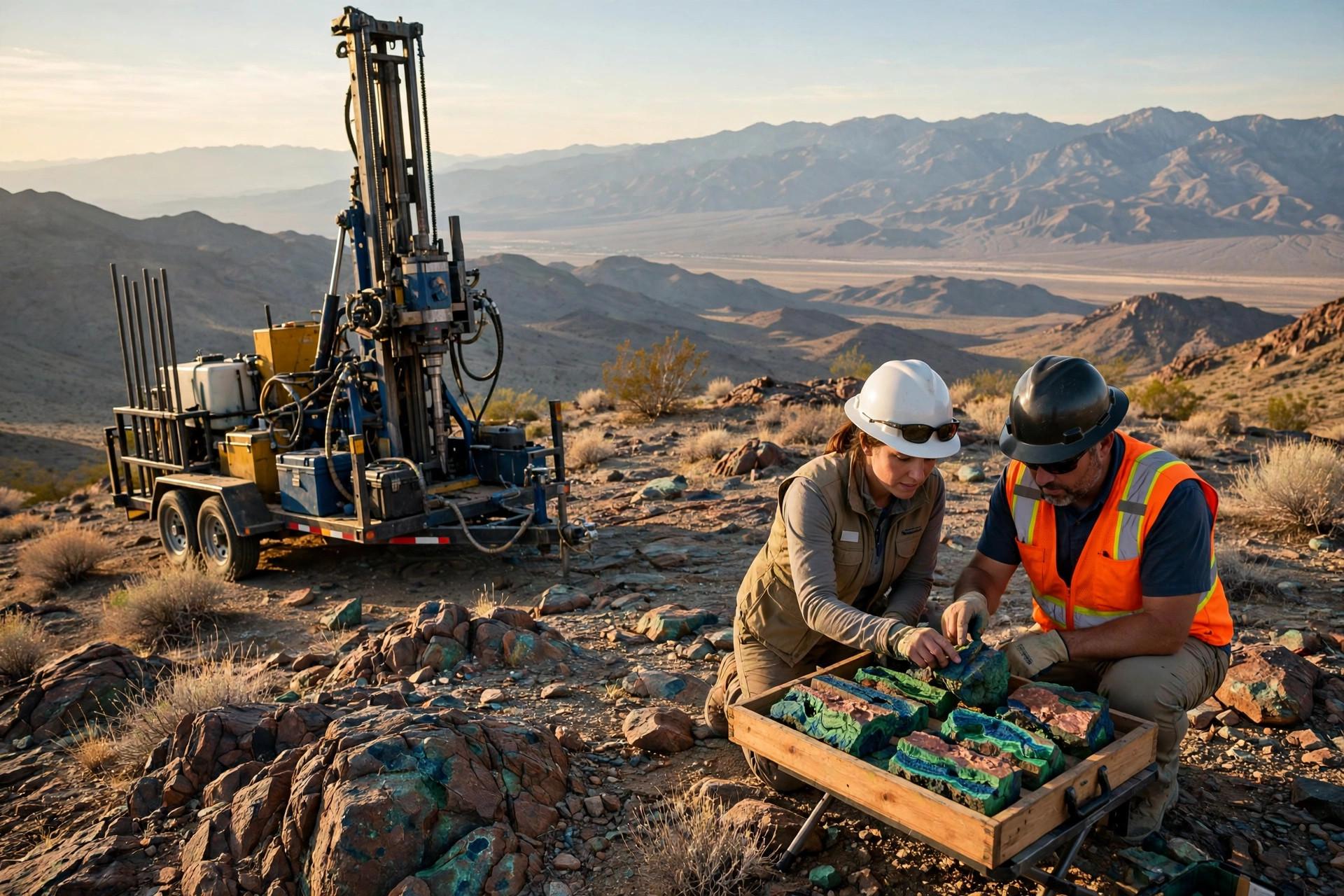
Phase 2 at Majuba Hill now has two holes in the box. Copper One Resources reported on November 6 that MHB-40 reached a final downhole depth of 1,615 feet (492 metres) — and that what the geologists saw in the core was a different flavour of the porphyry system than the native copper logged in the first hole.
- Second Phase 2 hole complete: MHB-40, drilled on an azimuth of 030° at an inclination of −55°, is the second hole of the up-to-10,000-foot (3,048-metre) Phase 2 diamond drilling program at the 100%-owned Majuba Hill copper-silver-gold project in Pershing County, Nevada.
- Phase 2 metreage so far: MHB-40 and the previously completed MHB-39 together account for 3,075 feet (937 metres) of diamond drilling.
- What was seen — visual only: preliminary core logging identified possible porphyry D-type veins associated with pervasive phyllic alteration characterized by quartz, sericite and pyrite, with photographs showing pyrite and minor chalcopyrite in stockwork veins. The release states repeatedly that visual identification is preliminary and not a substitute for laboratory assay results.
- The interpretation being tested: President and CEO David Greenway said the company is evaluating whether those veins mark an upper level of the porphyry system and could help guide deeper drilling — an interpretation, not a finding.
- The ground: about 9,684 acres (3,919 hectares), roughly 70 miles southwest of Winnemucca and 156 miles northeast of Reno, a past-producing copper mine with more than 95,000 feet (28,956 metres) drilled to date across more than 100 holes, year-round road access and nearby power and water.
- Program shape: HQ/PQ diamond core drilling by Evolve Exploration Nevada, an initial approximately 5,000 feet contracted, two shifts running 24 hours a day, seven days a week, with live drilling metrics and core photographs through Evolve's EVX Connect platform.
A different signal than MHB-39
The first Phase 2 hole, MHB-39, was extended past plan on persistent silicification and returned visually identified native copper and copper oxides. MHB-40's signal is alteration and veining instead: D-type veins are a classic porphyry texture, and Greenway framed the pair plainly — "Our geologists observed native copper and copper oxides in MHB-39, followed by possible porphyry D-type veins associated with quartz-sericite-pyrite alteration in MHB-40. We're evaluating whether those veins mark an upper level of the porphyry system and could help guide deeper drilling."
The program's stated objective remains systematic: test priority targets and advance Majuba Hill toward an inaugural mineral resource estimate prepared under NI 43-101.
The honesty box
There are no assay grades in this release — none, for MHB-40, for MHB-39, or for the completed Phase 1 program. The D-type veins are described by the company itself as "possible," the sulfides in the photographs are visually identified only, and the release's own forward-looking disclosure warns the veins may instead represent a later alteration event, the system may have been tilted or displaced, and laboratory results may differ materially from visual observations. Majuba Hill has no mineral resource and no mineral reserve — the release says so explicitly — and the inaugural resource is the program's goal, not an existing fact. The technical disclosure was reviewed by a Qualified Person the release identifies as non-independent.
What to watch
Assays — first from Phase 1, then from MHB-39 and MHB-40 — which will decide whether the visual story carries grades; whether Phase 2 collars deeper holes beneath the MHB-40 alteration, as the upper-level interpretation would suggest; and progress toward the maiden NI 43-101 resource.