
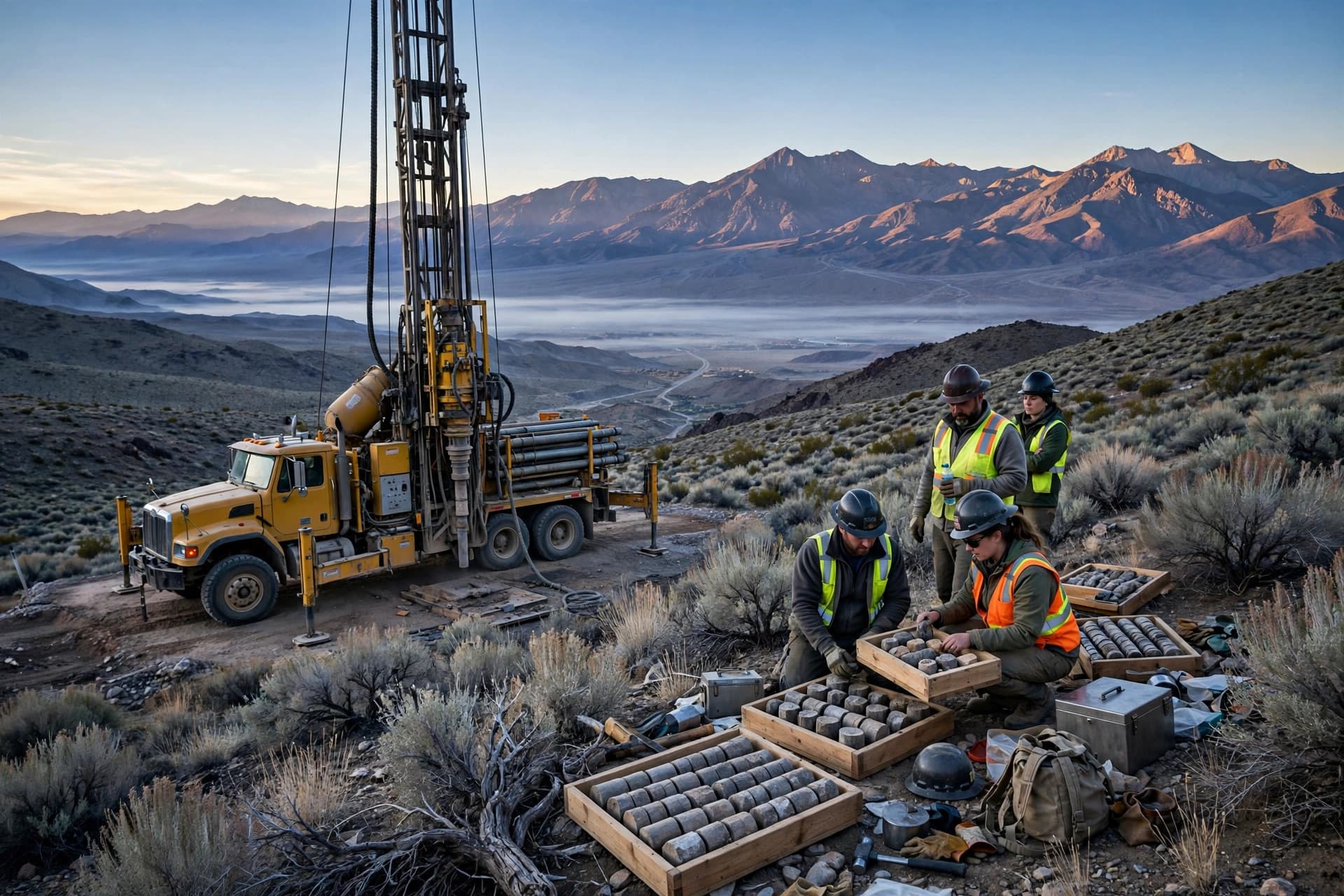
The broad intervals at Lapon Canyon keep coming. Walker River Resources reported on October 22 additional assay results from its 2026 reverse circulation drilling at the Lapon Canyon area of the Lapon Gold Project, about 60 kilometres southeast of Yerington, Nevada, in the Walker Lane structural corridor — a batch led by two near-50-metre intervals grading above 2 g/t gold.
- LC-26-175: 2.07 g/t gold over 47.25 metres from 80.77 metres, including 3.07 g/t over 30.48 metres.
- LC-26-179: 2.02 g/t gold over 48.77 metres from 24.38 metres, including 6.61 g/t over 7.62 metres, plus a separate 0.55 g/t over 27.43 metres from 103.63 metres.
- LC-26-183: 3.63 g/t gold over 12.19 metres from 74.68 metres. LC-26-186: 1.29 g/t over 38.10 metres from 24.38 metres, including 2.62 g/t over 9.14 metres.
- Supporting holes: LC-26-180 returned 1.06 g/t over 27.43 metres; LC-26-182 returned 1.27 g/t over 16.76 metres; LC-26-185 returned 1.39 g/t over 10.67 metres.
- Where it goes next: results from this and earlier programs will be the basis for an initial NI 43-101 mineral resource on the project. Nevada Canyon Gold, which is earning into Lapon Canyon under the February 3, 2025 agreement, said in its own October 22 release that the resource estimate is now expected in the first half of 2027, citing assay lab delays among other factors.
A second host rock changes the question
Historically, Lapon Canyon gold was tied to a broad, shallow, iron oxide-altered horizon. The 2026 program has also intersected gold hosted in intrusive rocks, including monzonite — the Nevada Canyon summary describes the new results as continuing to show the continuity and thickness of mineralization hosted in monzonite. Walker River says that raises the possibility that parts of the system relate to a broader intrusive-related, potentially monzonite porphyry-style, setting, with elevated copper values in multi-element sampling as an additional vector. That is an interpretation to be tested by mapping, geochemistry and more drilling — not a conclusion — and the company is also evaluating whether higher-grade intervals sit in structurally controlled zones inside the broader system.
The project covers 147 unpatented claims over about 2,940 acres in the Wassuk Range, including the Pikes Peak ground about 4 kilometres north and the Rattlesnake and Range Front claims about 3 kilometres west. The Lapon Canyon block itself — 96 claims — is subject to a US$5 million exploration stream earn-in agreement with Nevada Canyon Gold Corp.
The honesty box
Reported intervals are sampled lengths; true widths have not been established and may differ, per the release's own table note. Not every hole delivered: LC-26-174 was lost before reaching its target (it cut 0.39 g/t over 15.24 metres above the target zone), LC-26-178 was abandoned, LC-26-184 returned no significant gold values, and LC-26-186 was terminated at 64.01 metres by ground conditions while still in its reported mineralized interval — so that interval is open at its end, and incomplete. One quality-control standard failure in LC-26-183 was reanalysed by the lab with satisfactory repeats, per the release. There is no mineral resource yet at Lapon — only drill results feeding a future initial estimate — and a historical 20.6 oz/ton sample from the A Adit cited from a 2004 technical report is a historical result, not a current resource figure.
What to watch
Further assay releases from the 2026 program, the soil geochemistry and airborne geophysical integration across Lapon Canyon, Pikes Peak and Rattlesnake, and delivery of the initial resource — guided by Nevada Canyon to the first half of 2027.