
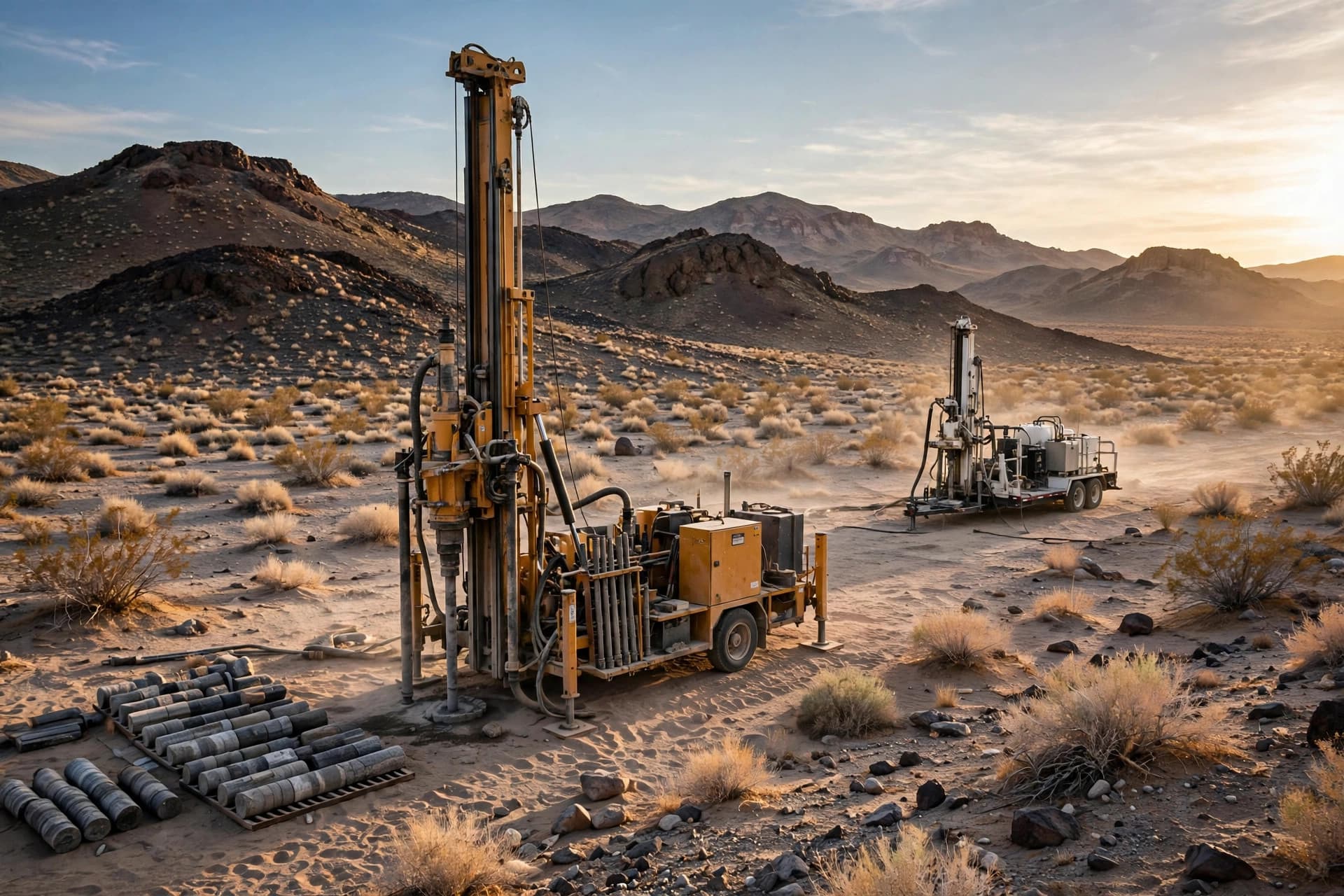
Most Nevada juniors are doing one thing at a time. Viva Gold's November 4 update is a study, a drill program and a permitting file moving in parallel — the combination that separates a developer from an explorer, in its own CEO's framing, at the Tonopah Gold Project on the Walker Lane, about a 30-minute drive south of Kinross Gold's Round Mountain Mine.
- The PFS: on schedule for completion in late Q4 2026. Mine design is substantially complete and detailed costing is under way, after a plant-sizing trade-off study based on a larger resource estimate incorporating 2026 drilling. The study design is a 3,000-tonne-per-day gravity/CIL mill for higher-grade mineralization plus a 7,000-tonne-per-day heap leach for lower-grade material.
- Midway Hills drilling: a 1,000-metre core program is under way at the discovery announced in July 2026, approximately 1.4 kilometres northwest of the main pit area. The first hole re-drills from the collar of discovery hole TG2617 (35.1 metres at 1.62 g/t gold and 16.7 g/t silver, plus 21.4 metres at 0.32 g/t gold) at minus 75 degrees to the northwest; at approximately 250 metres depth it has intersected the Ordovician Palmetto Argillite about 65 metres northwest of TG2617. Completion is expected next week, then logging, sampling and assay — no new assays are reported in this release.
- An early metallurgical signal: multi-element and cyanide-soluble assays from holes TG2616–TG2618 indicate Midway Hills mineralization carries higher cyanide-soluble-to-total gold and silver ratios and lower silica than the main Tonopah deposit — early indicators the company calls positive for recovery, to be confirmed by metallurgical test work.
- The water work: a second rig is drilling the first of four downstream groundwater monitoring wells, with a second aquifer pump-test well, two water-level boreholes and an upstream monitoring well to follow — feeding the numerical groundwater model the NEPA environmental review will require.
- The rest of the baseline file: an archaeological team is mobilizing for a Class III survey of unsurveyed or stale-survey ground, and the 2026 golden eagle and raptor survey report and completed geochemistry studies have been submitted to the BLM.
The sequence Viva is trying to hold
The stated plan is to carry Tonopah through the PFS and the baseline studies into a Mine Plan of Operations submitted to the BLM — the document that formally starts mine permitting. President and CEO James Hesketh: "We are well funded and moving quickly to carry Tonopah through the PFS and baseline studies and complete a Mine Plan of Operations, which will be submitted to the BLM to begin the mine permitting process. Moving Tonopah into permitting is the most direct path to de-risking the project and building shareholder value… Follow-up drilling at Midway Hills adds a second avenue for growth alongside that work."
The project already carries a 2025 preliminary economic assessment demonstrating, in the company's assessment, the potential for an economically viable open-pit heap leach/mill operation — a PEA is the lowest-confidence class of economic study, and the PFS now in progress is the step that supersedes it.
The honesty box
There are no new drill assays in this release: the Midway Hills hole is at 250 metres with completion and assays still ahead, and the alteration described in the overlying volcanic unit — iron oxide, silicification, quartz veining — is a visual observation the company itself states is not a substitute for laboratory assays. The PFS is not yet published, so its economics, reserves and mine life are not yet public facts; the mill-plus-heap-leach configuration is the study's design basis, which the finished study could revise. "Well funded" is the company's characterization; no cash figure is given in this release. Baseline submission to the BLM is the start of permitting, not a permit.
What to watch
The PFS itself in late Q4 — the first compliant look at Tonopah's economics at the larger resource size; Midway Hills assays once the 1,000 metres are logged and sampled; and filing of the Mine Plan of Operations, the step that converts baseline work into a formal BLM permitting clock.