
Company Chronicles. Every company has a story. This is StrikePoint Gold's.
- 1866 — the year silver was found in the Northumberland district, in the Toquima Range of what is now Nye County
- 230,730 ounces — of gold produced from this ground between 1939 and 1991, from 6.7 million tonnes at about 1.06 g/t — history, not inventory
- 1,548 — drill holes in the database (1,511 reverse-circulation and 37 core), every one of them drilled by somebody else: Cyprus, Western States, Newmont, Fronteer
- 2.86 million ounces — gold equivalent in the indicated resource: 67.0 million tonnes at 1.33 g/t AuEq, including 2.71 million ounces of gold and 11.6 million ounces of silver
- 1.57 million ounces — gold equivalent in the inferred resource, in a further 31.0 million tonnes at 1.58 g/t AuEq
- US$70 million — the cash StrikePoint paid Newmont at closing, on October 6, 2026
- C$190 million — the bought deal financing, led by Canaccord Genuity, that paid for the acquisition
- About C$90 million — the working capital left in the treasury after closing and related costs
- 15,000 metres — the first-phase drill program, under way since October 28, 2026
- 0 — mineral reserves. There are none, and nothing in this Chronicle should be read as saying otherwise
The Captains
The treasure hunter here is the company — StrikePoint Gold Inc. (TSX-V: SKP; OTCQB: STKXF), a Vancouver-based explorer that calls itself a multi-asset gold exploration company focused on acquiring, defining and developing precious metals projects in the Western United States. Until this autumn its map held two early-stage Nevada hunts, Hercules and Cuprite, and its treasury was a junior's treasury. In October 2026 it became something else: the owner of a past-producing, multi-million-ounce gold deposit bought outright from the largest gold mining company on earth, with the money already in the bank to drill it.
The current captain is Michael G. Allen, president, chief executive officer and a director since November 1, 2022. Allen is not a promoter dressed in a geologist's vocabulary; he is a professional geologist, and he is the company's own qualified person under NI 43-101 — the man who personally reviews and approves StrikePoint's technical disclosure. His record is a Nevada record. As president and chief executive of Northern Empire Resources, he identified, acquired and advanced the Sterling project in the Beatty district of southwestern Nevada, guiding that company from roughly a C$15 million market capitalization to its acquisition by Coeur Mining for approximately C$120 million, at the stock's all-time high; Sterling has since passed on to AngloGold Ashanti, folded into the Arthur Gold consolidation. He was later president of Elevation Gold Mining, then the operator of Arizona's largest precious metals mine. The company's own count gives him fifteen years of work in the Walker Lane. Men who have sold one Nevada gold project to a major at the top of its chart tend to know what a major's shelf looks like from the inside — which is, in the end, where Northumberland came from.
Around the captain, the closing rebuilt the bridge. Alan Pangbourne, appointed chairman as the deal completed, brings more than thirty-five years in global mining operations, including a term as chief operating officer of SSR Mining; he sits on the board of OceanaGold. Shawn Khunkhun, executive director, is the capital-markets hand — two decades of financings and transactions, and a former chief executive of Dolly Varden Silver. The bought deal's register tells its own story about who underwrote the bet: Tembo Capital at 19.9 percent of the company, Itahki at 13.7, BlackRock Advisors at 10.2. In October the company hired Keith Wood as exploration manager and took Stephen Quin on as a strategic advisor; on November 16, the day before this Chronicle was published, it added Scott Hicks — a veteran of the Lumina Group companies and of the RBC and BMO mining banking teams — as vice president of corporate development. Captains change, chairmen arrive, vice presidents get hired. The ground does not change. The ground is the story.
The Ground
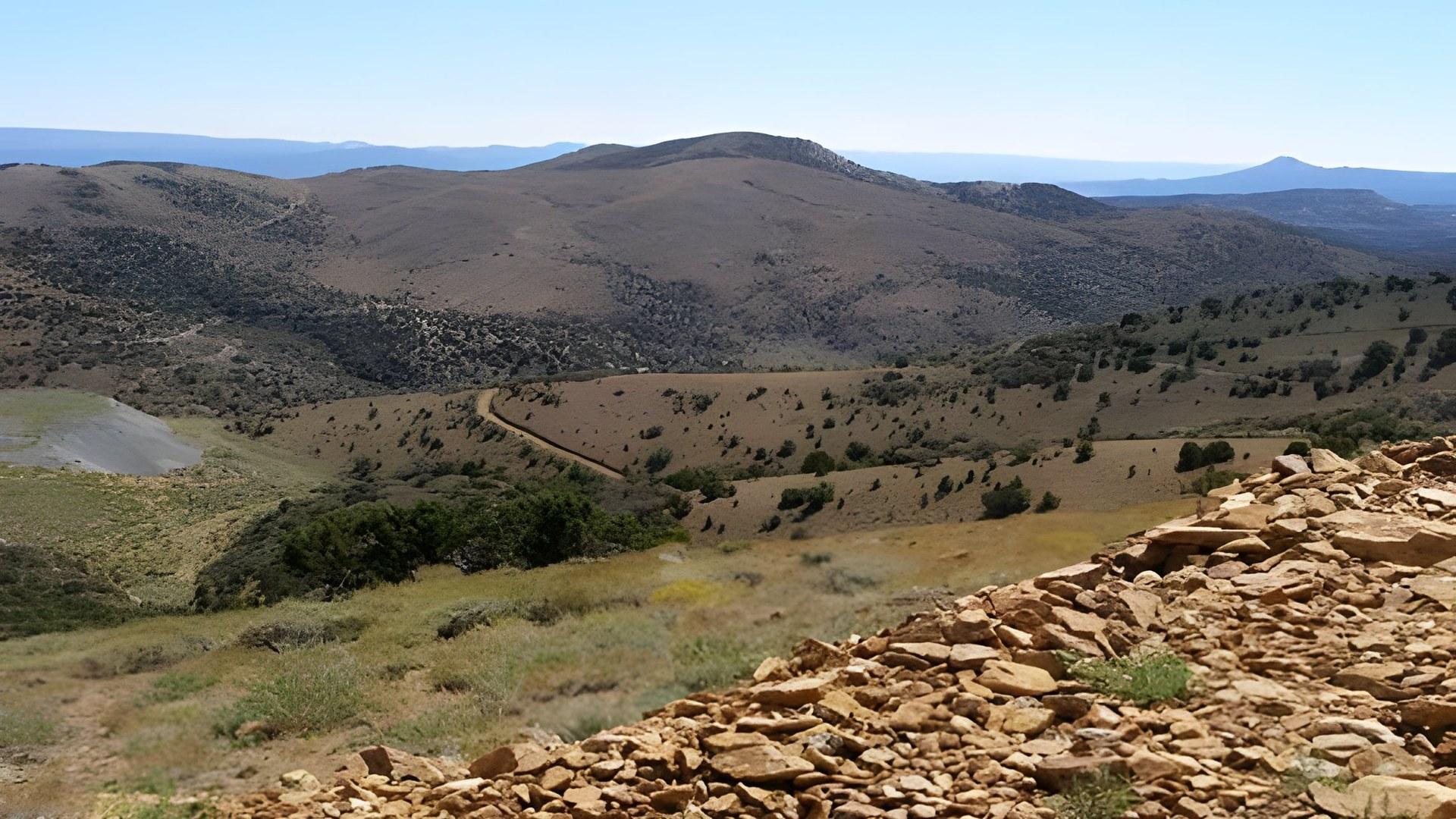
Northumberland sits in the Toquima Range of northern Nye County, in the same precious-metals belt as the Round Mountain, Manhattan and Tonopah districts — about 150 kilometres by road from Tonopah, with Kinross's Round Mountain mine, one of Nevada's great open pits, roughly 60 kilometres to the south. The land package runs to 12,035 hectares — 29,739 acres of patented, unpatented and leased claims — and the deposit itself lies largely on private land that hosted open-pit mining before, which the company reasonably expects to simplify the permitting road. Access is by State Route 376 and a maintained gravel road, year-round; power runs along the property's western flank; water rights are secured. The ground stands between 2,350 and 2,795 metres above sea level — high, cold, dry basin-and-range country, and empty in the way that makes Nevada the easiest place in America to run a drill.
The gold is Carlin-type: sediment-hosted, in Paleozoic rocks — principally the Hanson Creek and Roberts Mountains formations — stacked into structural panels by low-angle thrust faults and cut by Jurassic intrusions. Low-angle horizons channelled the hydrothermal fluids; the result is stratiform, stacked bodies carrying silicification, decalcification and argillic alteration, gold held with sulphides in fresh rock and left behind as residual gold in the oxidized zones above. It is the same family of mineralization as the great deposits of northeastern Nevada, transplanted to the state's centre. And the old drilling says the system has grade as well as size: among the 2005–2007 intercepts in the database are 4.05 g/t gold over 88.39 metres in hole NN-56, 7.75 g/t over 30.48 metres in NN-63, and 9.77 g/t over 12.19 metres in the oxide hole NUN-74 — historical results from previous operators, printed here as the property's record, which is what they are.
What remains open is most of it. The initial resource — 2.86 million ounces gold equivalent indicated and 1.57 million inferred, estimated by SLR Consulting and effective July 31, 2026 — is the floor the previous owners built and then stopped building on. The company's target list runs from the near to the far: an untested lower horizon at Rockwell, the unevaluated eastern limb of the anticline, down-dip extensions, poorly sampled upper zones, and beyond the pits the Caldera area, the Vinini target on displaced Roberts Mountains stratigraphy, and the White Canyon fault zone, which carries the strongest surface gold and silver soil anomalies outside the drilled ground. Five drill permits were already in place when StrikePoint arrived.
A Century and a Half of Digging
The documented record at Northumberland begins in 1866, when silver mineralization was found in the Toquima Range and worked, in a limited way, underground — a frontier silver camp of the Nevada rush years, in the decades when Tonopah and Goldfield, further south in the same Walker Lane belt, would turn Nevada gold and silver into legend and Round Mountain would begin its own long producing life. The gold chapter opened in the late 1930s: between 1939 and 1942 the NMC operation mined oxide gold at remarkable grade — about 45,000 ounces from 200,000 tonnes, 6.34 g/t — before operations ceased in 1942, the year the United States ordered its gold mines closed as non-essential to the war effort.
The modern era came in two campaigns. Cyprus arrived in 1981, defined the Main and Chipmunk deposits, and ran open-pit and heap-leach operations through 1984, producing 92,000 ounces of gold. Western States Minerals Corporation followed from 1985, mining through 1991 — 93,730 ounces — and finding the Zanzibar, Rockwell and Pad 4 deposits along the way. The full production table, compiled from company records and summarized in the 2026 technical report, reads 6,707,000 tonnes mined between 1939 and 1991 for 230,730 ounces of gold at an average of 1.06 g/t, with 485,762 ounces of silver beside it — and the table's own footnote concedes it is incomplete, excluding the pre-1939 silver production entirely.
Then the majors took their turn, and the tempo changed. Interests passed to Nevada Western Gold, a subsidiary of New West Gold, in 2005; Fronteer Gold acquired that interest in 2007; and in 2011 Newmont acquired Fronteer itself, Northumberland included. Across 2003 to 2011 the Newmont joint venture and Fronteer drilled 169 holes, ran metallurgical testwork and started a decline at Zanzibar — real work, the work of companies testing whether the deposit deserved a place in a major's pipeline. The verdict, delivered by silence, was that it did not — or not yet, or not at the gold price of the day. The decline stopped. The drills left. And the deposit went onto the longest shelf in the industry: the portfolio of the world's largest gold miner, where a four-million-ounce Carlin-type system in Nevada could wait fifteen years without once being missed.
The Long Quiet
From about 2010 to the autumn of 2026, nothing turned at Northumberland. The company's closing release states the plain fact without embroidery: the project "has not been explored since approximately 2010, when the gold price was much lower." That last clause is the whole economics of this story in nine words. The resource SLR estimated in 2026 is calculated at a long-term gold price of US$3,500 an ounce — the company's assumption, printed in its own report. A deposit grading 1.3 grams per tonne, much of it sulphide, some of it stubborn, is one kind of asset at one gold price and a very different asset at another. The ground did not change between 2010 and 2026. The price did, the majors' priorities did, and a junior with a geologist-captain who had spent fifteen years in the same belt was watching the shelf.
There is a pattern in Nevada mining that the old hands recite like a catechism: the majors find more gold than they can ever mine, and the juniors' living is made in the majors' leavings. Northumberland is the pattern at full scale — discovered by prospectors, proved by mid-tiers, shelved by the biggest miner alive, and finally carried out the door by a company whose entire market capitalization, before the deal, would not have bought the decline Newmont started and abandoned at Zanzibar.
The Deal
The agreement was announced August 18, 2026: StrikePoint, through its subsidiary Nu Gold LLC, would buy the claims, fee lands, licences, permits and equipment comprising Northumberland from Newmont USA Limited and Fronteer Development LLC, each a subsidiary of Newmont Corporation. The money was raised the way transformational junior deals are raised when the market believes them — all at once. A bought deal of subscription receipts, led by Canaccord Genuity as sole underwriter, was upsized within days of announcement and closed September 9 at C$190 million gross: 95,000,000 subscription receipts at C$2.00 each, the underwriter's option exercised in full. A ten-for-one share consolidation took effect October 2. On October 6, 2026, the transaction closed and StrikePoint paid the upfront cash consideration of US$70 million. Trading resumed October 8, and the company emerged with approximately C$90 million of working capital after closing and related costs — against a use-of-proceeds table that allocates C$89 million to drilling and corporate purposes. Two contingent payments remain ahead, each of US$25 million, structured to fall due only after significant re-rating points: the first within 120 days after completion of a feasibility study, the second within 120 days after achievement of certain commercial production milestones.
Allen's framing at the closing was the captain's own: "We are pleased to finalize the acquisition of Northumberland — a transformational acquisition for StrikePoint. We anticipate commencing drilling within a month at the project with the goals of expanding and infilling the existing resource." He kept the timetable. The commencement release came October 29: NISS Global had mobilized a core rig, and drilling — the first on the property in some fifteen years — had begun the day before. The first phase is planned at approximately 15,000 metres: infill drilling to upgrade confidence in the resource, expansion drilling on a system the company notes remains open in a number of directions, and metallurgical sampling across the deposit, all of it on private property and fully permitted, with additional rigs expected early in the New Year. Allen again: "The infill drilling is intended to upgrade our confidence in the current mineral resource estimate, which remains open to expansion in a number of directions, and provide new samples for metallurgical optimization."
The Second and Third Fronts
Northumberland is the flagship now, but it is not the whole map, and the other two properties explain how StrikePoint got here. The Hercules Gold Project — 10,368 hectares in the Pine Nut Range of Lyon County, in the northeastern Como Mining District, forty kilometres southeast of Reno and twenty kilometres east of the Comstock Lode — was acquired on August 30, 2024. The Como district was prospected in the 1850s and 1860s and then largely abandoned in the Comstock's shadow; the Hercules Mining Company developed underground workings in the late 1880s; and between 1968 and 2022 more than fifteen companies, Amax, Phelps Dodge, AngloGold and Teck among them, mapped, sampled and drilled the property — 396 historical holes in all. StrikePoint has added 36 reverse-circulation holes of its own, 5,353.6 metres, and in February 2026 it consolidated the southern ground by acquiring the Como Claims — fifty-one unpatented claims — from Fronteer Development, a Newmont subsidiary. Northumberland, in other words, was the second time this company bought ground Newmont was shedding.
The spring 2026 program at Hercules — twenty-nine holes — was aimed at the Cliffs target, and it delivered the broad, near-surface oxide intercepts the project is built on: hole H26004 cut 114.30 metres grading 0.69 g/t gold and 5.03 g/t silver, including 9.14 metres of 2.95 g/t gold; the final batch, reported July 21, was led by H26005 with 67.06 metres grading 0.53 g/t gold and 11.69 g/t silver around a high-grade core of 7.62 metres at 2.93 g/t gold and 54.48 g/t silver. The 2026 technical report by APEX Geoscience frames a conceptual exploration target of 39.8 to 68.7 million tonnes grading 0.46 to 0.61 g/t gold — a target, not a resource, a distinction this Chronicle will insist on again below — and its recommended two-phase program contemplates, in the second phase, evaluating the potential for an initial mineral resource estimate.

The third front is Cuprite, twenty kilometres south of Goldfield in Esmeralda and Nye counties: 2,892 hectares in 376 unpatented claims over a district-scale epithermal alteration system — a steam-heated advanced-argillic cap some five kilometres by two, of the kind that sits above the boiling zones where low-sulphidation gold-silver deposits form. StrikePoint acquired it from Orogen Royalties, which retains a 3 percent net smelter royalty, and drilled five reverse-circulation holes in 2024 — 3,069 metres, all reaching basement, four returning anomalous gold and silver at depths of 270 to 570 metres. The company itself files Cuprite as early-stage and non-core, with no current exploration program. It is an option on a concept, held cheaply, and the company says so. That candour is worth more than the claims.
The Open Door
What happens next is mostly drilling. The Phase 1 program at Northumberland runs through the winter on the permits already in hand, with more rigs expected early in 2027; every hole is planned to do several jobs at once — resource confirmation and upgrading, metallurgical sampling for a geometallurgical model, geotechnical data, and expansion. The company's stated path runs to an updated technical report in early 2028, with funds expected to be sufficient for a potential pre-feasibility study in 2028 or 2029. At Hercules, the technical report's recommended first phase is about US$770,000 of work, including some 1,750 metres of drilling and step-outs south of Cliffs.
Now the other side of the ledger, because a Chronicle keeps one. Northumberland has a mineral resource and no mineral reserve — none. A resource is a geological statement, not an economic one; no feasibility study exists, and the road from a 2026 resource estimate to a producing mine runs through years of drilling, metallurgy, engineering and permitting that have not happened. The metallurgy is the hard page of this file: much of the sulphide resource is preg-robbing — the carbonaceous rock re-adsorbs dissolved gold during leaching — and the resource estimate's own recovery assumptions fall as low as 60 percent for gold in the high preg-robbing fresh material. No significant metallurgical work has been done on the deposit in over fifteen years, and the processing route — pressure oxidation, ultra-fine grind, Albion processing, whole rock against concentrate — is undecided. The estimate itself rests on a long-term gold price of US$3,500 an ounce, the company's assumption; at materially lower prices, the optimized pit shell that constrains the resource shrinks with it. Success, if it comes, also sends bills: the two contingent payments to Newmont total US$50 million, payable on the feasibility and production milestones. And for all the database's 1,548 holes, not one of them is StrikePoint's — every intercept quoted in this Chronicle is a previous operator's work until the company's own first results arrive.
Hercules carries its own caution, and this company has been publicly corrected on it, which is precisely why it belongs in the record. On March 5, 2026, StrikePoint issued a clarifying news release — as a result of a review by the British Columbia Securities Commission — retracting earlier statements about the Hercules exploration target that implied it would convert to a mineral resource. An exploration target is conceptual: there has been insufficient exploration to define a resource, and it is uncertain whether further exploration will delineate one. The company has now said so itself, under regulatory instruction, and this Chronicle repeats the caution in the company's own corrected terms. Cuprite, for its part, has anomalous metal at depth and no known mineralization at current levels of exposure; the company calls it non-core and spends accordingly.
What is true today is narrower, and it is not nothing. A Vancouver junior with a geologist for a captain and roughly C$90 million in the bank owns one hundred percent of a drilled, past-producing, multi-million-ounce Carlin-type gold deposit on private land in the middle of Nevada — bought from the world's largest gold miner, at a moment when that miner had larger things to do, for cash it raised in a single bought deal the market oversubscribed. Three weeks after closing, its drills were turning for the first time in fifteen years. What Cyprus, Western States, Newmont and Fronteer found is in the books. What they left is the hunt.
A Reader's Note on the Record
This Chronicle is built on StrikePoint's own news releases — the Northumberland acquisition releases of August through October 2026, the October 29 drilling commencement, the November 16 management appointments and the July 21, 2026 Hercules results — on the company's project and investor pages, which draw on the NI 43-101 technical reports by SLR Consulting (Northumberland, 2026) and APEX Geoscience (Hercules, 2026), and on the company's 2025 management information circular for the captains' biographies. Five wrinkles in that record deserve daylight. First, the resource estimate's effective date: StrikePoint's releases and the SLR technical report give July 31, 2026, while the company's Northumberland web page carries July 10, 2026 in its resource header and notes. This article uses July 31, the date in the report and the releases. Second, the last exploration campaign: the releases say the project was not explored after approximately 2010, the project page says it was last explored in 2011, and the page's own history dates the Newmont–Fronteer campaign 2003 to 2011; this article says the last work ended around 2010–11. Third, one drill grade: Michael Allen is quoted in the July 21, 2026 release citing hole H26004 at 0.63 g/t gold over its 114.30 metres, where the company's project table gives 0.69 g/t gold for the same interval; this article uses the table. Fourth, the Hercules exploration target has been stated two ways — an earlier framing in ounces (819,000 to 1,019,000 ounces at 0.48 to 0.63 g/t) and the updated 2026 technical report's tonnage-and-grade ranges (39.8 to 68.7 million tonnes at 0.46 to 0.61 g/t), the earlier language having drawn the March 2026 clarifying release; this article uses the updated ranges and treats the target as conceptual throughout. Fifth — and this one corrects the brief this Chronicle was itself researched from — the Porter Idaho property is not, and never was, in Idaho's Silver Valley. It is a historic high-grade silver property near Stewart, in British Columbia's Golden Triangle, which StrikePoint acquired from Skeena Resources in 2019 and sold to Dolly Varden Silver in May 2025 for $1.1 million, satisfied in Dolly Varden shares. StrikePoint holds no Idaho ground at all. Its whole map — Northumberland, Hercules, Cuprite — is Nevada, and this Chronicle is written on that corrected record.
One hundred and sixty years ago, prospectors found silver in the Toquima Range and started a file that Cyprus, Western States, Newmont and Fronteer each added to and none of them finished. The deposit outlasted every owner it ever had. StrikePoint Gold is the smallest company ever to hold it — and, as of October 28, 2026, the first in fifteen years to drill it.