
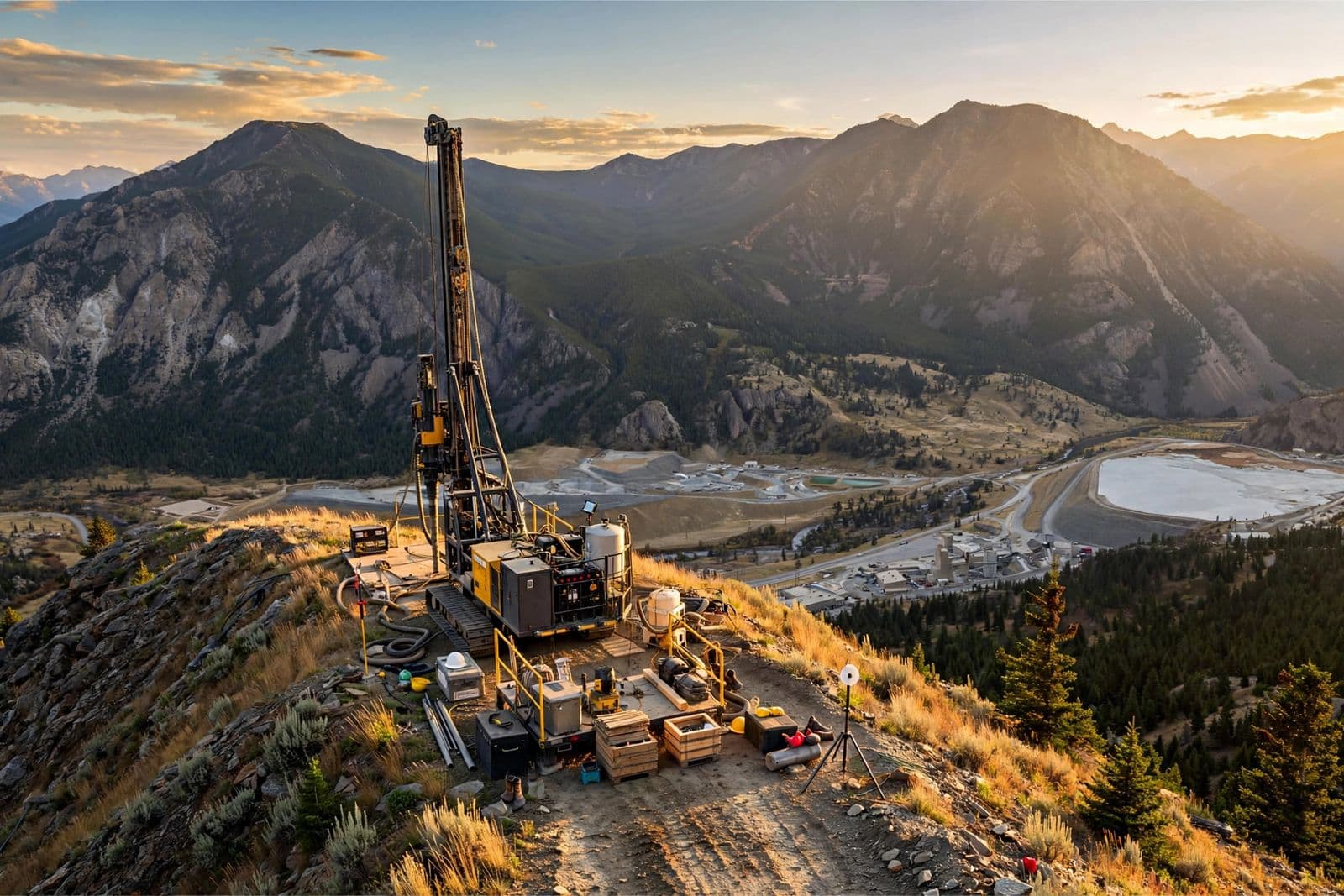
Company Chronicles. Every company has a story. This is Stillwater Critical Minerals'.
There is one mountain complex in America that produces platinum and palladium. In southern Montana, the Stillwater Igneous Complex — one of the three largest layered intrusions of its kind on Earth — hosts the J-M Reef, mined since 1986 and still, in the company's own words, the only primary platinum-group element producing complex in the United States. The reef got the fame. The base of the complex got Stillwater Critical Minerals.
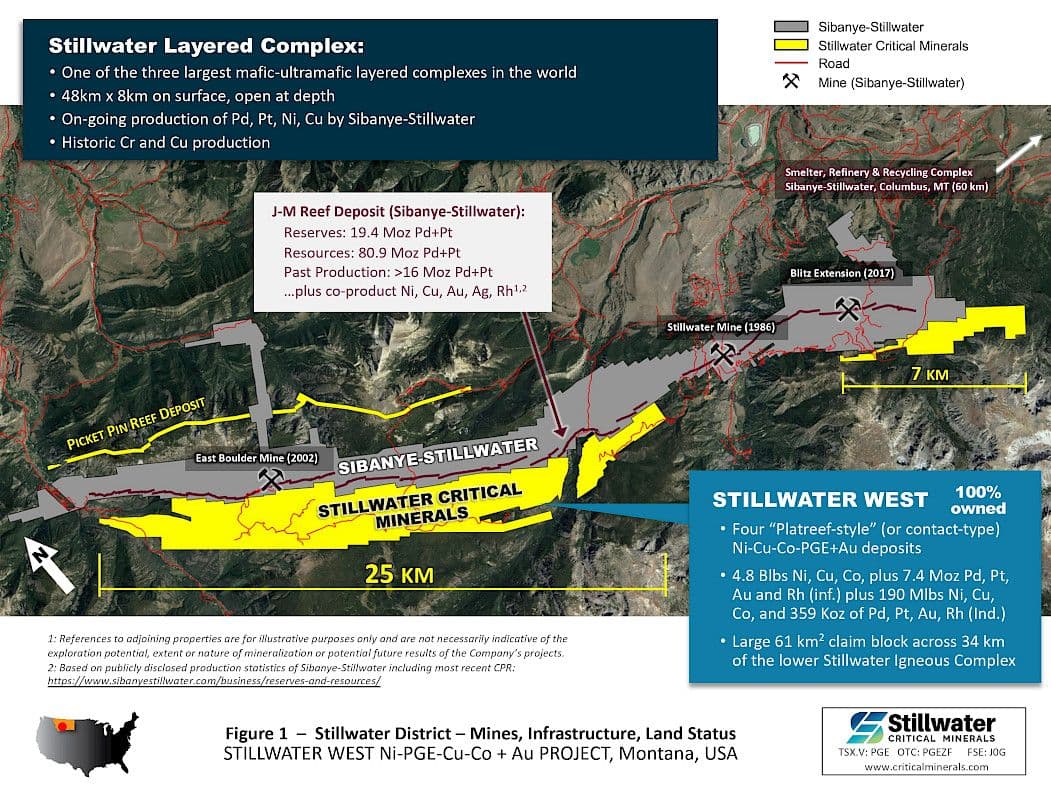
Layered intrusions keep a second system at their floor: where the magma met the rocks beneath it, sulphides gathered — nickel, copper, cobalt, gold and the full suite of platinum-group metals, the style of mineralization the industry calls Platreef-type, after the giant South African deposit of that name. Stillwater Critical Minerals spent two decades assembling that basal system at Stillwater West: a 61-square-kilometre claim block across 34 kilometres of the lower complex, held 100%, directly beside Sibanye-Stillwater's operating Stillwater and East Boulder mines. In August 2026, the measured size of the treasure more than doubled.
The Captains
President and CEO Michael Rowley co-founded the company in 2006 and has run it as president, CEO and director since 2017, bringing more than thirty years across exploration, development, mineral testing and mine environmental work. His long game was land: assemble the district-scale basal position while the complex was known almost only for its reef.
The field captain is Dr. Danie Grobler, vice president of exploration. Grobler arrived in May 2022 from Ivanplats, the Ivanhoe Mines subsidiary where he had led the delineation and advancement of Platreef itself — the world-class PGE-nickel-copper mine on the northern limb of South Africa's Bushveld Complex. Stillwater West is the same deposit style on a different continent, and the 2026 resource estimate reunited him with the team that modelled Platreef: independent consultants Mine Technical Services, where qualified person Timothy Kuhl worked alongside Grobler and the late Dr. Harry Parker on the Platreef resource estimates before founding MTS. Around them sit executive chairman Greg Johnson and chief financial officer Rebecca Moriarty, with geologist Mike Ostenson, P.Geo., as the company's qualified person in Montana.
The Ground: One Complex, Two Systems
The Stillwater Complex measures some 48 kilometres by 8 kilometres at surface, with a mining history that runs from early nickel, copper and chromium production to the modern reef mines. Sibanye-Stillwater's Stillwater Mine (1986) and East Boulder Mine (2002) work the J-M Reef along the complex's northern side; its smelter, refinery and recycling complex sits at Columbus, about 60 kilometres away. It is the only primary PGE-producing complex in the country, and every tonne of it is a neighbour's.
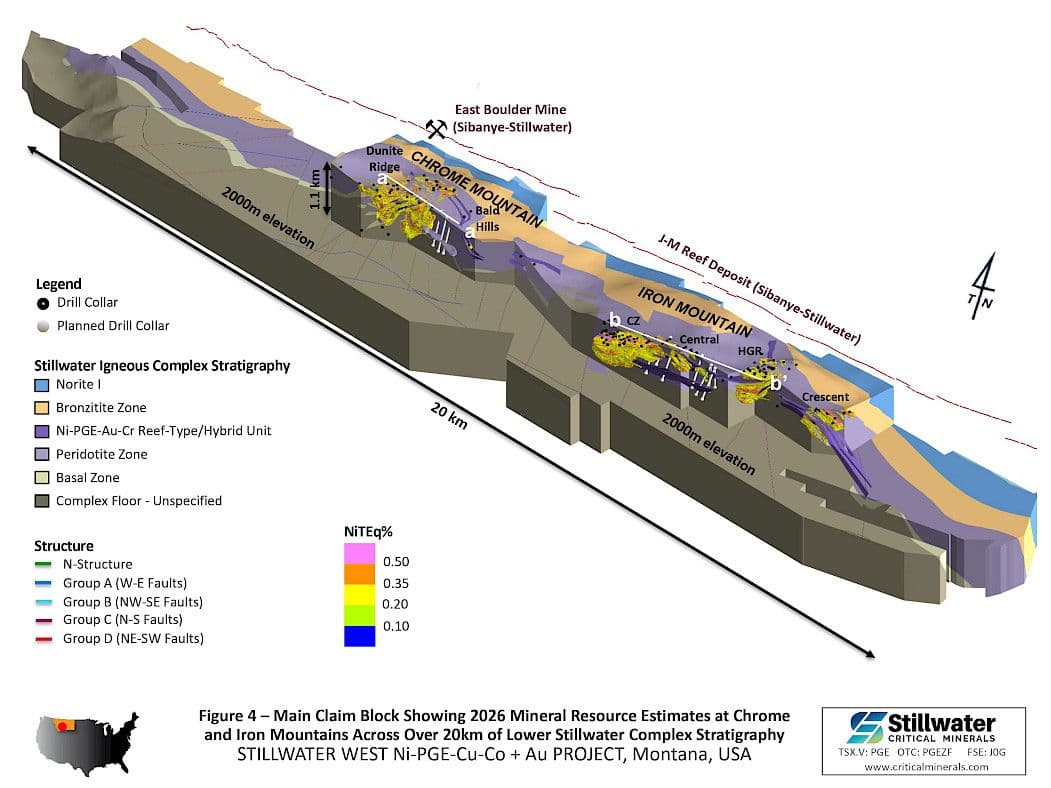
Stillwater West is the other system: the basal, contact-style sulphide mineralization of the lower complex, carrying eleven metals in the company's count — nickel, copper, cobalt, chromium, platinum, palladium, rhodium, ruthenium, iridium, osmium and gold — ten of which appear on the United States critical minerals list. The 2026 estimate models four zones across the central ten kilometres: Chrome Mountain, and the CZ, Central, HGR and Crescent deposits together at Iron Mountain, all of it starting at surface.
The Treasure, Measured Twice
The first measurement came on January 25, 2023: an inferred-only estimate by SGS covering five deposits over the central 9.5 kilometres, holding — as the company restates it — 1.64 billion pounds of nickel, copper and cobalt and 3.81 million ounces of palladium, platinum, rhodium and gold at a 0.20% nickel-equivalent cut-off. Sound, and early: no indicated material, and a chromium and rhodium endowment only partly defined.
Two drill campaigns followed — 2,310 metres in 2023 and 3,471 metres in eight holes in 2025 — alongside verification of the historic drill database. On August 27, 2026, Mine Technical Services delivered the second measurement:
- 805.1 million tonnes inferred at 0.34% NiTEq, up more than double on 2023, and
- 29.4 million tonnes indicated at 0.38% NiTEq — the project's first indicated resource —
at a 0.20% NiTEq cut-off in a pit-constrained model. Contained metal: 3.01 billion pounds of nickel, 1.52 billion pounds of copper, 283 million pounds of cobalt, 2.28 million ounces of platinum, 3.97 million ounces of palladium, 864,000 ounces of gold and 310,000 ounces of rhodium — 4.8 billion pounds of battery metals and 7.4 million ounces of precious metals. Add 6.6 billion pounds of chromium inferred, stated separately because no recovery or economic assumptions were applied to it. Inside the bulk tonnage sit higher-grade cores: at a 0.50% NiTEq cut-off, the inferred resource resolves to 83.0 million tonnes at 0.71%. The supporting NI 43-101 technical report was filed on October 19, 2026.
"This updated Mineral Resource estimate marks an important step forward for Stillwater West… reinforcing our belief that Stillwater West ranks among North America's most significant undeveloped polymetallic critical mineral projects." — Michael Rowley, President & CEO, August 27, 2026
The company positions the result at the top of the domestic table: the largest known rhodium deposit in North America, the largest nickel and cobalt deposit in an active U.S. mining district, and one of the largest nickel-PGE resources in the United States. Those are the company's claims for its ground; the tonnes and contained metal above are the filed estimate underneath them.
The Drilling Behind It
The 2025 campaign is what moved the model. At the CZ deposit on Iron Mountain, hole CZ2025-01 cut 201.6 metres at 0.20% NiEq from 16.9 metres downhole, including 53.3 metres at 0.37%, 29.0 metres at 0.44% and a 4.0-metre core at 0.76%; CZ2025-02 returned 106.1 metres at 0.34% NiEq from 12.2 metres, including 30.5 metres at 0.51%. At Chrome Mountain and the HGR deposit, drilling returned 40.8 metres at 0.44% NiEq carrying 1.03 g/t of platinum, palladium and gold combined, and higher-grade intervals of 4.3 metres at 1.36% NiEq, including 3.0 metres at 3.71 g/t of the three precious metals. Rhodium — rarely assayed for, and priced like it — showed up across the system, to 0.167 g/t Rh over 1.22 metres in the 2025 core, with historic rock samples at HGR running to 5.78 g/t.
The 2026 campaign, which the company describes as funded and permitted, is aimed at the two obvious growth vectors: extending Chrome Mountain, and joining the CZ-Central deposits to HGR at Iron Mountain into a single continuous system.
The Backing: Glencore, and Washington
Most juniors hunt alone. Stillwater hunts with a major on the register. Glencore — one of the world's largest natural resource companies — has invested three times, most recently in the C$8.78 million placement that closed August 13, 2025, the largest financing in the company's history to that date, priced at a 64% premium to its June 2024 round. Glencore holds a 15% strategic equity position, with board representation and a seat on the technical committee reviewing the project. The company has also partnered on US$2.75 million in U.S. Department of Energy grants through Cornell University and Lawrence Berkeley National Laboratory, and raised C$17.0 million in a unit placement that closed December 30, 2025 — the money that funded the run into the 2026 estimate.
The Wider Map
Stillwater West eats first, but it is not the whole company. Stillwater holds a 49% interest in the Drayton-Black Lake gold project in northwestern Ontario, adjacent to NexGold Mining's Goliath Gold Complex and held under an earn-in agreement with Heritage Mining; the Kluane PGE-nickel-copper-cobalt project in the Yukon, on trend with Nickel Creek Platinum's Wellgreen deposit; the Duke Island copper-nickel-PGE property in Alaska; and a back-in right on the past-producing Yankee-Dundee project in British Columbia, sold in 2013. Each is a real asset in a real district. Each, for now, waits its turn behind Montana.
- Listings: TSX.V: PGE · OTCQB: PGEZF · FSE: J0G
- The captains: Michael Rowley, President & CEO (co-founder, 2006) · Dr. Danie Grobler, VP Exploration (ex-Ivanplats — he delineated Platreef) · Greg Johnson, Executive Chairman · Rebecca Moriarty, CFO
- The flagship: Stillwater West Ni-PGE-Cu-Co-Cr + Au, 100%-owned — a 61 km² claim block across 34 km of the lower Stillwater Complex, Montana, directly adjacent to Sibanye-Stillwater's Stillwater and East Boulder mines
- The treasure (Aug 27, 2026, Mine Technical Services): 805.1 Mt inferred at 0.34% NiTEq + 29.4 Mt indicated at 0.38% NiTEq (0.20% cut-off) — 3.01 Blb Ni · 1.52 Blb Cu · 283 Mlb Co · 2.28 Moz Pt · 3.97 Moz Pd · 864 Koz Au · 310 Koz Rh, plus 6.6 Blb Cr inferred outside the equivalent calculation; NI 43-101 report filed October 19, 2026
- The drilling: 2025 campaign of 3,471 m in eight holes fed the new estimate — 201.6 m at 0.20% NiEq at CZ, 40.8 m at 1.03 g/t Pt+Pd+Au at Chrome Mountain; the 2026 campaign targets Chrome Mountain's extension and the CZ-Central to HGR connection at Iron Mountain
- The backing: Glencore — 15% strategic holder with board and technical-committee seats, three investments in; US$2.75M in Department of Energy grant partnerships via Cornell University and Lawrence Berkeley National Laboratory
- The treasury: C$14.9 million working capital at June 30, 2026, following the C$17.0 million placement closed December 30, 2025; 312.4 million shares outstanding
- The wider map: Kluane (Yukon) · Drayton-Black Lake, 49% (Ontario) · Duke Island (Alaska) · Yankee-Dundee back-in (British Columbia)
- December: the company lists AEMA's annual meeting in Sparks, Nevada (December 6–11, 2026) and the Montana Mining Association winter meeting in Billings (December 8–9, 2026) on its late-2026 circuit
Where It Stands
The honest ledger, because the story is strong enough to carry it.
This is a resource, not a reserve, and no economic study exists. The company's own stated next steps are metallurgical testing and mining studies — there is no preliminary economic assessment, no pre-feasibility, no mine plan. Every nickel-equivalent number rests on assumed recoveries — 80% for most metals, 85% for copper — benchmarked from comparable deposits, not yet demonstrated by Stillwater West testwork at scale, and on a price deck that includes US$3,000-per-ounce gold and US$6,500-per-ounce rhodium. The 6.6 billion pounds of chromium carry no recovery or economic assumptions at all.
It is a grade-for-scale trade. At 0.34% NiTEq, the 805 million tonnes work only as a very large, low-cost operation — the kind of build that needs a major's balance sheet or a strategic partner's patience. Glencore's 15% is a seat at the table and a technical committee at the model. It is not a commitment to build anything.
Almost all of the tonnage is inferred — the lowest-confidence category in the reporting code. The first indicated block is genuine de-risking and genuine progress. It is also 29 million tonnes out of 834.
Neighbour is not partner. Sibanye-Stillwater's mines, mill and Columbus smelter complex are the finest infrastructure adjacency a Montana junior could ask for. Adjacency is geography; no tolling, joint-venture or purchase arrangement has been announced.
The treasury funds the hunt, not a build. C$14.9 million of working capital at June 30, 2026 is a healthy junior treasury, and the company's own MD&A states plainly that it "will need to rely on raising capital in the equity markets" for the foreseeable future — with 312 million shares and 56.5 million warrants already outstanding, the dilution arithmetic is part of the file.
What stands, after all of that: a district-scale, Platreef-style system in the only PGE-producing complex in America, assembled claim by claim over twenty years, re-measured in 2026 at more than double its previous size by the geologists who modelled Platreef itself, with a top-tier strategic holding 15% and the drills aimed at joining its two halves. The resource covers ten kilometres of a 34-kilometre position. Most of the mountain is still untested — and the captains hunting it have found this exact kind of treasure before.
---
Treasure Hunter Chronicles · Company News · Stillwater Critical Minerals (TSX.V: PGE) · Stillwater District, Montana. Written from Stillwater Critical Minerals' own releases and filings, linked above. Not investment advice.