
Company Chronicles. Every company has a story. This is Kuya Silver's.
The Captain
Kuya Silver was founded in 2017 for a single stated purpose: to acquire the Bethania silver mine in Peru — one mine, in one of the great silver districts on earth, that had already produced and could produce again. Most junior miners are built on a dream and a financing. Kuya was built backwards: the producing mine first, the dreams second, and everything since has followed that order.
The captain of this hunt is the company's founder, David Stein — a geologist who became one of the market's own, then walked back out into the field with an investor's eye and a quarter-century of other people's mistakes to learn from. Stein trained at Queen's University — a bachelor's in geological engineering with first-class honours in 1998, a master's in economic geology in 2001 — and then did something most rock people don't: he went to Bay Street and stayed there. He spent the 2000s as a mining equities analyst at Cormark Securities, rising to Executive Director, valuing silver companies for a living. From the sell side he moved to running money as president and chief executive of Aberdeen International, an investment firm with mining at its core. Somewhere in those twenty-five years — analyst, executive, investor — Stein formed the opinion that became Kuya's blueprint: the best seat in the mining business is not grading the hunt. It is owning the mine that pays for one.
What that single decision built is now a three-country company. In Peru, Bethania is mining and selling silver-rich concentrate today. In Ontario, Kuya holds 13,000 hectares of the Cobalt camp — the richest silver district in Canadian history — and has already drilled the kind of intercept, 15,372 grams of silver per tonne, that camps are remembered for. And in Saudi Arabia, a joint venture at Umm Hadid is drilling toward a first resource on ground where 2026 holes have cut silver measured in the thousands of grams.
The architecture is the story. One of these assets is a sure thing — a permitted, producing mine with revenue on the books. The others are blue sky. And the sure thing is what makes the blue sky affordable. This is the story of the mine that pays, and the dreams it is underwriting.
Bethania, the Engine
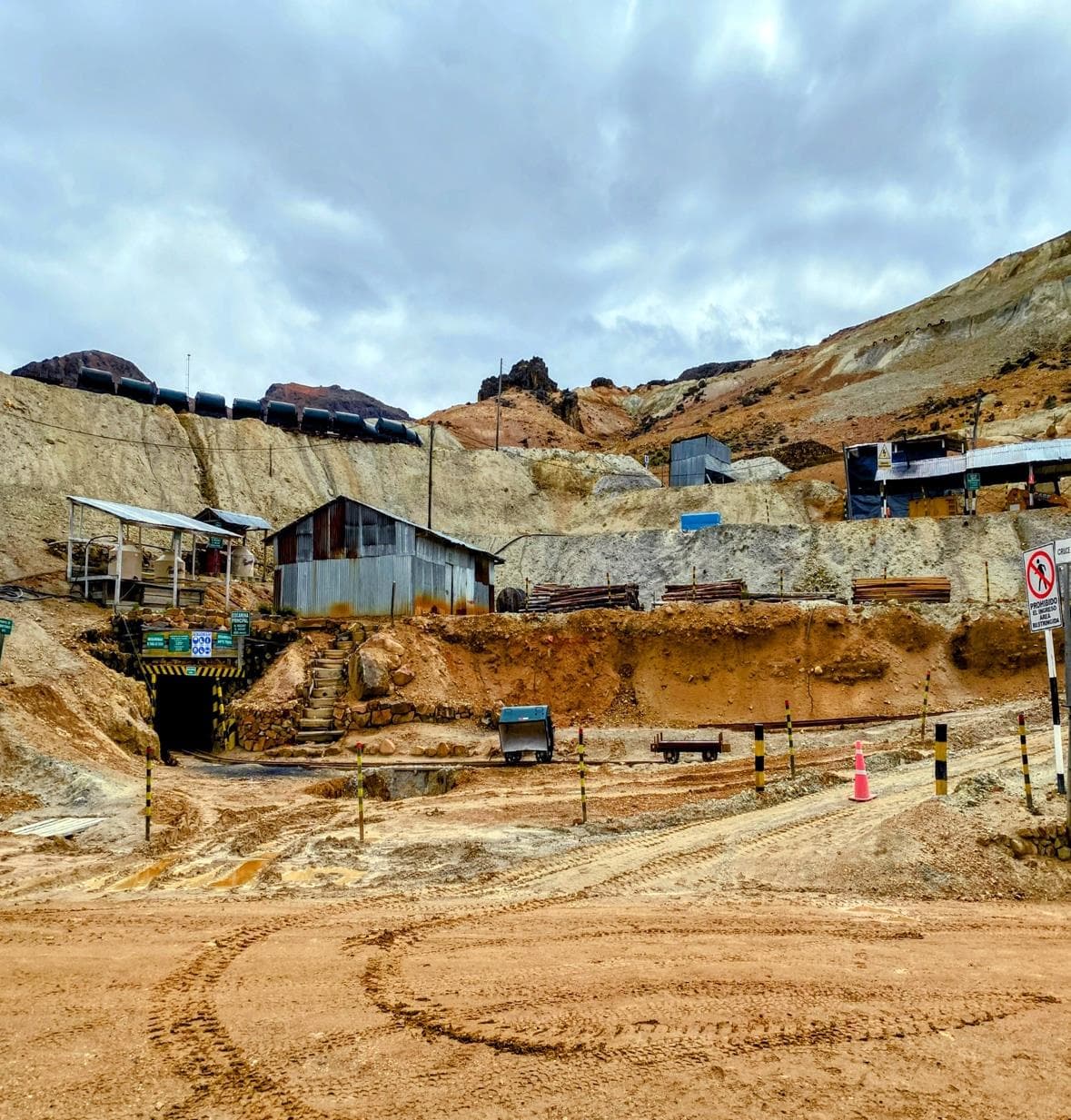
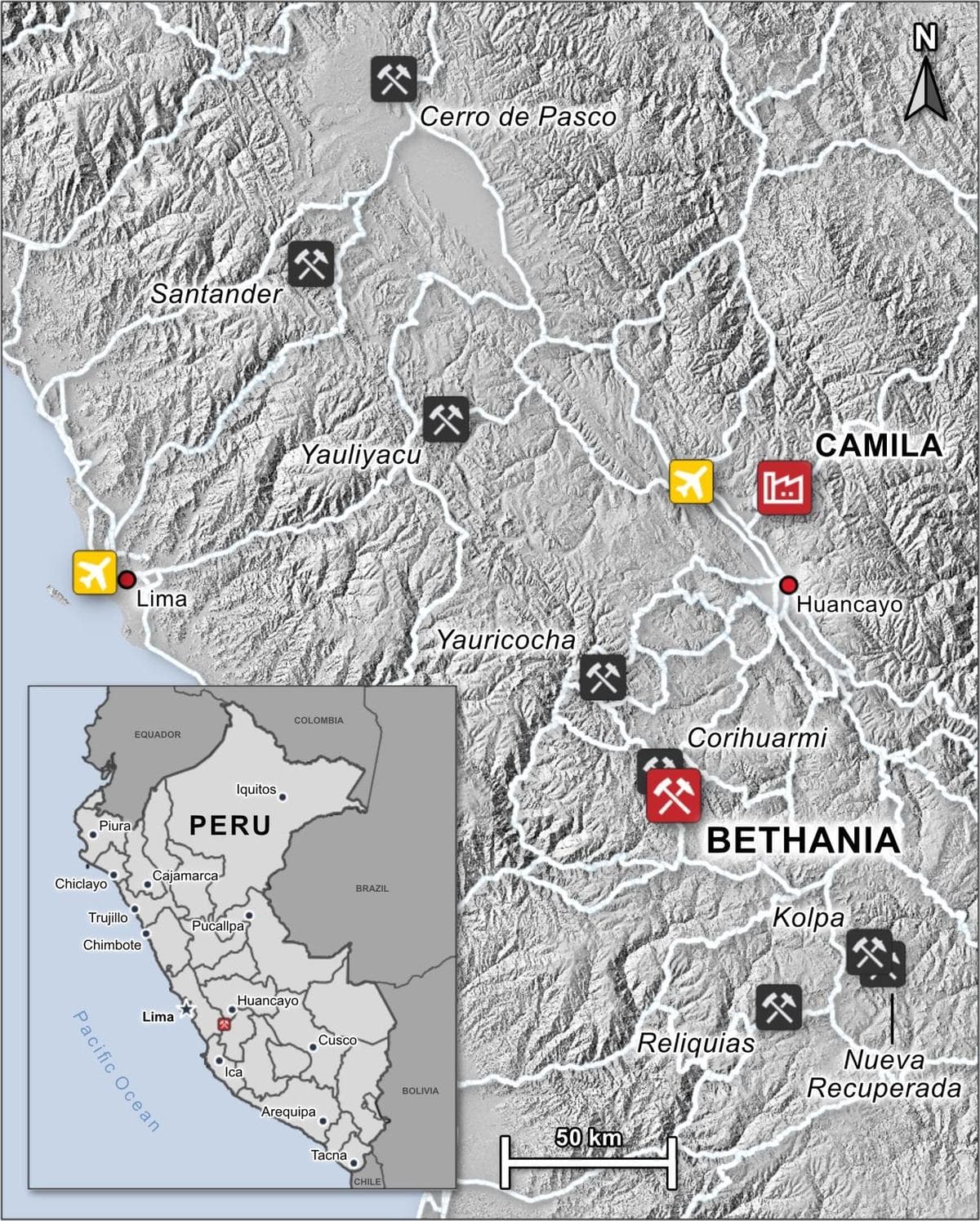
Bethania sits in the high Andes of Huancavelica, Peru — district of Acobambilla, roughly 70 kilometres southwest of Huancayo, on a 500-kilometre silver-lead-zinc trend that has been mined for centuries and still hosts some of the largest mining companies on earth as neighbours. The ground is serious: Kuya's district package has grown past 5,600 hectares, with seven silver vein systems and more than sixty individual veins identified.
The mine itself is no greenfield dream. Bethania produced for years — high-grade ore trucked out and toll-milled into silver-lead and zinc concentrates at regional plants — before the previous owners put it on care and maintenance, out of working capital in a weak market. The bones were good. What the mine lacked was money and an operator with a plan.
The acquisition closed on December 16, 2020. Kuya's Peruvian subsidiary bought 100% of S&L Andes Export S.A.C., the company holding the Bethania mine — its concessions, permits and rights — for US$3.5 million in cash plus shares for the first 80%, and US$1.325 million cash plus shares for the remaining fifth, about US$4.8 million in cash and 3.93 million shares in all. The seller, Erika Soria López, did not disappear: she became a significant shareholder and an advisor to the company — the old owner's knowledge stayed in the building.
Then came the unglamorous years that separate hunters from promoters. Kuya drilled about 5,000 metres in 2021, cut underground, sampled the old workings, and in early 2022 published a maiden resource — updated in the amended and restated preliminary economic assessment of October 2023: 404,000 tonnes indicated at 332 g/t silver (4.31 million ounces) and 700,000 tonnes inferred at 249 g/t (5.60 million ounces) — nearly ten million ounces of silver, over fourteen million silver-equivalent ounces, defined on roughly fifteen hectares. Fifteen hectares, on a district package of more than 5,600. The study contemplated a 350-tonne-per-day operation with all-in sustaining costs of US$9.85 per silver-equivalent ounce in the first eighteen months.
In May 2024, Bethania started mining again — the way careful operators restart mines: small, at a toll mill, selling concentrate, letting the rock pay for its own expansion. The ore goes to the Camila concentrate plant, and in October 2026 Kuya turned that arrangement into a secured partnership: rather than buying the plant, Kuya lent its owner US$400,000 to expand it to roughly 280 tonnes per day, in exchange for guaranteed capacity — 3,000 tonnes a month reserved for Kuya through March 2027, rising to 4,000 tonnes a month after — while Kuya points its own capital at the prize: a fully permitted 350-tonne-per-day plant of its own at Bethania, now in engineering.
The ramp is in the record, quarter by quarter. Kuya exited the first quarter of 2026 mining at 100 tonnes per day, with US$1.46 million in quarterly revenue. The second quarter was a record: 5,097 tonnes mined, up 66% on the quarter before; 23,912 ounces of silver — 30,559 silver-equivalent ounces — processed; June the best month in the mine's new life, with a record day of 124 tonnes; an average realized silver price of US$72 an ounce, silver accounting for 87% of revenue. The third quarter of 2026, reported October 29, tells the more honest story of a mine being built while it produces: management deliberately pointed the crews at development instead of stopes — a record 575 metres of underground development — and still mined 3,401 tonnes, processed 12,179 ounces of silver and booked roughly US$1.3 million in revenue, with recoveries improving to 83.3% and a development batch from the Española vein running 10 ounces per tonne at 91% recovery. The company holds its 2026 target of 150,000 to 200,000 silver-equivalent ounces.
Stein said the quiet part out loud in the second-quarter release:
"The revenue from mining operations on top of the Company's already strong balance sheet puts Kuya Silver in an excellent position, for the first time in our history, to deliver on its near-term production targets while at the same time expanding our exploration efforts."
>
— David Stein, President & CEO, Kuya Silver, July 21, 2026
And in the third:
"Our mine development operations really started to hit their stride in Q3 and continuing into October with record levels of underground development positioning the operation for significant growth in mining rates."
>
— David Stein, President & CEO, Kuya Silver, October 29, 2026
The drilling underneath it all: a 20,000-metre program — 10,000 metres underground at the mine, 10,000 on the district — began turning in the fall of 2026, aimed at an updated resource in 2027 and at the satellites already showing themselves around the mine: Tito PH, a near-twin target a kilometre and a half south; Millococha, a new discovery where surface grabs have run as high as 2,630 g/t silver; Carmelitas, where Kuya signed surface rights with the Poroche community in the third quarter of 2026.
The Turn: The Sure Thing Bankrolls the Dream
Here is the part of the Kuya story that most junior miners cannot tell, because almost none of them have it.
Bethania is not a promise. It is an operation with payroll, production tables and a revenue line — modest revenue, honestly stated, and growing on the company's own development schedule. The credibility of that operation, stacked on a strong treasury — US$25.5 million in cash and no debt at June 30, 2026, after a C$25.5 million financing closed in January 2026 — is what lets Kuya spend money the way it is spending it: on 20,000 metres of drilling in Peru, on a camp-scale land position in Ontario, on a frontier program in Saudi Arabia. The engine does not merely pay bills. It buys time, and time is the scarcest commodity in exploration.
The company has been explicit about the sequence from the beginning. Five days after closing on Bethania in December 2020, Kuya announced its letter of intent in Ontario. The mine came first — deliberately. The dream was bought with the sure thing already in hand.
Silver Kings, the Blue Sky
If Bethania is the mine that pays, Silver Kings is the ground that haunts Kuya — and it should. The Cobalt camp of northeastern Ontario is the most storied silver district in Canada: by Kuya's accounting, the Cobalt and neighbouring Silver Centre camps produced 550 million ounces of silver, from veins so rich the old-timers followed them by eye. Then the camp went to sleep. In the company's words, the district "has seen little to no exploration for silver over the past 40 years."
Stein's opening statement on the project, when the acquisition launched on March 1, 2021, was not hedged:
"This world class silver mining district has been largely abandoned for the past thirty years, and Kuya is excited to sink our teeth into this project. Our goal here is to build enough tonnage to justify a new Ontario silver mine that would be the platform to grow production in the district over time."
>
— David Stein, President & CEO, Kuya Silver, March 1, 2021
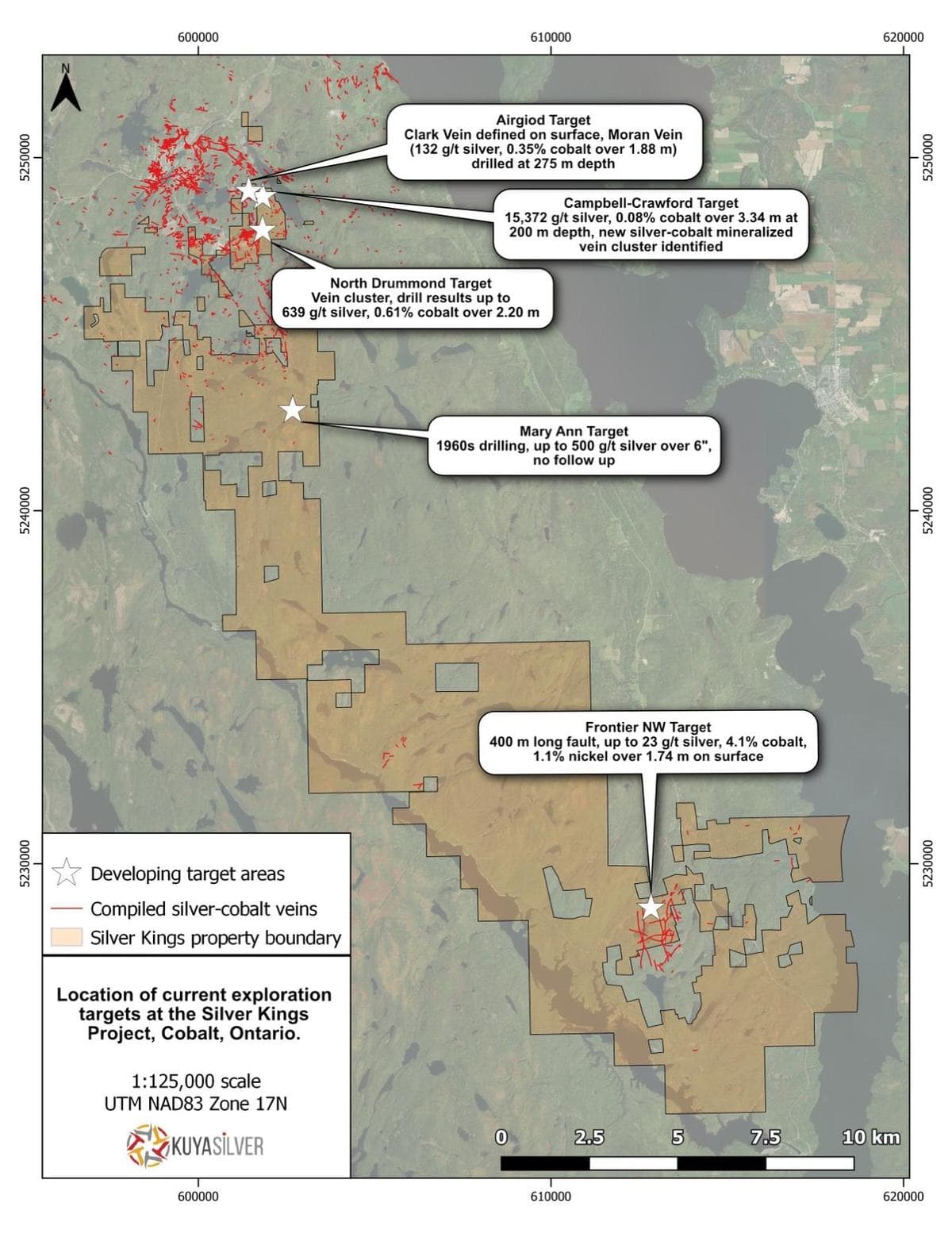
What Kuya assembled, in the consolidation completed in January 2023, is 100% ownership (subject to a 2% net smelter royalty on certain claims) of about 13,000 hectares across the Coleman, Gilles Limit, Lorrain, South Lorrain, Kittson, Barr, Klock and Dane townships — acquired principally from First Cobalt, now Electra Battery Materials, and grown by staking since. The Kerr group of past producers at its heart — Crown Reserve, Silver Leaf, Kerr Lake, Drummond, Hargrave, Silverfields — alone accounts for an estimated 70 million ounces of historic production. On the company's numbers, roughly one-sixth of everything the two camps ever produced — 96 million ounces of the 550 million — came off ground Kuya now holds.
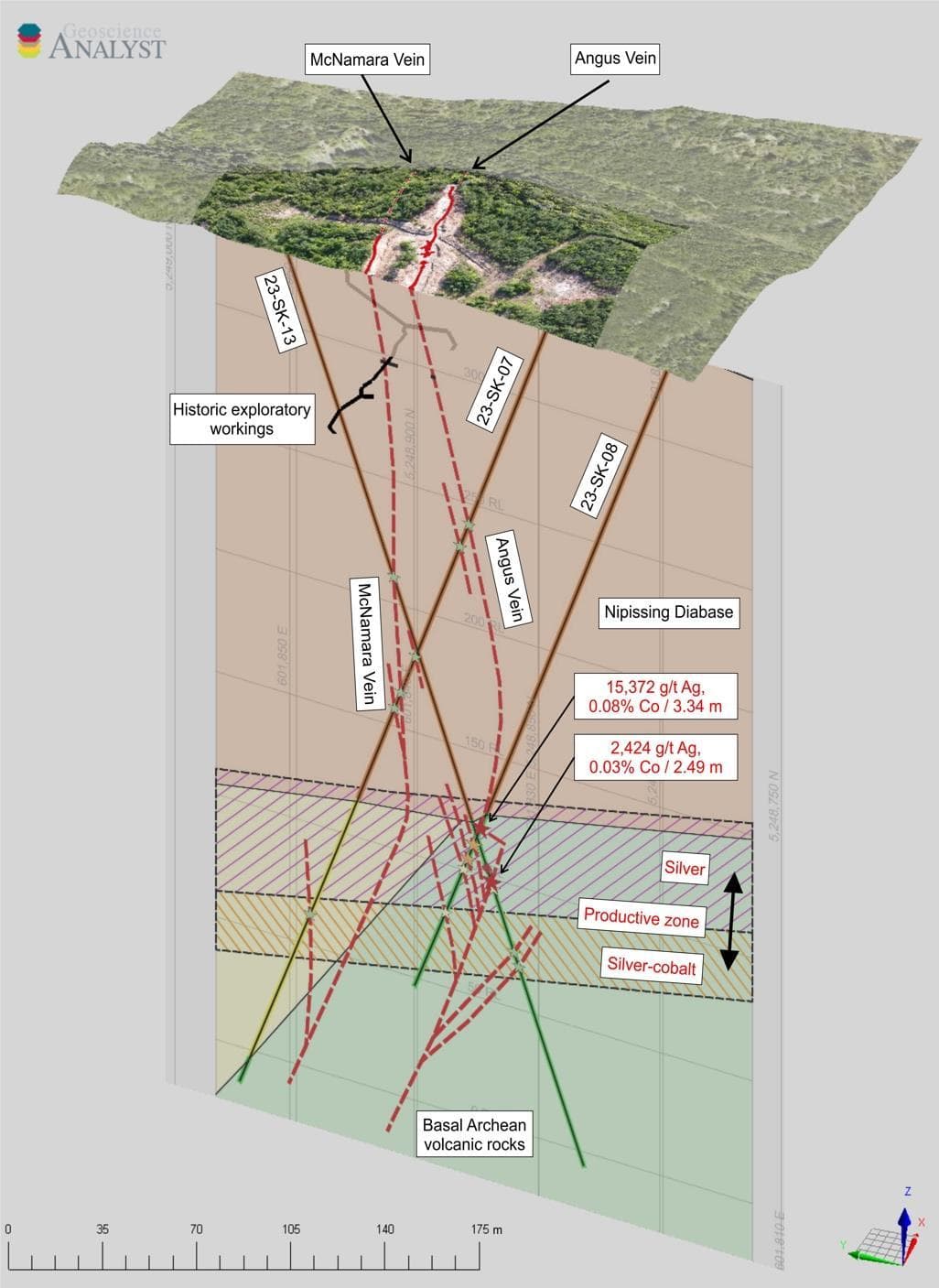
The old-timers mined what they could see: veins where they broke surface. Kuya's team came in with a different model — that the bonanza mineralization concentrates at depth, near the lower contact of the Nipissing Diabase at around 225 metres down, in blind veins under cover, away from the historic workings — and in March 2023 the model paid. At Campbell-Crawford, a stripped historic showing area, discovery hole 23-SK-08 cut the Angus Vein: 15,372 g/t silver — 494 ounces per tonne — over 3.34 metres, from 234.9 metres down. A second hole that spring, 23-SK-13, cut the same vein deeper: 2,424 g/t over 2.49 metres, including one metre of 5,935 g/t. Six mineralized vein structures were identified at Campbell-Crawford alone; later drilling traced the Angus Vein deeper and found wider, lower-grade envelopes around the bonanza cores, including 11.49 metres at 379 g/t silver-equivalent. At North Drummond, drill results have run to 639 g/t silver over 2.2 metres. These are the camp's first grassroots silver discoveries in decades.
And in 2026 the company opened a second front in the camp — the one thing richer than a bonanza vein may be a century of leftovers. Early Cobalt miners graded by eye and discarded everything below their enormous cut-offs; dozens of stockpiles and tailings sites dot Kuya's package. Preliminary sampling reported in August 2026 found the Kerr Lake Mill crushed stockpile running 168 g/t silver with 0.365% cobalt, the Frontier tailings at Keeley-Frontier running 75 g/t silver, Canadaka tailings at 47 g/t. The company is careful — this is reconnaissance sampling, not a resource — but Ontario's new Recovery of Minerals permitting gives it a road from sampling to reprocessing, and the strategy rhymes with everything else Kuya does: begin with the material whose value is already proven, and let it fund the search for more.
The People
Kuya is built the way its founder thinks: operators at the mine, in the country. Christian Aramayo, chief operating officer and a director, is a Peruvian mining engineer who ran global projects for Kinross and now runs Kuya's technical team from Lima. In April 2026 the company added Edgardo Orderique — former general manager of Las Bambas, one of the largest copper mines on earth — to lead operations in Peru. Exploration sits with Dr. Osbaldo Zamora, a 25-year veteran and the qualified person on Kuya's exploration releases; the treasury with CFO Sheila Magallon, whose career runs through Detour Gold, Torex and the GCM–Aris merger.
The third country runs on the same template — local strength, Kuya expertise. At Umm Hadid in Saudi Arabia, Kuya is the technical partner in a joint venture with Sumou Holding, holding a 5% carried interest through the permitted work program to 2029 and a right to buy back in for a further 40%. The maiden program, completed in December 2025, put 5,001.6 metres of drilling into 29 holes across a 6-by-2.5-kilometre field of high-grade silver-gold veins; 2026 drilling has returned intercepts including 0.3 metres at 3,779 g/t silver, and the program is aimed at a first resource estimate. It costs Kuya expertise, not treasury.
- Listings: CSE: KUYA · OTCQB: KUYAF · FSE: 6MR1
- Founder: David Stein, MSc, CFA — President, CEO & Director; founded Kuya in 2017 to acquire Bethania
- Bethania, Peru: 100% owned; producing and selling silver-lead and zinc concentrates via toll milling at the Camila plant; Q2 2026 production of 23,912 oz Ag (30,559 oz AgEq); 2026 company target of 150,000–200,000 oz AgEq; US$25.5M cash and no debt at June 30, 2026
- Bethania resource (NI 43-101 PEA, Mining Plus, October 2023): Indicated 404,000 t at 332 g/t Ag (4.31 Moz) · Inferred 700,000 t at 249 g/t Ag (5.60 Moz) — on ~15 of 5,600+ district hectares
- Silver Kings, Ontario: ~13,000 ha, 100% (2% NSR on certain claims) in the Cobalt camp; ground that produced ~96 Moz of the camps' ~550 Moz historic total; Angus Vein discovery of 15,372 g/t Ag over 3.34 m (2023); no mineral resource estimate yet
- Umm Hadid, Saudi Arabia: JV with Sumou Holding; 5% carried interest plus 40% back-in right; drilling toward a first resource; 2026 intercepts to 3,779 g/t Ag over 0.3 m
Where It Stands
The honest ledger, because a Chronicle that only cheers is advertising. Bethania is a mine in ramp-up, and Kuya says so itself: its own corporate roadmap lists "commercial production and cash flow generation" as a 2027 milestone. Today's revenue — roughly US$1.3 to $1.5 million in recent quarters — is real but modest, it fluctuates with deliberate choices like the development-first third quarter of 2026, and recoveries, while back to 83.3% and proven above 90% on high-grade batches, are still a work in progress as grades and feed vary. The resource underpinning the mine plan is a 2022 maiden estimate carried in a preliminary economic assessment — a study class that includes inferred material and promises nothing — and the 350-tonne-per-day future depends on finishing a ramp redesign and building a plant that today exists as an engineering update. The company's own plant and the expanded Camila agreement make the path credible; they do not make it done.
Silver Kings, for all its romance, has no mineral resource estimate — a bonanza intercept is a fact about 3.34 metres of core, not about a mine, and Ontario has seen a century of rich veins that never added up to tonnage. The tailings and stockpile numbers are reconnaissance sampling the company itself warns may not represent entire stockpiles. Umm Hadid is a 5% carried interest with a back-in right — influence and upside, not control — and any Saudi resource is still ahead of the drills. Kuya also runs on the public markets' patience: 195 million shares outstanding, and a model that spends on three fronts at once.
What is proven is not nothing. It is, in fact, the rarest asset in the junior sector: a permitted silver mine, at high grades, in production, selling concentrate, with a funded treasury, no debt, a district-scale land package around it — and a second, genuine discovery camp in Ontario that the production story makes affordable to explore properly. Most juniors hunt on other people's money and other people's timelines. Kuya arranged to hunt on its own.
Its founder spent twenty-five years reading other men's treasure maps. The map he drew for Kuya is simple enough to say in one line: buy the mine that pays, then go find the one that makes you famous. Bethania is paying. Cobalt is waiting. The hunt, as always, is the point — only now the hunter owns the ground under both.