
Company Chronicles. Every company has a story. This is Kilroy Metal's.
The Captains
The treasure hunter here is the company — Kilroy Metal Inc., built for one district and one hunt. But companies don't read core or raise money; people do, and this hunt is captained by the two founders. Patrick Wood, co-founder and chief executive, works the geology: the district read, the data archive, the drill targets. Brandon Wilson, co-founder and head of technology, built the vehicle itself — the financing and the platform that turned a data package into a company with a public listing in motion. Captains steer; they don't own the mountain. What matters for a long hunt is that the company holds both crafts at once: a great geological idea with no financing behind it is a hobby, and financing with no geology is a shell. Kilroy has both.
The founders' shared conviction is written all over the project they chose: not greenfield speculation, not a moose-pasture staking play, but a historic Arizona mining district re-examined with modern tools.
The tool chest matters here. Kilroy's land package was not assembled by chance or by map-staking around a rumour. The company says its initial targets were identified from 45 years of data collected and analysed by a VMS expert — historic production records, previous drilling, and VTEM geophysical survey data integrated into a single geological model. In a business where most juniors start with a claim map and a hope, Kilroy started with half a century of somebody else's homework, digitised.
The Ground
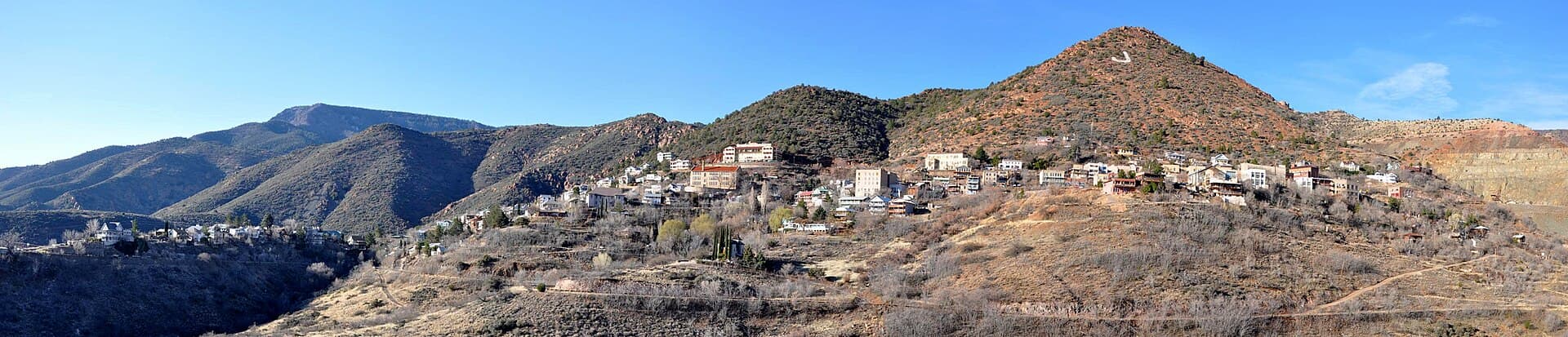
The Crown King Road Project sits in the Bradshaw Mountains of Yavapai County, Arizona — rough, historic mining country south of Prescott, in the same county that produced Jerome and a dozen other copper camps. The package covers 3,636 acres across a six-mile-long mineralised district: 516 acres under a lease-option agreement and 3,120 acres of unpatented claims in the Prescott National Forest, 156 lode mining claims in all. Existing power lines run nearby, and the company notes a year-round water source — the unglamorous infrastructure details that decide whether a discovery can ever become a mine.
Then there is the number that frames the whole story: less than 3 percent of the land package has been drilled. The district produced copper, zinc, gold and silver from underground mines generations ago, and then, essentially, everybody left. The system the old miners were chasing — a volcanogenic massive sulfide (VMS) system, the class of deposit that builds some of the richest polymetallic mines on earth — was never tested the way a modern explorer would test it.
The Two Mines
Two past producers anchor the package.
The Blue Bell Mine is the better documented of the pair: a past-producing copper, zinc, gold and silver mine on 182 acres of private patented claims, with historic workings reaching 460 feet deep across four levels. The company's technical disclosure quotes intercepts of 15 feet grading 3.46% copper and 4.9% zinc, and 32 feet grading 3.08% copper and 6.15% zinc, both from 120 feet — the kind of grades that made the Bradshaws worth mining a century ago, sitting close to surface. Its Northwest Zone runs 1,000 feet long and remains untested along strike.
The DeSoto Mine is the high-grade ghost: a historically significant copper-zinc-gold-silver mine where historic drilling found consistent mineralisation from surface to 200 feet, identified two distinct mineralised bodies across 350 feet of strike and 200 feet down-dip, and recorded historic core grades up to 8.4% copper. Two zones on the property have never been tested at all, and the company flags the potential VMS feeder and root zones below the known mineralisation — the deep plumbing where VMS systems keep their richest ore.
Copper is the headline metal here, and zinc is close behind. But note what runs through both mines' production history: gold. In a market paying record prices for it, the gold carried inside a copper-zinc VMS system is no footnote — it is a second hunt inside the first one.
See the ground: Kilroy's own overview film walks the Crown King Road Project — the district, the two mines, and the plan to drill them.
The Plan
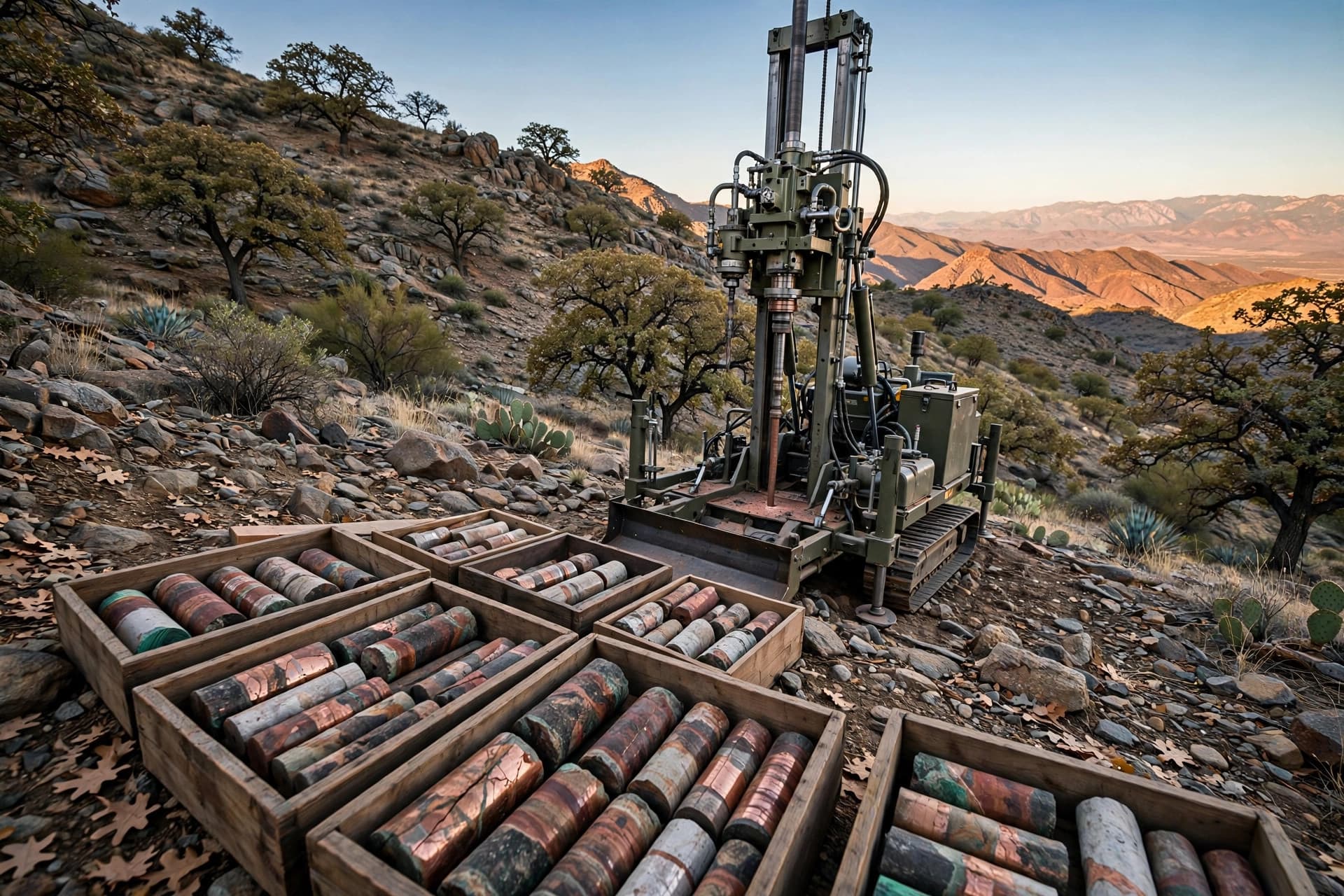
Kilroy's stated method runs in four steps: consolidate the historical data, validate it with modern geophysics, drill with precision, then expand with confidence. Phase 1 is a 12-hole diamond drill program designed to test shallow resource expansion, the chalcocite blanket, and shallow extensions of the known high-grade lenses — drilling the company says is expected to begin in the near term. Phase 2 steps deeper, testing down-plunge targets and geophysics-guided step-outs. Phase 3 is definition drilling aimed at a first mineral resource estimate.
The technical foundation is a current NI 43-101 technical report on Blue Bell and DeSoto prepared by Mining One Pty Ltd, with independent qualified persons Louis Cohalan and Allan L. Schappert — real paperwork, independently signed, which is more than many private juniors can show.
The Public Turn
Private companies stay invisible, and Kilroy has decided not to stay private. On September 18, 2026, the company announced a definitive agreement with Left Field Capital Corp. (TSXV: LFC.P) to complete a Qualifying Transaction — the Canadian route by which a private company becomes a public one — resulting in a TSXV-listed company named Kilroy Metal Inc., focused on the Crown King Road Project. Alongside the transaction, a non-brokered private placement of subscription receipts at C$0.45 is planned to raise C$5 million to C$6 million, with the proceeds earmarked for exploration at Crown King Road, property payments and working capital.
Now the honest ledger, because a Chronicle keeps one. The listing is agreed, not closed: it remains subject to TSXV acceptance and other conditions, and the C$5–6 million is a planned raise, not money in the bank. There is no mineral resource at Crown King Road yet — not a historic one the company will stand behind, nor a current one — and the eye-catching grades quoted above are historic in nature, as Kilroy's own disclosure is careful to say; they have not been verified to current NI 43-101 standards. The 12-hole program has no published start date. What is true today is narrower and still considerable: a six-mile historic VMS district in one of America's great copper counties, two past-producing mines with high-grade historic numbers, 97 percent of the ground undrilled, a data archive most juniors would kill for, and a public listing in motion to pay for the drills.
When the Season 1 tour rolls through Arizona, it will pass through country the Bradshaws overlook — the Copper State, where the hunt never really stopped, it just waited for a new generation with better instruments. Kilroy Metal is betting that 45 years of data and twelve well-aimed holes can wake a district that has slept for a century. The drills get the next word.