
Company Chronicles. Every company has a story. This is K2 Gold's.
- 1865 — the year silver was discovered at Cerro Gordo, a mile and a half north of the property line
- 4.4 million ounces — the silver the Cerro Gordo district produced before it went quiet in 1949
- 140+ — historic drillholes put into this ground by Mobil, Asamera, Newmont and BHP before K2 arrived
- 5 years — from a Plan of Operations the BLM accepted as complete (March 2021) to the Record of Decision (April 2026)
- C$25.25 million — raised in February 2026 to fund the program the permit unlocked
- 14,000 metres — the 2026 drill program, the largest ever run on the project
- 83.82 metres — of 3.40 g/t gold, from surface, in Dragonfly hole DF26-031, October 2026
- 27 — holes drilled at the Newmont target, assays still pending
- 8 square kilometres — of steam-heated alteration capping Si2, K2's Nevada gold system in the Walker Lane, staked by the same team that identified the Silicon discovery
The Captains
The treasure hunter here is the company — K2 Gold Corporation (TSX-V: KTO; OTCQX: KTGDF), a Vancouver explorer built around a two-state hunt — Mojave, the California flagship, and Si2, a second front in Nevada's Walker Lane — and a simple proposition: own the ground outright, win the permit nobody else could, and drill it properly. K2 belongs to the Discovery Group, the Vancouver alliance founded by John Robins and Jim Paterson in 2002 — the stable behind Kaminak Gold, sold to Goldcorp for some C$520 million, and Great Bear Resources, sold to Kinross for C$1.8 billion. Robins, a geologist and prospector of 35 years' standing and a PDAC award winner, sits as K2's executive chairman. The group's companies claim credit for over 10 million ounces of gold discovered. K2 is the branch of the family currently standing in the Inyo Mountains.
The current captain is Anthony Margarit, a Lakehead-trained geologist with more than 25 years across majors and juniors — gold, base metals, uranium and diamonds, from greenfields prospecting to advanced development. Robins had known him for over 15 years when K2 brought him in as president in January 2022; two months later, with the Mojave permitting fight about to turn brutal, he became president and chief executive. Signing the technical record beside him is Eric Buitenhuis, vice president of exploration and the qualified person on every release — a geologist who began his career at Kaminak in 2011, was instrumental in its Coffee gold project, and followed Coffee into Goldcorp when the major bought it. The Discovery Group's two biggest paydays run through both men's résumés. Captains change; the pattern they were hired to repeat does not.
The Ground
The Mojave Project occupies the southern Inyo Mountains of east-central California — 5.5 kilometres east of Keeler, on the dry eastern shore of Owens Lake, and 25 kilometres southeast of Lone Pine, under the Sierra Nevada's rain shadow. K2 states the package at 5,830 hectares, wholly owned, and describes a mineralized system some 10 kilometres by 10 across more than 1,100 vertical metres. It is really two hunts sharing one claim block. On the east side, around Conglomerate Mesa, lies sediment-hosted oxide gold. On the west and north, toward the old Cerro Gordo district, the system turns polymetallic — copper, silver, lead and zinc in skarn, veins and replacement bodies, with a possible copper-gold porphyry underneath.
The eastern geology, in plain terms, is a stack of Permian seafloor — calcareous siltstone laid over blocky limestone — folded, thrust and cracked by a family of west-dipping reverse faults, the Conglomerate Mesa Fault System. Hot fluids climbed those faults and, where they met the right beds, spread gold finely through the rock rather than concentrating it in veins: disseminated gold, in the sediment-hosted style geologists call Carlin-type, though the technical report is careful to imply no kinship with Nevada's Carlin Trend itself. Near surface, desert weathering has rusted the rock to oxide, and the gold starts at surface — the simplest kind of gold there is to dig and to process, when you are allowed to dig it at all. That last condition is the whole story of this ground.
Fat Hill
The mountain a mile and a half north of K2's boundary is called Cerro Gordo — Fat Hill — and in 1865 a Mexican prospector named Pablo Flores found silver-lead ore beneath its peak. What followed was one of California's great hard-rock camps. The ore sat in vertical chimneys and fissures in fractured Devonian marble, rich enough that some 90 percent of the district's production came from less than one square mile of ground — the Union, Santa Maria and San Felipe mines — and the wagon trains hauled it down to smelters in Los Angeles, a raw town the Cerro Gordo trade helped feed and finance. By the time the district went idle in 1949, the U.S. Geological Survey's record credits it with more than 35,000 short tons of lead, 4.4 million ounces of silver and 11,800 short tons of zinc, worth over $17 million at period prices. The town of Cerro Gordo is a ghost under private restoration now.
K2's ground wraps around that history without quite touching it. Inside the company's northwestern block — the Morningstar ground, a separate holding adjoining the Mojave claims — the Morning Star Mine worked gold-bearing marble from 1899. On the Mojave block's southwest corner, the Keeler Mine chased gold-silver veins until 1961. But the eastern gold ground itself — Conglomerate Mesa, Dragonfly, Newmont — has no production history at all. The old-timers were hunting silver chimneys they could see and smelt. Disseminated gold, invisible in the hand and worthless to a nineteenth-century mill, waited in the rusted siltstone for a century and a half, in plain sight, three miles from one of the most famous silver camps in the West.
The Majors' Turn
The modern hunt began in 1984, when Mobil Oil's geologists found gold at Soda Ridge, on the property's northwest corner — rock chips running as high as 48 g/t. Asamera Minerals took the project from Mobil and drilled the first real program, more than 120 holes, before fading out by 1992. Then came Newmont. From 1989, Newmont Exploration worked the eastern ground, found surface gold at an outcrop it called the Discovery, and in 1990–91 drilled 25 holes that delineated the oxide zones the maps still carry as the Newmont, Central and East targets. Newmont abandoned its claims in 1993. The record gives no reason; what it does show is that the ground then sat inside a federal Wilderness Study Area, a designation revoked in 1994, a year too late to matter.
BHP arrived in 1995, when the ground was called the Perdito Project, delineated eight target areas, and in 1997 drilled ten holes. Every hole hit gold, and one of them — CM97-4 — is regarded as the discovery hole at Dragonfly. Then BHP, too, went quiet. Juniors held the ground after that; Great Bear Resources consolidated the scattered positions into one contiguous package; and in 2016 Silver Standard Resources — a producer, not a promoter — optioned the whole thing, mapped and trenched it, and fought through a contested approval for a helicopter drill program. It never drilled. Unable to secure road permits, facing stakeholder opposition, Silver Standard withdrew in 2017. The pattern across forty years is written in the file: the gold kept being found, by company after company, and the ground kept being left — not for want of metal.
The Long Road
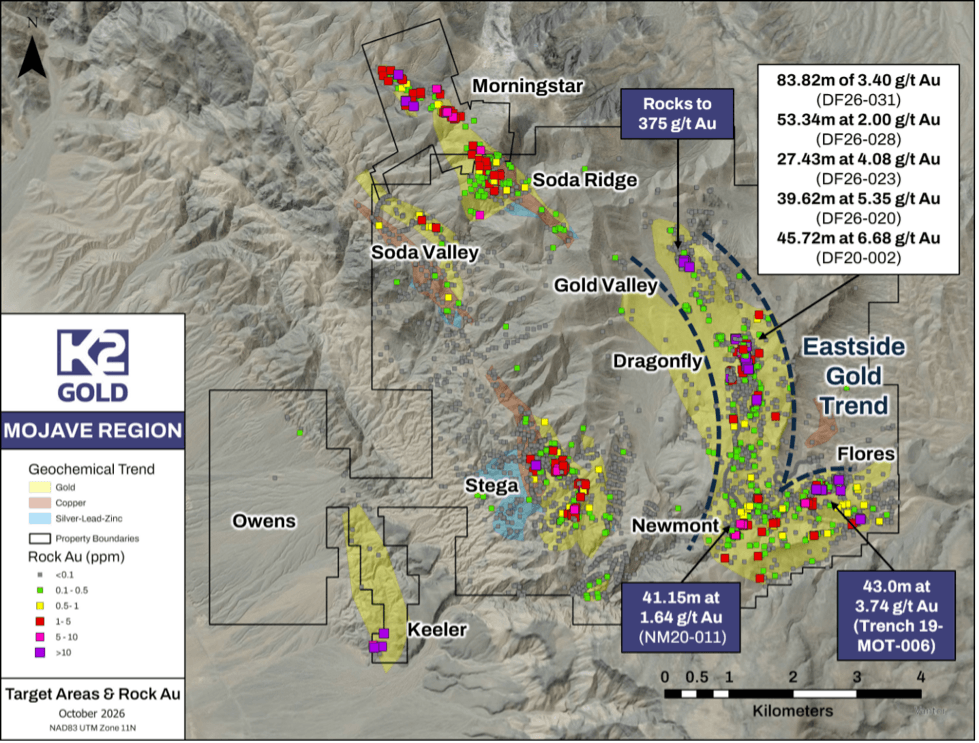
K2 optioned the project in July 2019 from prospectors Steven Van Ert and Noel Cousins — US$1.4 million in staged cash and 2.4 million shares to earn 100 percent of the old Perdito ground. Under an earlier environmental assessment, it drilled 17 holes in 2020 and confirmed what BHP had found: at Dragonfly, hole DF20-002 cut 45.72 metres of 6.68 g/t gold from surface, and at Newmont the drills returned 41.15 metres of 1.69 g/t. In March 2021 the Bureau of Land Management accepted K2's amended Plan of Operations as complete. The finish line seemed to be in sight.
It was not. In March 2022 the BLM informed K2 that its Phase 2 program — all 12.2 acres of proposed disturbance — would require a full Environmental Impact Statement, the heaviest instrument in American environmental law. K2 called the decision unprecedented, suspended Mojave indefinitely, and pivoted its money and its drills to Nevada. The EIS process formally began in August 2023. The draft appeared in May 2025; the final statement, that November, recommended a helicopter-supported program — up to 22 drill sites, roughly half an acre of total disturbance — inside a conservation landscape whose Conglomerate Mesa ground carries a cumulative disturbance cap of one-tenth of one percent. While the paper ground forward, K2 finished buying the rock: the option was exercised in August 2024, title transferred in May 2025, and Mojave became 100 percent K2's, carrying a 3 percent royalty to the vendors. In February 2026 the company raised C$25.25 million. And on April 8, 2026, K2 announced the Record of Decision. "Receiving the Record of Decision for Mojave is a transformative milestone for K2 Gold," Margarit said. Five years, almost to the month, after the plan had been accepted as complete.
On June 25, 2026, the drills finally turned — helicopter-supported, the largest program in the company's history. Margarit's quote from that morning is the honest summary of the whole middle of this story: "It has been a long road to get to this point, and it feels like we're just getting started."
Dragonfly Answers
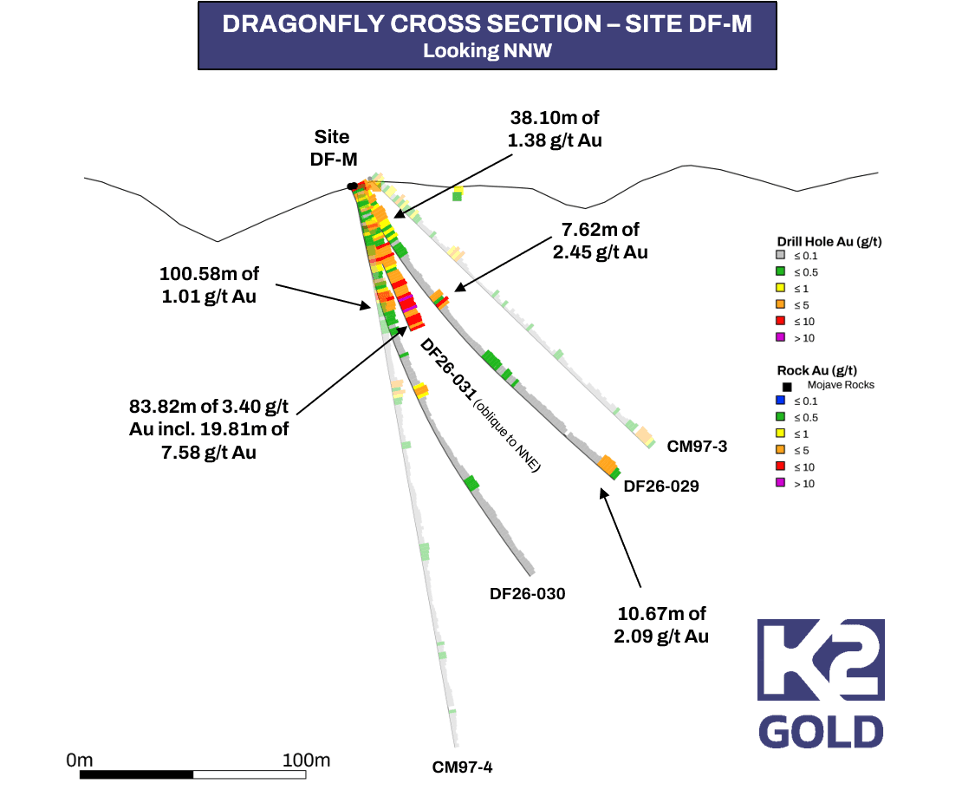
The 2026 program is 14,000 metres of reverse-circulation drilling on a $9.8 million budget. By October 20, 42 holes and 8,013 metres were complete, and the eastern corridor — the Eastside Gold Trend, more than 6.5 kilometres from Gold Valley in the north to Newmont in the south, with Dragonfly midway — had begun to answer in sequence. August brought DF26-020: 39.62 metres of 5.35 g/t gold. September brought 53.34 metres of 2.00 g/t, including an oxide core of 15.24 metres at 5.33 g/t. Then, on October 20, the final holes of Dragonfly's first phase: all 15 reported Dragonfly holes had hit high-grade oxide gold, and the best of them, DF26-031, cut 83.82 metres of 3.40 g/t gold from surface, including 48.77 metres of 4.98 g/t and a core of 19.81 metres at 7.58 g/t. The hole was abandoned still in mineralization, its last 1.52 metres running 9.72 g/t. Beside it, DF26-030 cut 100.58 metres of 1.01 g/t from surface. The numbers are drilled lengths — DF26-031 was angled obliquely across the structure, not a true width — and they are exploration intercepts, not a resource. They are also, by a wide margin, the strongest results in the property's forty-year modern file.
The supporting evidence is lining up behind the intercepts. In September the company reported initial gold-solubility testing at Dragonfly — an encouraging first indication, in Margarit's words, "that a high proportion of the gold in the Dragonfly samples tested is readily soluble," the metallurgical character oxide gold is prized for. In October, surface work extended the Dragonfly structure south into the Flores target, where rocks returned up to 10.9 g/t gold nearly 500 metres beyond the last known high-grade outcrop. North of Dragonfly, Gold Valley — where surface samples have run as high as 375 g/t gold — remains undrilled. And seven kilometres west, the second hunt has a pulse of its own: 613 rock samples across the Morningstar ground in August returned silver as high as 2,738 g/t, with gold to 9.16 g/t and copper to 5.35 percent, from the same skarn-and-replacement family that made Cerro Gordo rich.
The Other Hunt
While Mojave waited on paper, Nevada carried the company — and Si2 is a hunt of a different kind. The project sits in Esmeralda County in the Walker Lane, some 60 kilometres northwest of Tonopah and 20 kilometres northwest of Allegiant Gold's Eastside deposit, which carries 1.4 million ounces of gold and 8.8 million ounces of silver. K2's ground there is 118 road-accessible BLM lode claims covering 986 hectares — the central 65 of them held under an option agreement with Orogen Royalties — and what drew the company is written on the surface: roughly eight square kilometres of steam-heated alteration, alunite, kaolinite and buddingtonite, the pale, acid-leached cap that forms at the top of a low-sulfidation epithermal system.
That cap is the whole thesis, because it is the same style of alteration that sits above AngloGold Ashanti's Silicon discovery near Beatty — and Si2 was found by the same eyes. In 2019, geologists from Renaissance Gold, the team that had identified Silicon, staked this ground as the Elba prospect; K2 took its option in early 2022. In a system like this, the gold is not expected at surface: the steam-heated cap is the top of the plumbing, and the metal concentrates below it, in the boiling zone where the rising fluids dropped their load. A quiet surface is no disappointment here — it is what the deposit model predicts — and the only way to test the idea is to drill down through the cap.
Others had looked, and stopped shallow. Pegasus Gold put four RC holes into the ground in the late 1980s and intersected minor gold. Miranda Gold held the property as Kibby Flat from about 2013 to 2016, read it as an unrecognized high-sulphidation system, and let the claims lapse without drilling a hole. Since 2022, K2 has mapped Si2's alteration from orbit with WorldView-3 imagery, sampled it on a grid, and run magnetics, ELF and induced-polarization surveys across it — then drilled: 1,777 metres of diamond core in four holes at the Southern Rhyolite Dome in 2023. Those holes say the model is alive. One ran 185.57 metres of anomalous gold at 0.053 g/t; the best interval cut 3.2 metres of 0.52 g/t; and the grades build with depth, as the boiling-zone theory says they should. They also say, plainly, that nothing intersected so far is economic. These are the fingerprints of a system, not yet a deposit.
K2 drilled on regardless — eight holes and 3,871 metres in early 2026 — and reported the results in June with unusual plainness: a "very large, fertile epithermal gold system" confirmed over 1.6 by 1 kilometres, open in every direction — and, in the company's own words, "this round of drilling did not intersect economic grades." So the two hunts stand at opposite chapters. Mojave is the treasure with answers in hand and assays in the lab. Si2 is the one still being stalked — a Nevada system whose cap has been read, whose depths have been touched, and whose best ground, if the Silicon analogy holds, has not yet been drilled.
The Open Door
Which leaves the 27 holes. In the 2026 program's second half, K2 drilled 27 holes at Newmont — the southern anchor of the trend, two kilometres south of Dragonfly, the ground Newmont Exploration itself discovered and drilled in 1990–91, when its CGL holes cut intervals like 1.5 metres of 8.23 g/t gold and K2's own 2020 follow-up cut 41.15 metres of 1.69 g/t. As this Chronicle is published, those assays are still pending. They are the next word in the corridor — and the corridor, Gold Valley undrilled at its north end, Flores untested to the east, a 400-metre-wide stack of mostly undrilled structures at Dragonfly, is nowhere near finished.
Now the other side of the ledger, because a Chronicle keeps one. Mojave has no mineral resource — none. Everything in this article is drill intercepts and surface samples on an exploration project, and the historical resource estimates that earlier operators calculated were reviewed by the authors of the 2026 technical report and determined "not suitable for disclosure"; they should not be relied upon, and this Chronicle does not print them. The Record of Decision permits exploration drilling — a helicopter program of 22 sites and about half an acre of disturbance — and nothing more; any future mine would face its own, longer permitting road through a conservation landscape with a hard disturbance cap. The 3 percent royalty rides the ground permanently. The adjacent Morningstar block is held under a staged purchase agreement with payments outstanding, not owned outright. And the treasury that stood above $24 million in October is being spent at drill-program speed. What is true today is narrower, and it is not nothing: for the first time in the ground's modern history, one company owns Mojave outright, holds a hard-won federal permit to drill it, is funded to do so, and has just produced the best drill hole in the property's file — with the target a major named for itself still waiting on the lab.
A Reader's Note on the Record
This Chronicle is built on K2's own disclosures and its January 2026 NI 43-101 technical report, with the Cerro Gordo district record from the U.S. Geological Survey. Four wrinkles in that record deserve daylight. First, K2's own documents do not agree on the property's size — 5,830 hectares in the January 2026 release, other figures elsewhere; this article uses the January 2026 figure. Second, K2's October 20, 2026 release prints the best included interval of hole DF26-031 as 19.81 metres of 7.51 g/t gold in its headline and 7.58 g/t in its body, table and cross-section; this article uses the body figure. Third, the reasons Newmont and BHP left this ground in the 1990s are not stated in any authoritative record we could find, and this article does not guess at them. Fourth, Si2's record is younger and thinner than Mojave's: its central claims are held under an option from Orogen Royalties rather than owned outright, and its drilling to date has returned anomalous gold, not economic grades — this article describes both exactly as K2's own project page and releases state them. The 4.4 million ounces of Cerro Gordo silver, finally, belongs to the historic district north of K2's boundary — produced from mines K2 does not own — and is told here as the neighbourhood's history, not the company's asset.
When the Season 1 tour runs U.S. 395 up the Owens Valley, it passes Lone Pine with the Inyo Mountains on its right — the Fat Hill ghost town up one canyon road, K2's helicopter pads over the ridge to the east. Mobil found the gold in 1984. Newmont named a target for itself and left. BHP discovered Dragonfly and left. A producer walked away over a road permit in 2017. K2 Gold is the company that stayed — for the five-year permit, for the ownership, for the drill program — and the ground has begun, at last, to answer. The Newmont assays get the next word.