
Company Chronicles. Every company has a story. This is Contango Silver & Gold's.
Most mining mergers are a rescue wearing a costume: one company has the asset, the other has the money, and both pretend it was a wedding. This one was closer to an actual wedding. Contango ORE had what Dolly Varden Silver lacked — a producing gold mine in Alaska throwing off cash. Dolly Varden had what Contango lacked — a district-scale, high-grade silver project in British Columbia's Golden Triangle with no way to pay for its own development. On December 8, 2025, the two announced a merger of equals. On March 26, 2026, it closed, and the combined company was renamed Contango Silver & Gold Inc.
The company's own description of the strategy fits on one line: district-scale silver and gold exploration in the Golden Triangle, funded by high-grade gold production in Alaska. One side of the house pays. The other side hunts. This is the story of both.
The Captains
The combined bridge is deliberately split between the two founding crews. Chief executive officer Rick Van Nieuwenhuyse — Contango's founder and the geologist who built NovaGold — runs the company from Fairbanks. His side of the marriage brought the operators: mine builders whose whole model is the direct-shipping-ore play, mining high-grade rock and trucking it to somebody else's mill rather than building their own.
President Shawn Khunkhun is the other half of the ticket, and the company's front man. He ran Dolly Varden as its president and CEO, carried its story to the market for years, and now fronts the combined company — a director as well as its president, and the voice in most of the rooms where this story gets told. Around them: Mike Clark, executive vice president and chief financial officer; chairman Clynt Nauman; and, in the field, Dave Larimer, CPG, vice president of exploration — the geologist who spent the last two seasons rebuilding the Kitsault Valley model from the core up, as the September estimate below shows.
The Combination
The mechanics, briefly, because they matter to what the company is. Under a statutory plan of arrangement, each Dolly Varden share was exchanged for 0.1652 of a Contango share (or, for eligible holders who elected it, an exchangeable share of the acquiring subsidiary). Contango issued 13,686,278 shares and 1,597,301 exchangeable shares, leaving 30,507,599 shares outstanding at the close, split roughly 50/50 between the two shareholder bases. The combined company opened with more than US$100 million in cash and minimal debt. Dolly Varden's shares were delisted — from the TSX Venture Exchange at the close on March 27, 2026, and from NYSE American on April 6 — while Contango kept the CTGO ticker in New York and added a TSX listing under the same symbol.
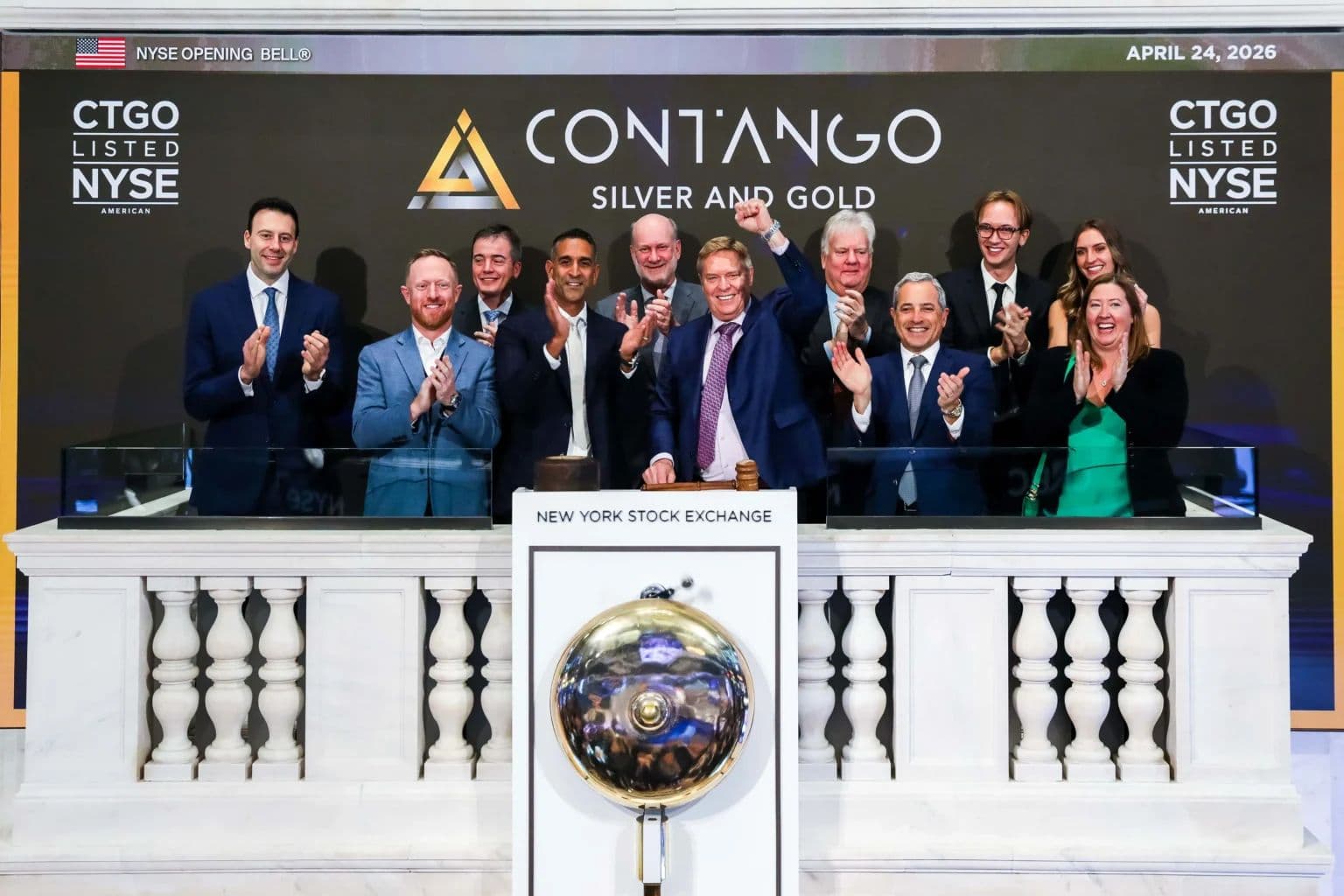
"Contango Silver & Gold offers investors exposure to an emerging North American mid-tier producer focused on high-grade silver and gold assets." — Shawn Khunkhun, President, March 26, 2026
Manh Choh, the Cash Engine
The engine is a joint venture: the Peak Gold JV, 30% Contango, 70% Kinross Gold (through KG Mining), with Kinross as operator, leasing some 675,000 acres near Tok, Alaska. Manh Choh is a small, very high-grade open pit — the ore is not milled on site but trucked by road to Kinross's Fort Knox mill, the direct-shipping model in its purest form. First gold was poured on July 8, 2024.
The engine's record so far: in 2025, Contango's share of production was 60,200 gold-equivalent ounces. By mid-2026 the company could state the sentence every developer wants to say: against an initial capital investment of US$105 million, total returns from Manh Choh had reached US$160 million — the initial investment fully repaid, with distributions still arriving, US$9.0 million in the second quarter of 2026 alone.
The honest texture of 2026 belongs in the story too. Production guidance for the year is 40,000 to 45,000 ounces to Contango's account, and in October the company guided to the low end of that range: the third processing campaign ran August 20 to September 24 and was cut short by persistent rain, mill modifications for higher copper and sulphide content raised reagent use, and the leftover tonnes roll into a fourth campaign in November. Costs in this transition year are guided high — all-in sustaining costs of US$2,200 to US$2,300 an ounce. The set-up for 2027 is the reverse: as mining moves into the higher-grade South Pit, the company guides 75,000 to 80,000 ounces at AISC of US$1,300 to US$1,400. What the mine holds, as of December 31, 2025: proven and probable reserves of 634,000 ounces of gold at 6.8 g/t on a 100% basis — 190,000 ounces of it Contango's share. High grade, real cash, finite rock. Hold that thought for the ledger below.
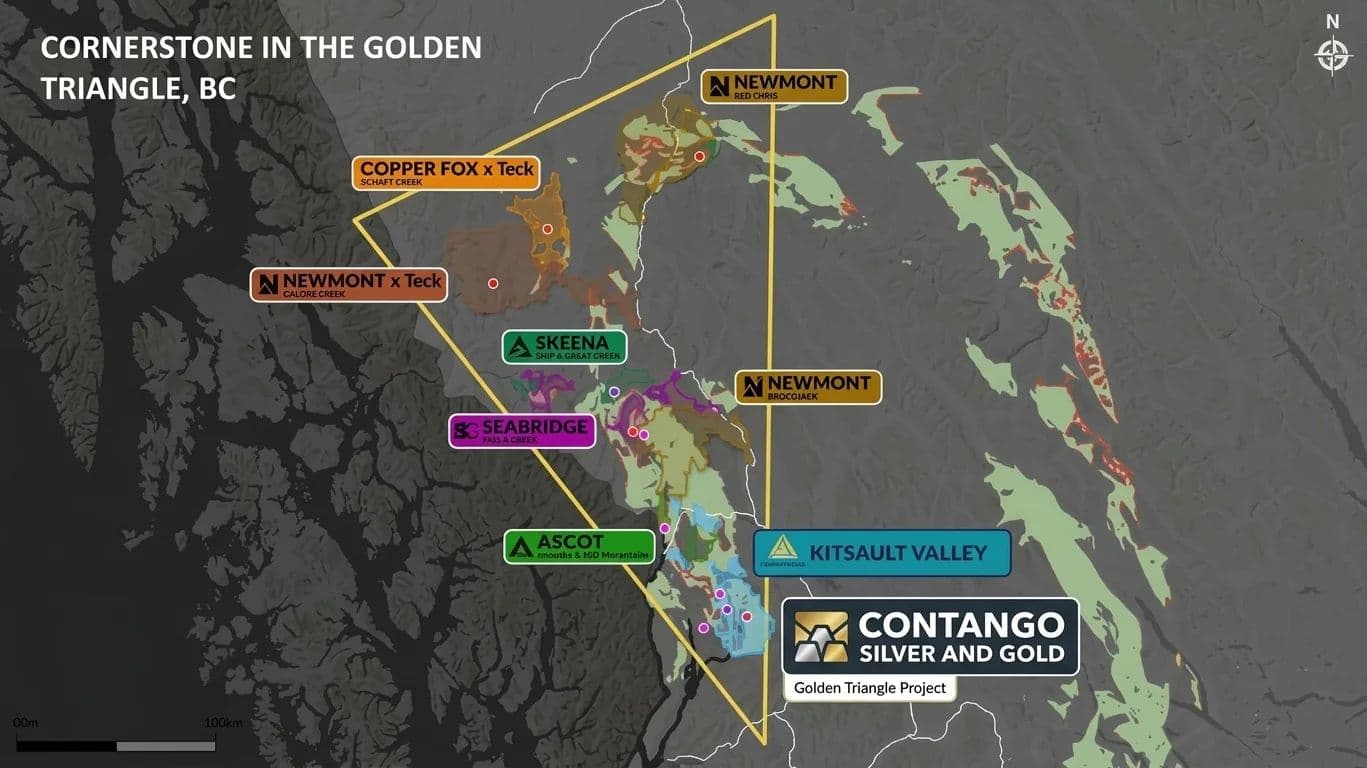
Kitsault Valley, the Silver District
The treasure sits at the southern corner of the Golden Triangle, where the Kitsault River runs down to tidewater through some of the most mineralized mountains in Canada. Contango holds roughly 247,000 acres (100,000 hectares) of tenures in and around the valley. It is really two historic camps stitched into one project: the Dolly Varden area in the south — silver-dominant deposits named Torbrit, North Star, Wolf and Kitsol, where silver was mined generations ago — and the Homestake area in the north, where Homestake Main, Homestake Silver and South Reef carry the gold-silver-copper side of the system. Eight deposits in all, along one valley trend.
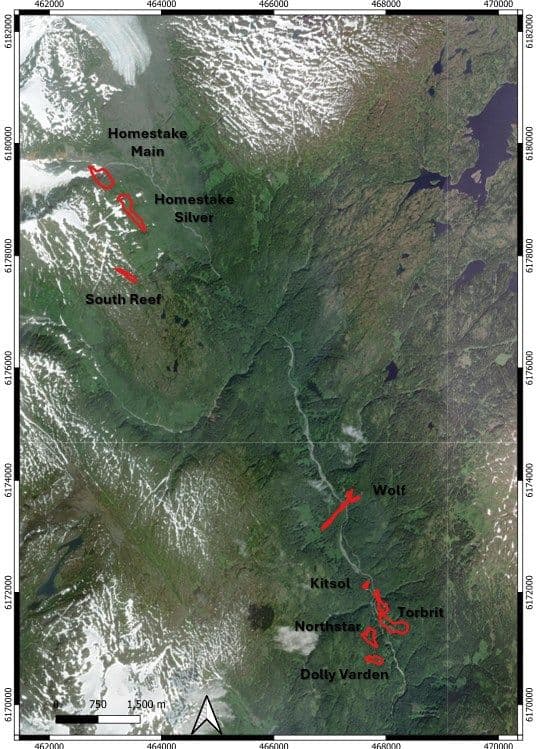
On September 22, 2026, the company published the valley's new measurement — an updated mineral resource estimate under SEC S-K 1300, effective September 11, 2026:
- Indicated: 89.55 million ounces of silver equivalent in 7.66 million tonnes at 363 g/t AgEq — containing 58.7 million ounces of silver, 394,700 ounces of gold, and 9.38 million pounds of copper, 78.16 million pounds of lead and 88.85 million pounds of zinc;
- Inferred: 64.92 million ounces AgEq in 6.31 million tonnes at 320 g/t AgEq.
The indicated figure is up 93% on the 2023 statement. The split tells the two-camp story: the Dolly Varden area contributes 5.52 million indicated tonnes carrying 52.57 million ounces of silver, while Homestake contributes 2.14 million tonnes at 5.63 g/t gold — 387,420 ounces of it. The increase was not just more drilling. Larimer's team migrated a database of 1,873 drill holes and 433,934 metres out of legacy software, rebuilt all 34 mineralized domains in 3D, and re-classified — which is also why inferred ounces fell 25% as material converted upward and the interpretation tightened.
"Our Indicated resource has increased 93% to just shy of 90 million ounces silver-equivalent, driven not just by more drilling but by a fundamentally improved geological understanding of both the Dolly Varden and Homestake systems." — Rick Van Nieuwenhuyse, CEO, September 22, 2026
And the September number is already stale — deliberately. The 2026 drill program, planned at 40,000 metres, actually completed 56,492 metres in 152 holes by October 15, roughly 40% over plan. None of it is in the estimate. Assays are landing through the fall — Torbrit cut 506 g/t AgEq over 13.90 metres and North Star 807 g/t AgEq over 4.96 metres in September infill and expansion drilling. The roadmap from here is printed: a further resource update in the first half of 2027 folding in the 2026 drilling, then an S-K 1300 Initial Assessment — the first look at economics — targeted for later in 2027, with pre-feasibility work over the following years.
The Alaska Pipeline: Johnson Tract and Lucky Shot
Two more hunts run behind the district, both in Alaska, both built on the same high-grade, ship-the-ore logic.
Johnson Tract is the polymetallic prize: a lease from Cook Inlet Region Inc. (CIRI) over a 20,942-acre private inholding inside Lake Clark National Park, near tidewater 125 miles southwest of Anchorage. Its indicated resource stands at 1.1 million gold-equivalent ounces — 0.6 million ounces of gold, 0.7 million ounces of silver and 400 million pounds of zinc — with a small inferred tail. An Initial Assessment completed May 6, 2025 put a post-tax NPV (5%) of US$615 million and a 53% IRR on the project at a US$4,000 gold price, with AISC of US$860 per gold-equivalent ounce. The project was accepted onto the federal FAST-41 permitting dashboard in December 2025. In 2026 the company built the 2.6-mile access road from camp to the portal site — bridges included — ahead of schedule and under budget, finished the portal laydown and a new camp pad a year early, and aimed at a 60-man winterized camp and the start of the underground exploration drift in 2027. The exploration permit behind that road survived its day in court: on September 14, 2026, a federal judge in Alaska granted summary judgment to the United States on every claim in the environmental groups' challenge to the Corps of Engineers' permit, and left the permit in place.
Lucky Shot is the sprinter: a past-producing high-grade gold vein mine in the Willow Mining District, about 75 miles north of Anchorage, carrying an indicated resource of roughly 0.1 million ounces at 14.5 g/t gold. In 2026 Contango tidied the asset completely — it bought out the underlying lease and 2% NSR royalty from Alaska Hardrock (closed July 1, 2026; total consideration of US$16.07 million, including a US$10 million promissory note) and settled US$18.75 million of milestone obligations for US$6.6 million in cash and shares, emerging with clean 100% ownership. The drills have been busy ever since: a Coleman surface program of 5,800 metres, underground drilling on the KM vein, and — from October 22, 2026 — the first modern program ever to test the eastern extent of the vein system from the 2070 East Drift, with a second rig following in November. The intercepts explain the hurry: 972.10 g/t gold over 0.17 metres with visible gold, 86.05 g/t over 2.45 metres, and 140.23 g/t over 0.63 metres. The company's targets are stated plainly: build the resource toward 400,000 to 500,000 measured and indicated ounces, complete a feasibility study in the first half of 2027, make a production decision that year, and run Lucky Shot as a 40,000-to-50,000-ounce-a-year DSO mine.
- Listings: NYSE American: CTGO · TSX: CTGO
- The captains: Rick Van Nieuwenhuyse, CEO · Shawn Khunkhun, President & Director · Mike Clark, EVP & CFO · Clynt Nauman, Chairman · Dave Larimer, CPG, VP Exploration — HQ Fairbanks, Alaska, with a Vancouver office
- The combination: merger of equals with Dolly Varden Silver — announced December 8, 2025, closed March 26, 2026 at 0.1652 Contango shares per Dolly Varden share; 30,507,599 shares plus 1,597,301 exchangeable shares outstanding at the close; more than US$100 million combined cash at closing
- Manh Choh (producing, Alaska): 30% of the Peak Gold JV (Kinross 70%, operator); ore trucked to the Fort Knox mill; 60,200 AuEq oz to Contango in 2025; US$160 million returned to date against a US$105 million investment; 2026 guidance 40,000–45,000 oz (low end expected), 2027 guided at 75,000–80,000 oz at US$1,300–1,400 AISC; reserves of 634,000 oz Au at 6.8 g/t (100% basis; 190,000 oz attributable) at December 31, 2025
- Kitsault Valley (flagship growth, BC): 100%-owned, ~247,000 acres in the Golden Triangle; September 2026 estimate — 89.55 Moz AgEq indicated (7.66 Mt at 363 g/t) + 64.92 Moz AgEq inferred (6.31 Mt at 320 g/t); 56,492 m drilled in 2026, none of it yet in the resource; next update H1 2027, Initial Assessment later in 2027
- Johnson Tract (Alaska): leased from CIRI; 1.1 Moz GEO indicated; 2025 Initial Assessment NPV5% of US$615 million, 53% IRR at US$4,000 gold; FAST-41 permitting; portal road built in 2026 and its permit upheld in federal court in September 2026; exploration drift from 2027
- Lucky Shot (Alaska): 100%-owned since the July 2026 buyout; ~0.1 Moz Au indicated at 14.5 g/t; feasibility study targeted H1 2027, production decision 2027, DSO target of 40,000–50,000 oz per year
- The treasury: US$89.0 million cash at June 30, 2026; hedge book fully liquidated in July 2026 — at the cost of growing the credit facility to US$46.3 million, repayable mostly in the first half of 2027
Where It Stands
The honest ledger, because this story is strong enough to carry it.
Kitsault Valley has a resource, not a mine. There are no reserves in the valley and no economic study — the first one, the Initial Assessment, is targeted for late 2027, and a pre-feasibility study sits years behind it. The silver-equivalent arithmetic rests on the company's chosen deck — US$53 silver, US$3,500 gold — and on deposit-by-deposit recovery assumptions folded into the equivalents. The 93% indicated increase is real de-risking, and it is also partly reclassification: inferred ounces fell by a quarter in the same update, through conversion, reinterpretation and historical depletion. The 56,492 metres of 2026 drilling that could grow it again are, today, assays pending.
The engine is rich, finite, and not theirs to drive. Contango owns 30% of Manh Choh and operates none of it; the mine runs on Kinross's campaigns, Kinross's mill, and Alaska weather — all three of which bit in 2026, a guided ~40,000-ounce year at transition-year costs. The reserve math is the real clock: 190,000 attributable ounces in the ground at the end of 2025 against a guided 75,000 to 80,000 ounces for 2027 alone. Unless the joint venture finds more high-grade rock, the engine that funds everything else has a short runway — which is precisely why Johnson Tract and Lucky Shot are being pushed this hard.
The clean balance sheet was bought with debt. The merger closed in March with minimal debt; by July, exiting the gold hedge book — 15,000 ounces of 2027 hedges struck at US$1,935 — had grown the credit facility from US$12.6 million to US$46.3 million, with US$44.3 million of it repayable in the first half of 2027, plus a US$10 million note from the Lucky Shot buyout. The trade has a logic — full exposure to the gold price, no ceiling — and US$89 million of cash stood against it at June 30. But the repayment wall is near, and it assumes Manh Choh's distributions keep arriving on schedule. As of mid-August, 11,000 ounces of residual carry-trade contracts also still had to run off in late 2026.
Johnson Tract's headline numbers are the softest class of study there is. An Initial Assessment at a US$4,000 gold price is a sketch, not a plan; the project sits inside a national park inholding, its ore plan depends on trucking and barging through Cook Inlet, and while the exploration road's permit is now court-tested, the mine itself faces its own separate, multi-year federal review. FAST-41 coverage is a timetable, not an approval. Lucky Shot's targets carry the same caution in miniature: a plan to mine 40,000 to 50,000 ounces a year is being built on roughly 100,000 indicated ounces today, and its most spectacular intercepts are centimetres wide — in narrow-vein mining, width is the whole question.
The growth slogan is a plan, not guidance. Management talks of growing from roughly 60,000 gold-equivalent ounces a year to more than 200,000 ounces of gold plus 5 million ounces of silver. Every ounce of that beyond Manh Choh is unbuilt, unpermitted or unstudied today.
What stands, after all of that: a producing mine that has already repaid its purchase price and keeps paying, a high-grade primary silver resource of genuine scale — freshly re-measured, still growing, and now attached to a cash flow that can actually fund it — and two high-grade Alaska projects being advanced with unusual speed by a crew that has built mines before. Two countries, four assets, one engine paying for three hunts. That is where it stands.
---
Treasure Hunter Chronicles · Company News · Contango Silver & Gold (NYSE American / TSX: CTGO) · Golden Triangle, British Columbia & Interior Alaska. Written from Contango's own releases and filings, linked above. Not investment advice.