
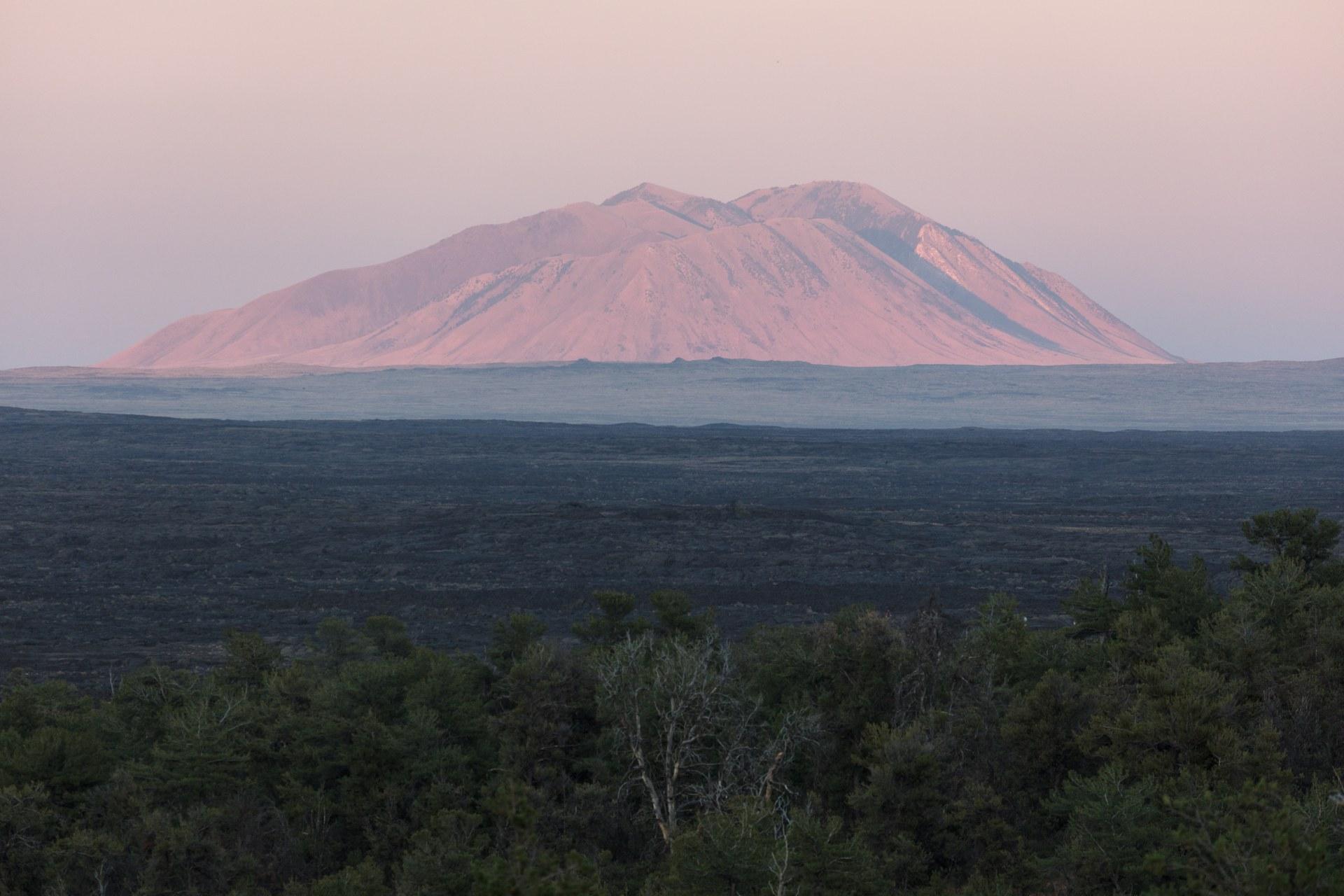
Company Chronicles. Every company has a story. This is Champion Electric Metals'.
- 1989 — the year Bema Gold began pouring gold at Champagne; the mine ran to 1992
- ~25,000 ounces — of gold produced per year at the mine's height, by the company's account of the historic record
- 2.8 million tonnes at 1.2 g/t AuEq — the historic estimate Mine Development Associates calculated in September 1989 — historic, non-43-101, and partly mined since
- 100 metres — roughly as deep as Bema ever drilled, by its current owner's account; the system below was never tested
- 32 kilometres — southwest of Arco, the town that in 1955 became the first on Earth lit entirely by atomic power
- 26.98 km² — the property position today: five patented claims and a patented mill site at Mine Hill, ringed by 329 unpatented claims
- 3,735 metres — drilled by Idaho Champion in 2020, the first modern program on the ground
- 1.04 g/t AuEq over 42.98 metres — core hole DDH-CC-20-02, drilled in 2020 into the unmined gap between the North and South pits
- 0.94 g/t AuEq over 35.1 metres — RC hole CC-05, oxide gold and silver below and beside the North Pit, 2020
- Four decades — of project data being compiled into a single three-dimensional model in the 2026 desktop study
- $0.005 — where the shares traded this fall
- 10,393,961 — shares held by the captain himself
The Captains
The treasure hunter here is the company — Champion Electric Metals Inc. (CSE: LTHM; OTC Pink: CHELF; FSE: 1QB0), a Toronto-based explorer whose map is Idaho: the Champagne gold project in Butte County, the Twin Peaks cobalt property in Lemhi County, and a royalty interest in the Baner gold project it has optioned to another company to work. It began life as Idaho Champion Gold Mines Canada Inc., taken public by reverse takeover in September 2018 with a portfolio of Idaho gold and cobalt ground. In 2023 its shareholders renamed it Champion Electric Metals as it added a lithium project in Quebec's James Bay country. The lithium has since been sold. The company that remains is, once again, an Idaho company.
The current captain is Jonathan Buick — president, chief executive and a director, and the same man who founded the public company in 2018 and has run it, with one interruption, ever since. Buick is a financier, not a geologist, and this Chronicle will not dress him as one: twenty-six years and more in mergers and acquisitions, restructuring, equity research and corporate finance; owner of the Toronto advisory firm Harp Capital Corp.; credited in the company's own 2026 management information circular with raising in excess of $400 million over his career. He is also a believer with his own money down — 10,393,961 shares in his own name at the last circular. In August 2025 he stepped down as chief executive for health reasons, stayed on the board, and handed the bridge to Nicholas Konkin as interim chief executive, who spent the year tightening the company's structure. On July 17, 2026, recovered, Buick took the job back: "I am grateful to be back and thankful for the support of our Board, our team, and our shareholders throughout my absence," he said. "I'm energized and ready to get back to work." The board he first assembled was chaired by Bruce Reid, who had run Bunker Hill Mining; Patrick Highsmith, the geologist-chairman of FireFox Gold, has sat on it since 2020. Captains change — this one changed, and changed back. The ground at Champagne has been waiting through all of it.
The Ground
The Champagne project lies 32 kilometres southwest of Arco, in Butte County, reached by a county-maintained gravel road — high, dry country where the lava plains of the Snake River Plain run up against the foothills, in the drainage of Lava Creek. The gold lives in Tertiary volcanic rocks, the tuffs and flows of the Challis Volcanics laid over the older sediments of the Milligan Formation: a high-sulphidation epithermal system, its hill — Mine Hill — spread with argillic and sericite alteration, silica flooding, alunite and barite. Two open pits, the North and the South, were mined on the hill; between them runs an unmined interval of about 300 metres.
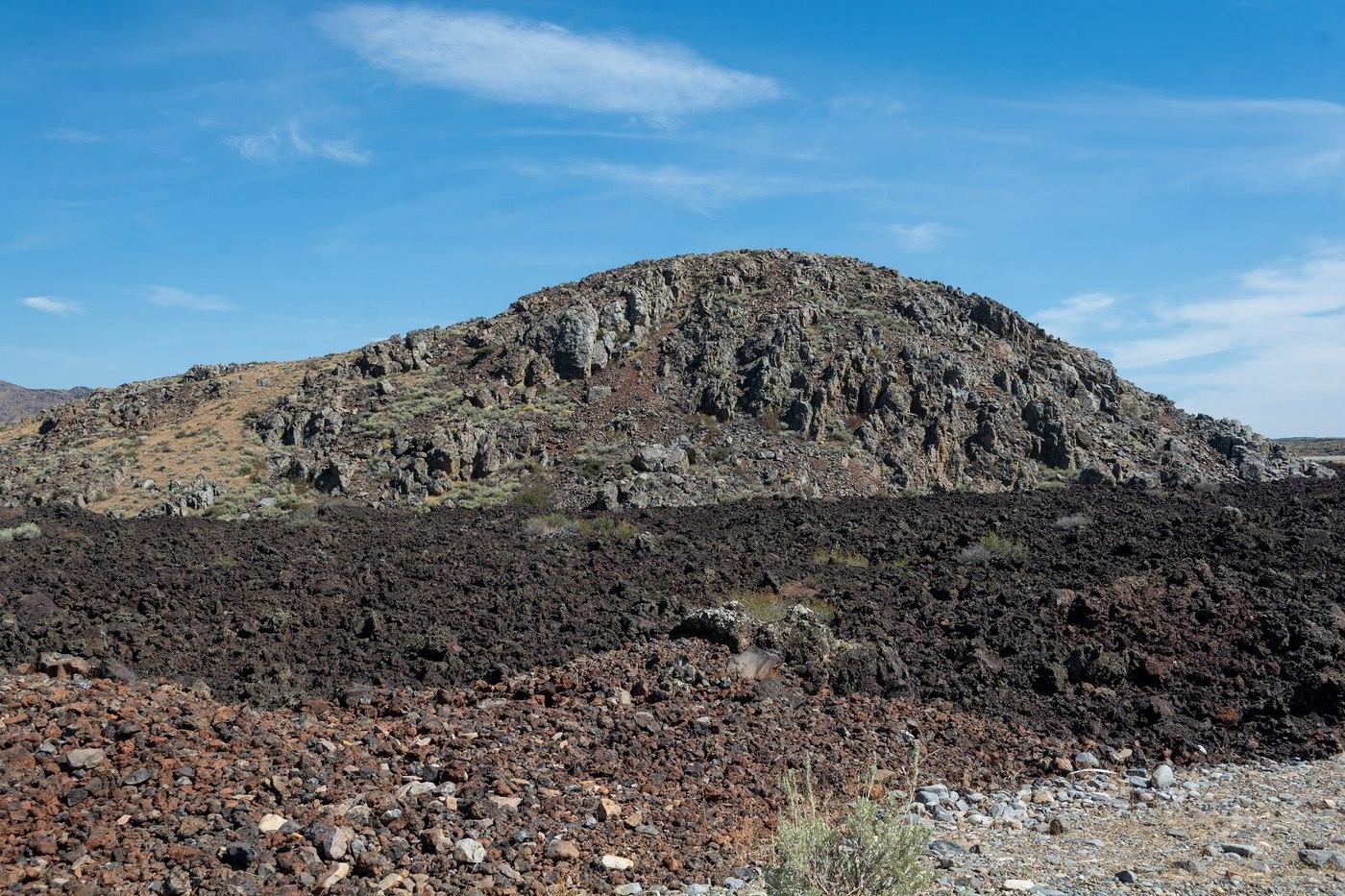
The core of the property is private ground, and that matters more here than acreage: five patented mining claims and a patented mill site, purchased in 2018 for US$150,000, around which the company staked 329 unpatented claims to build a position of 26.98 square kilometres. Patented ground is the ground a drill can turn on fastest, and the company's 2026 study is explicitly aimed at defining targets "suitable for drill testing on patented claims."
Beneath the hill, there may be a bigger shape. Induced-polarization surveys outline a large chargeability high extending to the west and northwest of the historic pits, with the pits themselves sitting along its southeastern margin. The company's thesis — in interim chief executive Nicholas Konkin's words in May 2026 — is that "the historical miners may have been working the fringe of something much bigger": a porphyry copper-gold-silver system beneath and to the north of the epithermal gold and silver the old operators took. That thesis is a geophysical outline and a geological argument. It is not a discovery. It is also the entire reason ground that was mined and dismissed a generation ago is being re-read today.
The rest of the Idaho map is supporting cast. In Lemhi County, in the Idaho Cobalt Belt, the company holds the Twin Peaks project — 341 unpatented claims over 2,761 hectares, including the historic Twin Peaks copper mine. And at Baner, near Elk City in Idaho County — the brand-new gold discovery Idaho Champion itself drilled in 2018 through 2021 — the work now belongs to Legacy Gold Mines Ltd., which closed its option in October 2024; Champion keeps a 1 percent net smelter royalty and a final $500,000 payment due in the spring of 2027, and Legacy has applied for drill pads to work the ground in 2026. Champagne is the front the company kept for itself.
Silver First, Then Gold
Mining on Mine Hill did not begin with the gold men. The structure Champion's best modern core hole was drilled to test — the Last Chance Zone — had been exploited historically for oxide silver at the Horn Silver Mine, and for lead-zinc-silver sulphides at depth; to the north, the Ella Mine worked a breccia vein. The silver men left no production ledger that survives in the public record, and this Chronicle prints none. What they left was the knowledge that the hill carried metal, and where.
The gold era arrived with Gold Fields, which assembled the early data, and then Bema Gold, which through its wholly owned subsidiary Idaho Gold Corporation built the modern mine: open pits on Mine Hill and heap leach pads below them, worked on a high-sulphidation system in the volcanic rocks. Bema drilled 72 shallow reverse-circulation holes of its own, on top of the earlier operators' drilling and trenching. In January 1989, Mine Development Associates set the hill's oxide inventory down in a reserve table — 2,820,811 tons in total, proven and probable — the figure the company renders today as a historic estimate of 2.8 million tonnes at 1.2 grams per tonne gold equivalent. Bema poured from 1989 to 1992, at approximately 25,000 ounces of gold a year by the company's account. And then it stopped: the shallow oxide taken, gold cheap, and the deeper story unread — by Buick's account, Bema never drilled below about a hundred metres. His contention, argued from the data package his company later bought, is that the first operator left mineralized rock behind: it took the near-surface oxide it could see, at the prices of its day, and no more.
One hole from that old data shows what was being walked over. LC8892, a historic hole in the property's southern area, cut 6.1 metres at 2.22 grams per tonne gold and 1,099.64 grams per tonne silver. It is a historic result — drilled in the Bema era, unverified by any modern qualified person, and printed here as history, not inventory. But a gram-and-a-half of silver in every kilogram of rock is the kind of number that keeps a file from ever quite closing.
The Town That Lit the World
Champagne's nearest town deserves its paragraph, because Arco is not an ordinary dot on the high desert. In 1949 the U.S. Atomic Energy Commission planted its National Reactor Testing Station on 890 square miles of the plain east of town. On December 20, 1951, Experimental Breeder Reactor I — EBR-I, down the road from Arco — generated the first usable electricity from atomic energy anywhere on Earth. And on July 17, 1955, the station's BORAX-III reactor was wired into Arco itself: for about an hour, the whole town ran on nuclear power, the first community in the world lit entirely by the atom. The station grew into the Idaho National Laboratory, which anchors the region's economy to this day.
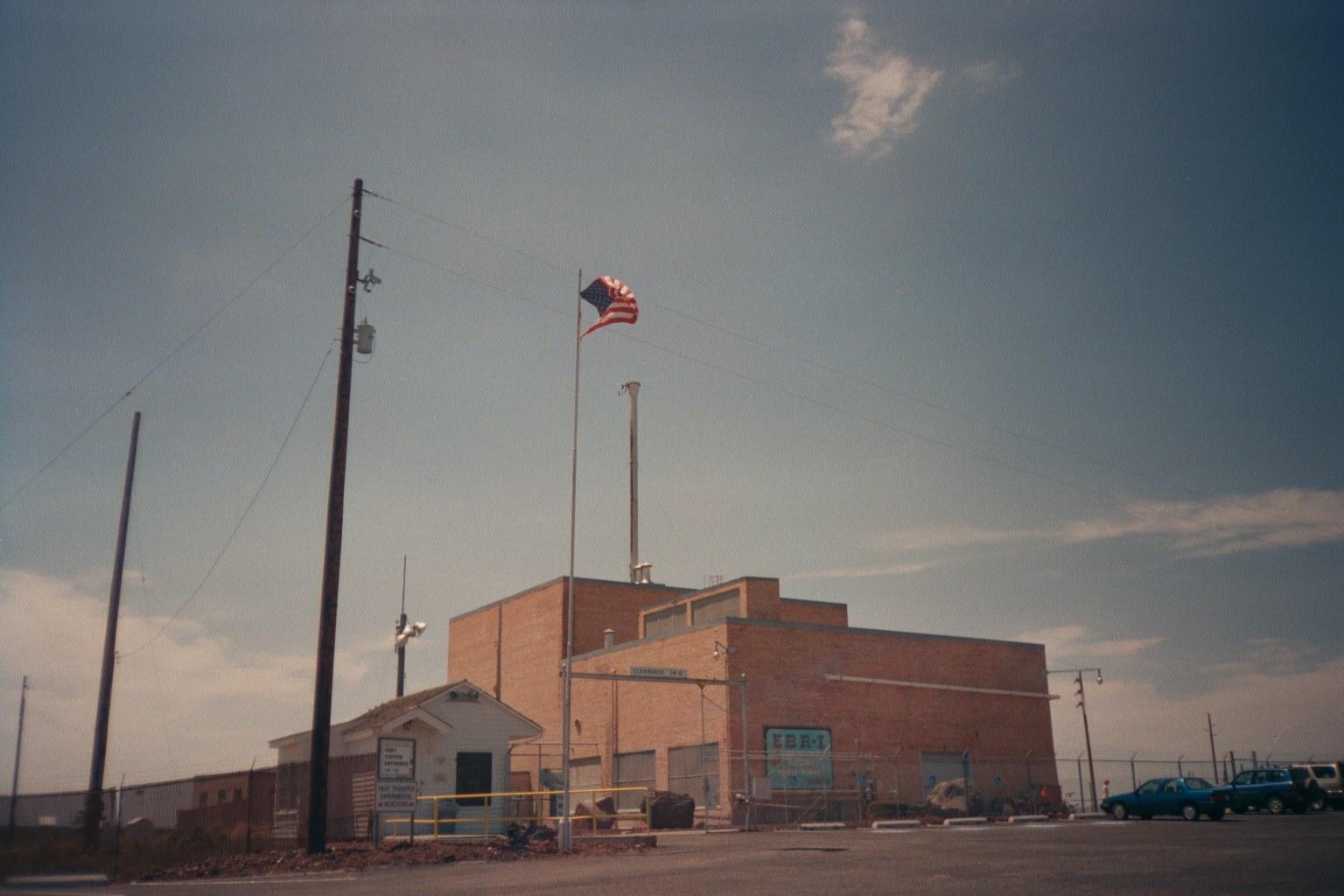
There is a symmetry available here, and this Chronicle will take only a little of it: a company renamed for the electric age — Champion Electric Metals — keeps its flagship gold project half an hour from the ground where the electric age was, quite literally, switched on. The name was chosen for lithium and cobalt, in another chapter of the company's life. The ground it now points at is gold and silver, in atomic country.
The Long Quiet
From the mine's closure in the early 1990s until 2018, nothing modern touched Champagne — no deep drilling, no significant modern exploration, by the company's own repeated account. Bema Gold was acquired by Kinross Gold in 2007, and the mine's files — preserved through Bema's Idaho Gold Corporation — passed into Kinross's keeping. The pits weathered on their hill. The data slept. Gold's long climb through the 2000s and 2010s made other past producers rich targets for revival; Champagne, its records in a major's archive and its patents in private hands, sat this one out. What a past producer needs to wake up is not just a price. It needs somebody to assemble the ground, buy back its memory, and believe the first operator stopped early. That somebody arrived in 2018.
The Dusting Off
The company that became Champion took the ground in 2018 — the patents bought, the claims staked around them. In March 2020 it bought the memory: the complete historic Champagne data package from Kinross, the files Bema's subsidiary had preserved through two changes of ownership. "Acquiring the data package from Kinross is a key first step in fully understanding what we believe is the tremendous upside that Champagne has to offer," Buick said at the time.
Then, in 2020, the first modern drills. Five reverse-circulation holes totalling 935 metres, in and around the North Pit; seven core holes totalling some 2,800 metres, at Mine Hill and toward the Ella Mine — 3,735 metres in all. The results, reported in the first weeks of 2021, are the technical heart of this Chronicle:
- CC-05, an RC hole drilled from the bottom of the North Pit, cut 0.94 g/t gold equivalent over 35.1 metres from 13.7 metres downhole — including 1.36 g/t AuEq over 16.8 metres — in oxidized breccia below and beside the pit Bema left: 0.76 g/t gold and 8.81 g/t silver across the full interval, the company reported, with near-continuous lower-grade gold enrichment running on to 208.8 metres.
- DDH-CC-20-02, a core hole collared on Mine Hill in the approximate centre of the unmined 300-metre interval between the North and South pits, cut 1.04 g/t AuEq over 42.98 metres from 123.14 metres — including 1.22 g/t AuEq over 31.93 metres: the old Last Chance Zone at depth, strongly pyritized breccia carrying 0.67 g/t gold and 27.87 g/t silver across the full interval, with copper, lead and zinc in the mix.
Both are 2020 holes, printed here as the company reported them in January and February 2021, gold equivalents calculated as the company calculated them then. The 2021 follow-up — a ten-hole core campaign of 3,430 metres testing the big IP anomaly — found the system's plumbing rather than its vault: long runs of anomalous silver, zinc, copper, molybdenum and lead, only one narrow interval of gold above 0.3 g/t, and a geological conclusion the company has carried since, that the results suggest a large zoned polymetallic system consistent with a porphyry at depth. Consistent with is not the same as proven. The drills stopped after 2021, and the company's centre of gravity wandered north — a Quebec lithium project, a new name, an electric brand for a gold company's ground.
What brought the focus home was the price of the metals, a streamlining, and a captain's return. In December 2025, the company agreed to sell the Quebec lithium project to one of its own directors for US$1 million in aggregate cash payments — a related-party transaction approved by its independent directors, completion subject to exchange approval. "The proposed sale of the Champion lithium project allows us to streamline the company and sharpen our focus on the next stage of its development," Konkin said. On May 14, 2026, the company mobilized its technical team for the desktop study: four decades of Champagne data — the 1980s drill and trench records from the open-pit and heap-leach operation, the 2020–2021 drilling, the IP geophysics, the surface geology and geochemistry — compiled and integrated into a single three-dimensional model, with the 2020 holes re-read first. "Gold and silver prices have fundamentally changed the economics of what was previously considered marginal," Konkin said. And in August 2026, the company's half-year filing records the next step taken: Jeff Phinisey, the study's qualified person, engaged to update Champagne's NI 43-101 technical report — with management, in the same breath, "exploring joint venture and/or alternative opportunities for this Project."
The Open Door
Now the other side of the ledger, because a Chronicle keeps one. Champagne has no current mineral resource and no mineral reserve — none. The only number ever put on the hill is Bema's, calculated in 1989, expressly not compliant with modern standards, and partly mined away in the three production years that followed. A second historic figure circulates in the company's own releases — 2.3 million tons at 1.9 grams of gold, determined by a party the release does not name, by a method it states is unknown — and it cannot be reconciled with the first; it is not relied on here. The 2020 drill results are real, but they are five years old, stated in gold equivalents under the prices and formulas of 2021. The 2021 campaign, the one that tested the big idea, came back anomalous rather than rich. The desktop study's own qualified person has not verified the third-party historic data the study is built from — the company says so itself, in its own release, in its own cautionary language. And no drill program has been announced: what exists today is a study, a technical report being updated, and a management telling its shareholders it is exploring joint ventures or alternatives — which may mean the next chapter at Champagne is drilled by a partner, on a partner's clock, or not soon at all.
The company carrying all this is a micro-capitalization explorer in the plainest sense. Its shares traded at half a cent this fall. It has settled debts in new shares at a penny — C$440,063.68 worth in March 2026, through 44,006,638 shares, and a further $175,900 proposed in May 2026, $164,400 of that owed to a director. It has elected semi-annual financial reporting, to save the cost of quarterly filings. Its own MD&A states, without decoration, that the company is dependent upon debt and equity financings, the accommodation of service providers and creditors, and the optioning or sale of assets for its funding. If the US$1 million lithium sale completes, it helps. None of this is hidden. All of it is in the company's own paper, and a reader weighing the Champagne story should weigh it with the story.
What is true today is narrower, and it is not nothing. A past-producing mine on patented ground, in a state that knows how to permit mines, holds a documented historic inventory its first operator mined for three years without ever drilling deeper than about a hundred metres. The only modern holes put into it since both found gold and silver where the model said they would. The metals it carries are priced at multiples of anything Bema ever saw. Four decades of its data are, for the first time, being read as one book, by a qualified person now engaged to rewrite its technical report. And the man who assembled the position — who bought the patents, bought the data, and drilled the holes — has come back from a year's sick leave to finish the argument. The study will say what it says. The drills, when they come, whosever they are, get the next word.
A Reader's Note on the Record
This Chronicle is built on Champion Electric Metals' own news releases from 2020 through 2026, its management information circular of June 30, 2026, its annual and interim MD&A filings on SEDAR+, the 2020 NI 43-101 technical report on the Champagne property by Karelse and Baughman, Metals News' November 2020 interview with Jonathan Buick, and Argonne National Laboratory's record of the BORAX-III experiment. Six wrinkles in that record deserve daylight.
First, the Kinross data purchase. A trade-press item dated June 19, 2025 re-ran the acquisition story in the near-exact words of the company's own release of March 11, 2020 — including, as a current plan, funding work at the Baner project, which had been optioned away the previous October. The company's March 2020 release and its 2019 annual MD&A both date the purchase to March 2020, and Buick spoke of receiving the data "in March" in a November 2020 interview. This Chronicle dates the purchase to March 2020.
Second, Bema's production years. The company's releases and MD&A most often give 1989 to 1992 for the Champagne mine's operation; one May 2020 release states the historic resource "was mined as an open pit heap leach operation by Bema from 1989 to 1993." This Chronicle uses 1989–1992, and describes the closure as the early 1990s.
Third, the historic estimates conflict, as set out above: Mine Development Associates' September 1989 figure — 2.8 million tonnes at 1.2 g/t gold equivalent — is the one with an author and a date, and it is the one used here. The competing figure of 2.3 million tons at 1.9 g/t gold appears with its computational method stated to be unknown. Both are historic and non-compliant with NI 43-101; neither is a mineral resource, and neither should be treated as one.
Fourth, Kinross's acquisition of Bema: the company's releases date it to 2007; Buick said 2006 in his 2020 Metals News interview. This Chronicle follows the releases.
Fifth, the Quebec lithium sale: announced December 29, 2025 as an agreement dated December 19, 2025, with completion subject to Canadian Securities Exchange approval. The company's later filings speak of the sale in both the future and the past tense, and no closing release was found in the record reviewed for this Chronicle. It is described here as agreed, not closed.
Sixth, the production figure. The approximately 25,000 ounces of gold per year attributed to Bema's operation is the company's own characterization, repeated consistently across its releases and MD&A; no independent production ledger for the Champagne mine was found in the public record reviewed, and the figure is attributed to the company wherever it appears in this article.
Thirty-seven years ago, a heap leach mine on a volcanic hill in the Idaho lava country poured its first gold, ran three years, and stopped — not out of rock, but out of price, patience and depth. The hill waited through cheap gold and dear gold, a takeover, a renaming, a lithium detour and its captain's sick bed, holding four decades of paper that nobody had ever read all at once. That reading is now underway, at prices Bema never dreamed of, under a captain who came back to work to finish it. A mine named Champagne invites the toast, and this Chronicle will leave it unmade. The dust is off. What the study finds under it is the next chapter, and it belongs to the drills.