
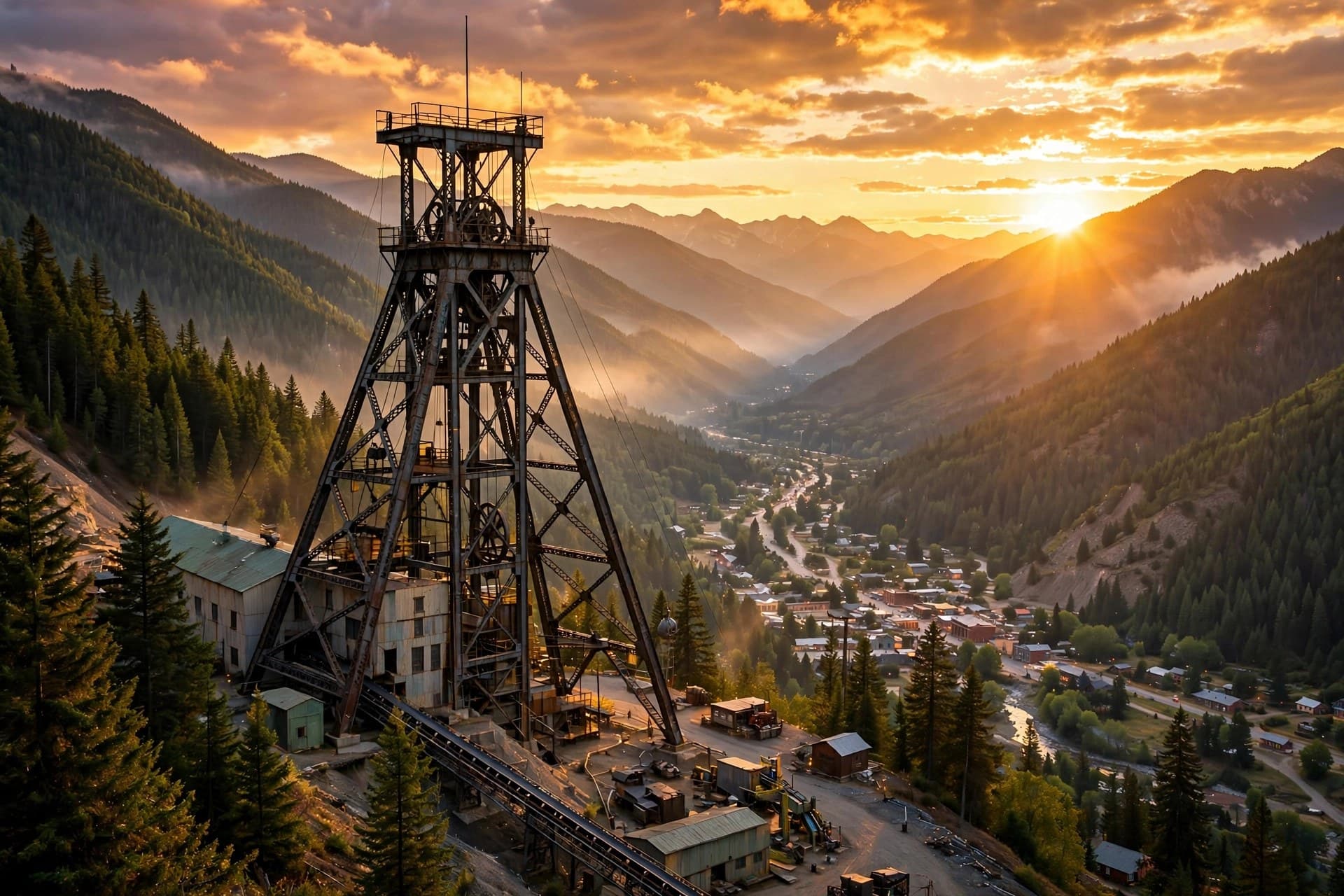
*Treasure Hunter Chronicles — the first installment. Every company in our purview has a story. This is Bunker Hill's.*
The hills above Wardner, Idaho, in the fall of 1885, were not the kind of place that made men rich. They were the kind of place that made men tired.
Noah Kellogg had come up from the played-out placer camps with a grubstake the State of Idaho would later chisel into a historical marker, because it tells you everything about the man: one jackass, and $18.75 worth of flour, bacon, and beans. That was the whole of his fortune. And then, in Milo Gulch, the jackass wandered off.
Every mining district in the West has a discovery story. Most of them are lies told by men who needed investors. This one has the rare quality of being true in the way that matters: Kellogg went looking for his animal, followed its trail up the hillside, and found the burro grazing on an outcropping of galena so rich and so massive it stopped him cold. Lead ore, silver-bearing, lying there in the open air like the hillside had been cut open to show him its heart.
Local history calls him Bill. An 1886 photograph — the burro standing in a Wardner street with town boys climbing on his back — captions him as "Noah Kellogg's infamous burro Bill, who allegedly discovered the Bunker Hill and Sullivan Mine." The men who got rich named a town after Kellogg. The jackass got a caption. Remember that. It's the first lesson of this story: the treasure was never the point. The hunt was.
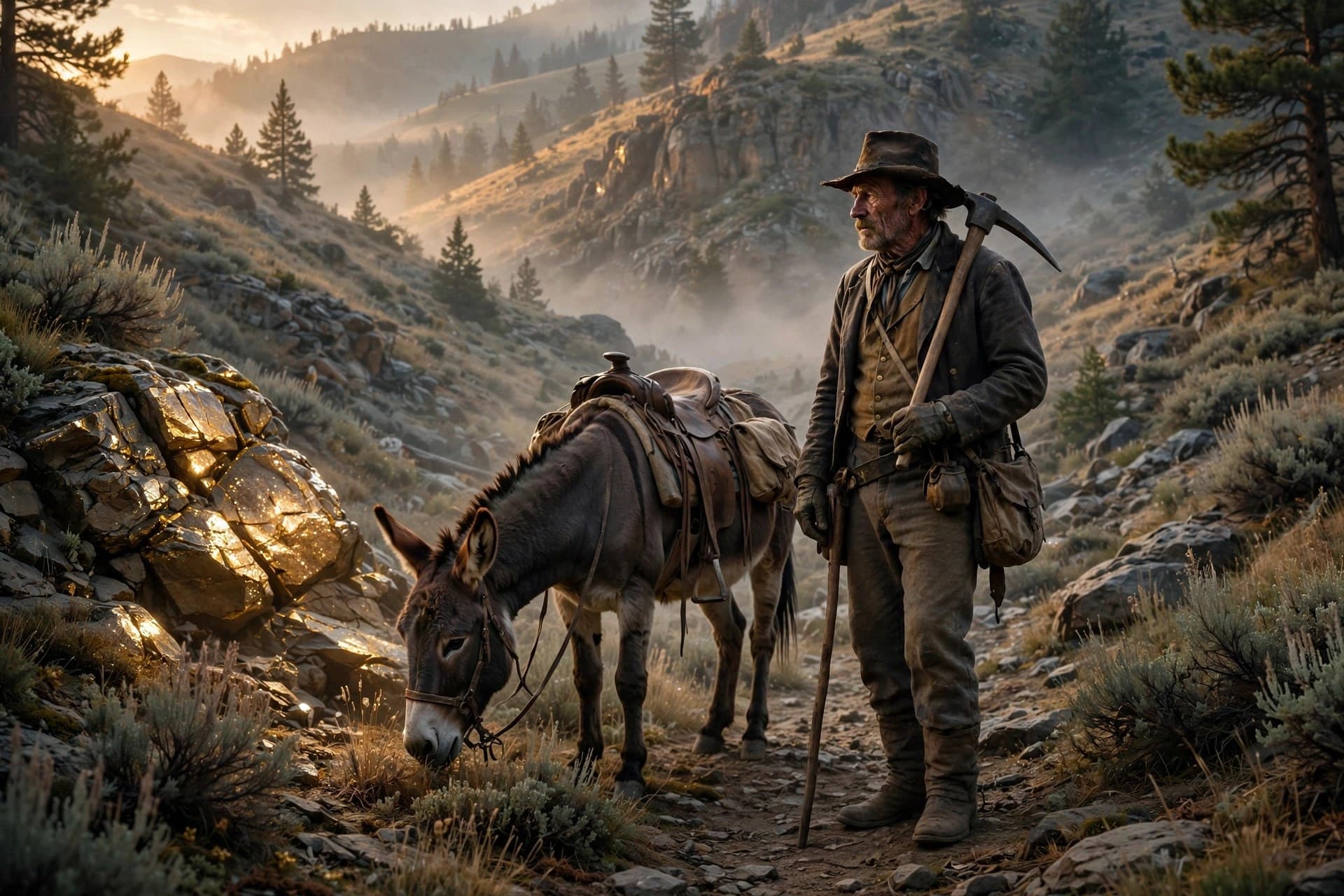
*Bill the burro, in the gulch where it happened.*
The Claim
What Kellogg staked in September 1885 became the Bunker Hill and Sullivan claims — and within two years, one of the great industrial machines of the American West. In July 1887, Simeon Reed bought the ground and incorporated the Bunker Hill and Sullivan Mining and Concentrating Company. He hired John Hays Hammond to run it. Then, in 1893, a young engineer named Frederick Worthen Bradley took over management, became president in 1897, and built the thing into a legend: the first electric hoist in 1894, a 10,000-foot aerial tramway carrying ore from the Wardner adit down to the mill at Kellogg, and in 1897, the start of the great Kellogg Tunnel that would become the mine's beating heart.
The numbers from the century that followed are the kind that make modern mining executives go quiet. Over its 95-year run, the Bunker Hill Mine yielded some 42.8 million tons of ore, at average grades of 8.4% lead, 4.5% zinc, and 3.5 ounces of silver per ton. The company's own accounting of a lifetime: roughly 165 million ounces of silver and 4.5 million tonnes of base metals. (The mine's 2021 technical report tabulates it a little differently — 35.78 million tons at 161.7 million ounces of silver — but whichever ledger you trust, this was one of the most productive mines America ever built.)
The town of Milo, the little prospecting camp nearby, was renamed Kellogg in 1894, in the discoverer's honor. The jackass got a caption. The hunt, remember.
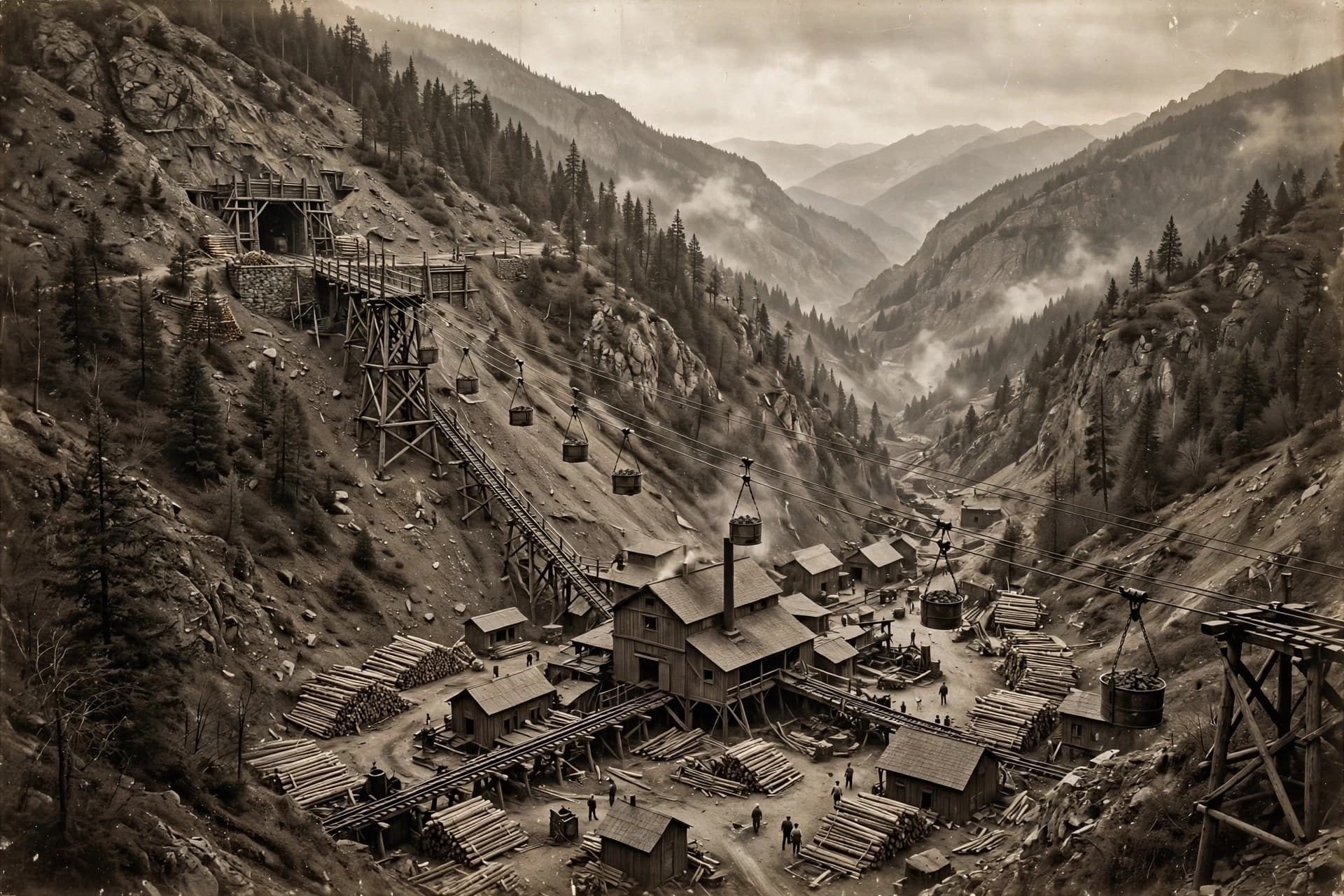
*The industrial machine Bradley built.*
The Price of Greatness
A mine like that doesn't get built without blood in the ledger. Bunker Hill was the richest prize in the Coeur d'Alene district, and everybody wanted a piece of the men who dug it.
In 1892 the district exploded into open war between union miners and company guards. Then, on April 29, 1899 — seven years into Bradley's presidency, in a year the company paid more than $600,000 in dividends — 250 union miners hijacked a train in Burke, rode it down to Wardner carrying 3,000 pounds of dynamite, and blew the $250,000 Bunker Hill concentrator to splinters. Two men died. The governor declared martial law. President McKinley sent federal troops. More than 700 men were arrested.
The company rebuilt a bigger, better mill within three months and kept mining. That's the thing about Bunker Hill: it absorbed everything the century threw at it — dynamite, depression, war — and kept producing. During World War II, Bunker Hill's miners carried a specific exemption from the draft, because the nation's need for lead and zinc was that vital. The mine was, by then, not just a business. It was infrastructure. It was America, underground.
The Fall
Nothing lasts forever, not even the great ones. By the late 1970s the world had changed around the old mine. Base metal prices sagged. An extended labor strike bled it. And then came the new American environmental laws of the 1970s — the most demanding on earth — and the old smelter complex, built for a different century, couldn't meet them without capital the company didn't have.
In 1981, after 95 years of continuous operation, Bunker Hill closed. Two thousand local jobs vanished. In 1983, the EPA declared the mine and smelter complex the nation's second-largest Superfund site. The smelter and the zinc plant were eventually dismantled. An EPA-run water treatment plant took over the mine's discharge. The great Kellogg Tunnel went quiet.
There was a brief, flickering attempt to bring it back — the mine reopened in 1988 and ran until 1991 — and then the long sleep began in earnest. For thirty years, Bunker Hill sat in care and maintenance: a dormant, unloved asset lying forgotten inside a Superfund site, in a valley that had built its entire identity around the thing that was gone.
Kellogg didn't die. But it never stopped being a mining town with no mine.
The Reawakening
Every resurrection story needs someone unreasonable enough to attempt it.
In December 2021, a revitalized Bunker Hill Mining Corp. signed the agreement to buy the mine property — mineral titles and surface rights — from Placer Mining and the Pangburn family, assuming ownership in January 2022 and committing to $17 million in environmental bonding. A month later, it bought Teck Resources' Pend Oreille process plant, dismantled the whole mill, and hauled it to the Bunker Hill site in August 2022. A Caterpillar underground fleet arrived. Timberline Drilling was contracted for 25,000 feet of fresh drilling. Forty months went by without a single lost-time injury.
This is the part of the story most people miss, and it's the most important part: the new Bunker Hill didn't just reopen an old mine. It rebuilt the social contract. The company worked with the regulators instead of against them. It hired local — more than 200 Silver Valley people now draw a paycheck from the mine. It built what its own releases call the largest and most modern processing facility in the Silver Valley: 1,800 tons per day of crushing, grinding, and differential flotation, with a filter press, dry-stack tailings, and paste backfill — the environmental controls the old operation never had, engineered in from the first drawing.
On March 25, 2026, the company graduated from the TSX Venture Exchange to the main board of the Toronto Stock Exchange, still trading as BNKR. The venture exchange is where treasure hunters start. The big board is where the ones who found something go.
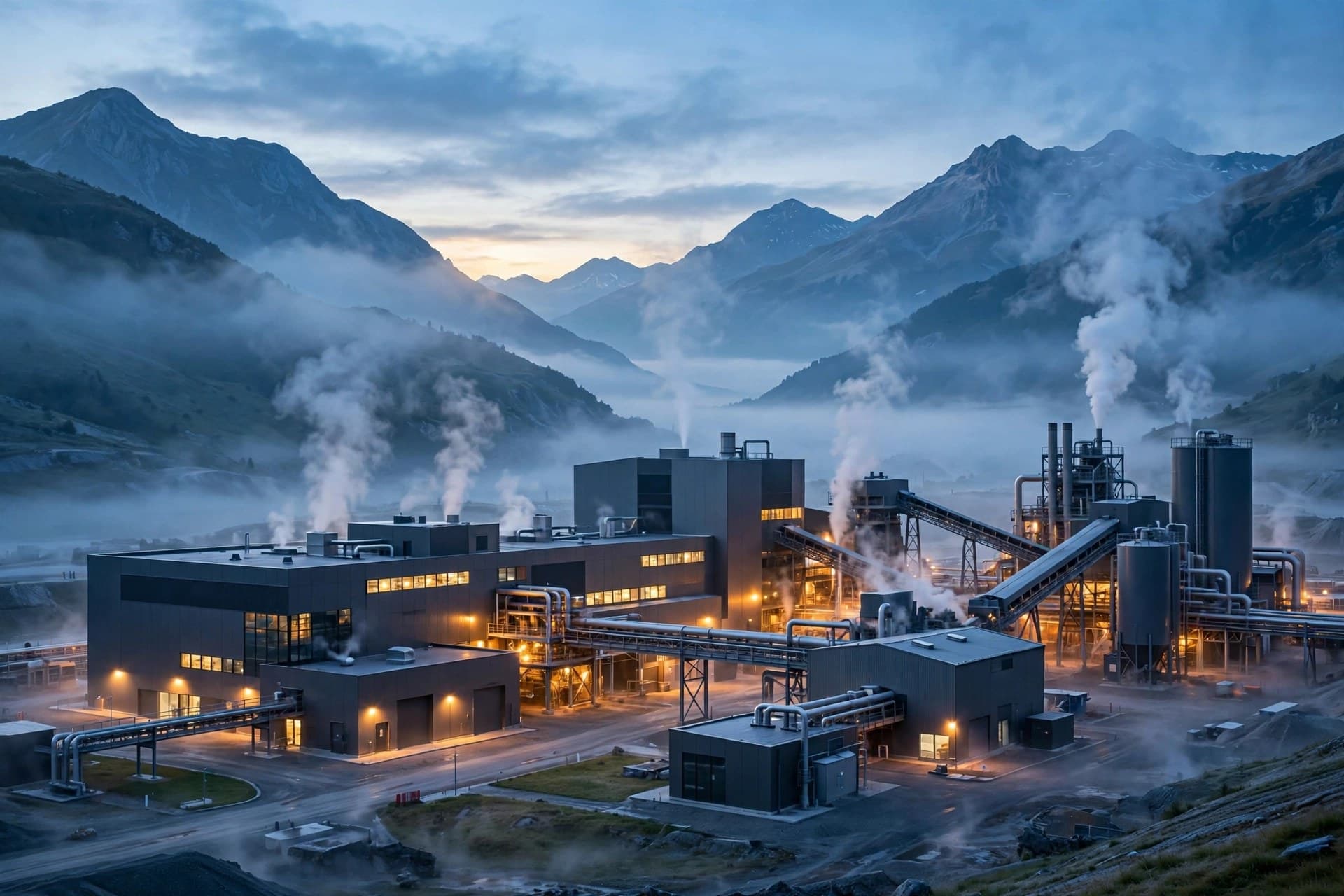
*First light on the new operation.*
Today
On June 29, 2026, Bunker Hill Mining Corp. announced the production of the first concentrate from the new Bunker Hill Mine — the first product shipped from that ground in 45 years.
Read that again. Forty-five years. There are miners working that plant today whose grandfathers worked the old one, and whose fathers grew up in a town shaped like a mine with the mine cut out of it.
"This is a defining moment for both the new Bunker Hill and the communities of Kellogg and Wardner," Sam Ash said that day. "Although we are just starting the ramp-up to commercial production... we are now firmly back in business, employing world-class local labour, and supplying these critical metals safely into the US domestic supply chain at a vital time for our country."
A month later, the first trucks rolled: concentrate analyzed by Silver Valley Analytical, hauled 140 miles north to Teck's smelting complex at Trail, British Columbia, under the company's offtake arrangements. Commercial production — defined as 90 days above 65% of the plant's 1,800-ton-per-day capacity — is expected by the end of 2026. The drills are turning again on the Cate-8 vein, where 16 holes totaling nearly 6,000 feet have all hit visible galena. The company is studying an expansion to 2,500 tons per day — Bunker Hill 2.0. It has acquired the neighboring Ranger-Page project, six historic high-grade silver mines in one package. And in August 2026, Bunker Hill announced a merger with Silver47 to build what the companies call a "Made in America" U.S. silver and critical minerals champion.
The old mine gave America 165 million ounces of silver and the metal that wired a century. The new one is being built for the century that's coming — the one that runs on batteries, and grids, and the hard, unglamorous metals that make the modern world possible.
Noah Kellogg came up that gulch with a jackass and $18.75 in supplies. He was looking for his animal. What he found built a town, fed two thousand families, survived dynamite and martial law and a Superfund listing — and then, when everyone had written the obituary, it came back.
The treasure was never the point. The hunt was. And the hunt, at Bunker Hill, isn't over.
---
*Coming soon: a conversation with Sam Ash, President & CEO of Bunker Hill Mining Corp. — the cherry on top of this chronicle.*