
Treasure Hunter Chronicles. Every company in our purview has a story. This is Blue Moon Metals'.
The Captains
The treasure hunter here is the company — Blue Moon Metals Inc., a Toronto-based developer (TSXV: MOON; NASDAQ: BMM) built around brownfield critical-metals projects: permitted, previously worked ground in the American West and Norway. But companies don't sign deals or read flowsheets; people do. Christian Kargl-Simard, chief executive and director, is a metallurgical engineer by training — University of British Columbia, professional engineer — who spent a decade in mining investment banking at Raymond James and Haywood before founding Adventus Mining in 2016, building it from a C$2 million exploration asset base into a C$235 million sale to Silvercorp Metals in 2024. He is, by biography, the precise kind of captain a dead processing plant would order if it could: a metallurgist who can also raise the money. Shaun McGeough, who joined in May 2026 as senior director of corporate development, works the partnerships desk — the seat across the table from Elmet and EQ Resources when the Springer transactions were structured. Captains steer; they don't own the mountain. What matters for a long hunt is the pattern in the record: Kargl-Simard buys built things the market has mispriced. Springer is the biggest built thing he has ever bought.
The Ground
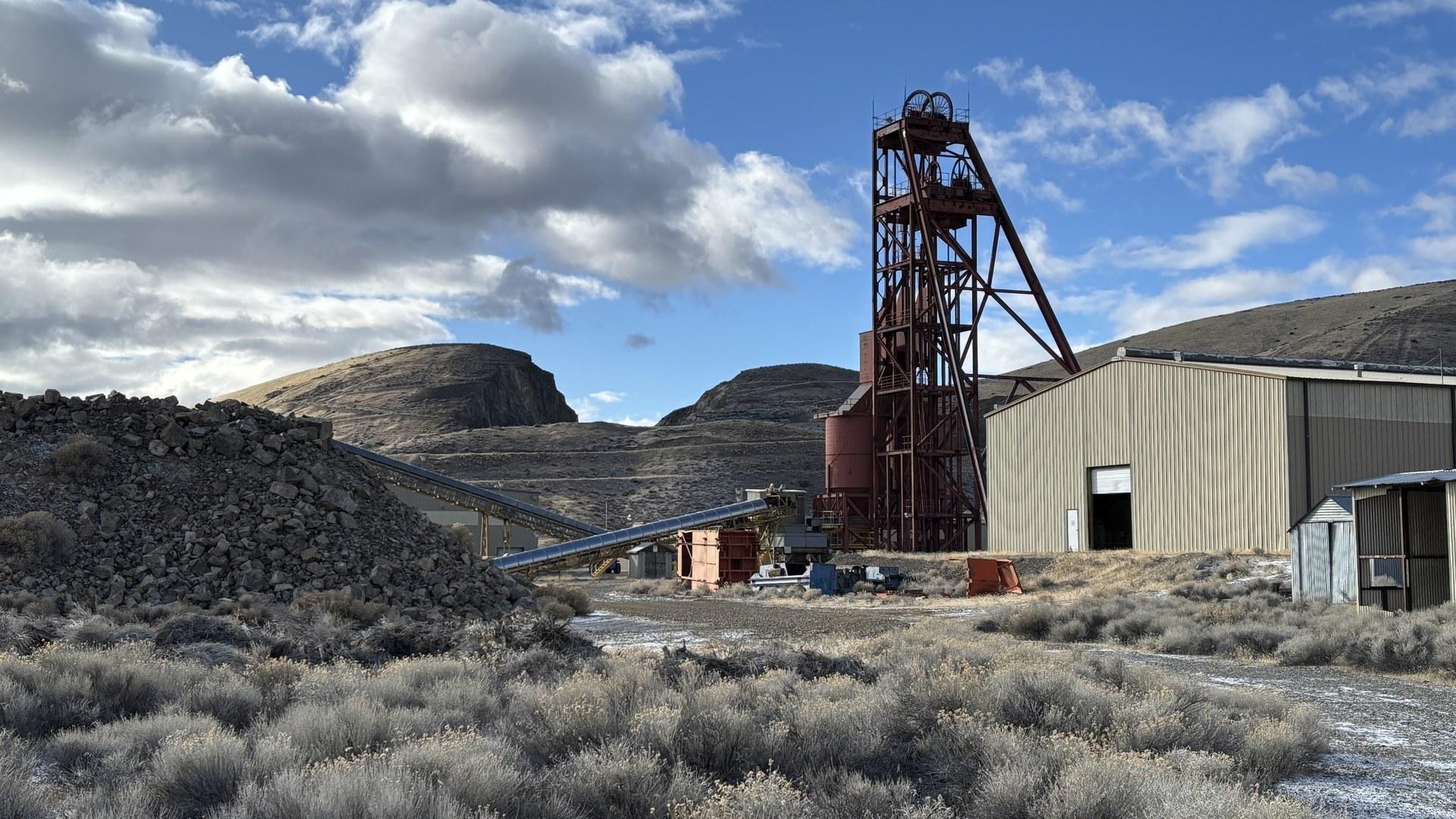
The Springer Tungsten Complex sits in the foothills of the Eugene Mountains near Imlay, in Pershing County, northwestern Nevada — some 11,280 acres of mineral claims and fee lands, with the mineralization lying entirely on private fee land, a few miles from the Union Pacific main line and Interstate 80. The treasure is scheelite — tungsten oxide, with molybdenum riding along — held in skarn horizons where an intruding stock cooked the surrounding limestones: five named ore beds, the Humboldt, Springer and Stank horizons and the Sutton No. 1 and Sutton No. 2. The plant above it is not a plan or a rendering. A vertical shaft reaches 1,600 feet, served by a steel headframe and a three-compartment hoist. A flotation mill rated at 1,200 tons per day stands beside an ammonium paratungstate plant — autoclave circuit and all — capable of up to 4,000 tonnes of APT a year, the standard intermediate product the tungsten trade actually buys. Substations, crushers, conveyors, water rights, and both conventional and dry-stack tailings capacity complete the inventory. The permits are as real as the steel: this August the Nevada Division of Environmental Protection transferred the water pollution control and reclamation permits into Blue Moon's name and approved the reclamation bond, the Division of Water Resources authorized construction of the tailings dam, and construction at the site is authorized. In September the company added water rights and land for direct rail access. Blue Moon's model for all of it is hub and spoke: Springer as the hub mill, fed over time by smaller high-grade mines across the western United States — its own Blue Moon zinc mine in California and the Apex germanium-gallium ground in Utah stand first in that line.
The Camp Called Tungsten
The Eugene Mountains were prospected for silver and gold from 1862, but tungsten arrived by accident. Emil Stank, panning for silver in the canyon that now carries his name, kept turning up a heavy white mineral — scheelite — and set it aside as worthless. In 1917, with the First World War making tungsten a war material for hardening steel, Stank remembered the white rock and staked his claims that March. Within months three companies were working the hills: Pacific Tungsten took over Stank's ground, Thomas Sutton organized the Mill City Tungsten Mining Company on Sutton Hill, and L.T. Friedman formed the Nevada-Humboldt Mining Company on Humboldt Hill. Ore moved by team wagon to the railhead at Mill City; two mills were running by the end of 1918. Then came the Armistice, the war price vanished, and by 1919 the camp had gone quiet.
It did not stay quiet. In 1925 the creditors of Pacific Tungsten formed the Nevada-Massachusetts Company under Charles Segerstrom, and over the following years it consolidated every principal property in the district under one operator. The camp that grew up around the mines was named, without adornment, Tungsten. For three decades Nevada-Massachusetts ran it — company histories of the era credit the camp with most of the nation's tungsten supply in the 1930s — through the Second World War, and into its most prosperous years, 1950 to 1956, when the federal government stockpiled scheelite against a hot war in Korea and a cold one everywhere else. The Humboldt workings, connected underground to the Springer, were reckoned among the deepest tungsten mines in the country. The USGS record credits the district with some 3.26 million tons of ore produced between 1917 and 1958. In 1958, the stockpile full and the price gone, production ceased, and the camp went onto standby. By 1962 it had slipped into disrepair — a town's worth of tungsten history waiting in the sagebrush for somebody to want the metal again.
The Seven-Month Mine
Somebody did — the largest electrical manufacturer on earth. In 1969 Segerstrom's heirs, operating as Tungsten Properties Limited, reacquired the property, and in 1971 they dealt with the General Electric Company, which needed tungsten for its own lamps, tools and alloys and wanted a supply of its own. GE and Utah International — GE holding 80 percent — spent the late 1970s doing the thing properly: a modern underground mine, the 1,600-foot shaft, extensive workings, the 1,200-ton mill and the APT plant, a complex the U.S. Geological Survey priced at $55 million. Production commenced in March 1982. It closed in October 1982. Seven months. China, then emerging as the world's low-cost tungsten supplier, had flooded the market, the price had fallen through the floor, and a brand-new American tungsten complex could not compete. GE put the whole plant on care and maintenance.
What followed is the strangest chapter in the file: for more than four decades the plant waited — mothballed under caretakers who kept the equipment in working order, the red headframe standing over the sagebrush, a permitted and essentially complete tungsten factory in a country slowly importing its entire supply of the metal. Owners came and went. EMC Metals bought the complex from GE in 2006 and spent some $38 million rehabilitating it; others followed; nobody restarted it. The ore never moved and the price never came back — until the world changed around the deposit. In February 2025 China placed export licensing on tungsten, APT included. The USGS records prices climbing sharply. Washington began writing cheques and, from January 1, 2027, American defense contracts must exclude tungsten mined in China, Russia, North Korea or Iran altogether. And in February 2026 a small Toronto developer closed on the whole complex — $500,000 down, $18 million at closing, US$18.5 million all in — having already completed its first underground drill hole on February 6, four days before the deal closed. Blue Moon had not come to look. It had come to restart.
The Second Hunt
The context the restart rides on is not sentiment; it is arithmetic. The U.S. Geological Survey records no commercial tungsten mine production in the United States since 2015, net import reliance above 50 percent, and China mining about 79 percent of the world's tungsten in 2025. Roughly 60 percent of American tungsten consumption goes into cemented carbide — the cutting and wear parts that machine everything else. Into that gap, in September 2026, came the transaction that changed Springer's scale. The Elmet Group, a Maine-based American tungsten manufacturer fresh from a US$450 million investment by the U.S. Department of War, signed a binding letter agreement with Blue Moon and Australia's EQ Resources — which mines tungsten in Australia and Spain and brings ore-sorting technology and the APT plant's engineering — inside the Department of War's TEG Landmark Initiative, US$150 million of it designated for Springer. The structure, in one breath: some US$150 million from Elmet, split between a US$50 million prepayment facility (two $25 million tranches, repaid as a credit against concentrate sales), a US$25 million equity subscription in Blue Moon (closed October 19 as C$35 million, with Elmet's nominee William Jacob Homiller joining Blue Moon's board), and US$75 million into a new joint venture to own and operate the APT plant — Elmet 70 percent, Blue Moon 20 percent contributed as the plant itself and its concentrate commitment, EQ 10 percent — with a further US$25 million set aside on standby. The mine and mill remain one hundred percent Blue Moon's, permits and all; the Department of War, for its part, completed a NEPA review of the site and describes the restarted plant as what will be the only independent APT facility in North America.
The execution has followed the announcement at working pace. The 67,000-metre, two-phase diamond drill program — up to six rigs, paired with relogging and reassaying 18,000 metres of preserved historical core — began in August and runs to the first quarter of 2027, converting a century of paper into a modern, compliant resource. On October 26 the company contracted RAM Enterprise of Elko to refurbish the mill, with Nordmin Engineering on the tools and Wood Group USA as owner's engineer, the plant refurbishment expected to finish in the fourth quarter of 2027; it even bought the incoming workforce a place to sleep, a US$1.7 million accommodations site seven miles from the mill, closing in December. On November 3, Blue Moon sold its Norwegian business — the construction-stage Nussir copper mine and the NSG property — to ACG Metals for US$220 million in shares, announcing it would focus on its U.S. critical metals assets; closing, expected November 30, leaves Blue Moon holding about 27.6 percent of ACG. Days later the company also let its August agreement for 33 western tungsten and antimony projects lapse by mutual consent. Breadth was traded for focus. Springer is the story now, and the company's targets are stated plainly: the mine and mill back in production in the fourth quarter of 2027 — potentially, in the company's words, the first material tungsten concentrate production in North America — and the APT plant restarted in the second half of 2028.
Now the honest ledger, because a Chronicle keeps one. Springer today has no current NI 43-101 mineral resource or reserve — none. The figures in circulation are artifacts, and the company says so itself: a 1984 estimate by the prior operators, General Electric and Utah International, of 10.7 million tonnes at 0.45 percent WO3, and a 2012 preliminary economic assessment's historical estimate of 355,000 tons indicated at 0.537 percent WO3 and 1,933,600 tons inferred at 0.493 percent. A qualified person has not verified either under modern standards, and neither is to be relied on; the drill program exists to replace them with a number the company can stand behind. The Elmet and EQ transactions are a binding letter agreement, not closed definitive deals — they remain subject to due diligence, exchange approvals and final documentation, and the APT joint venture depends on the partners performing. The restart dates are targets, the Norway sale is agreed rather than closed, and the economics lean on a tungsten price that spiked after China's export controls — a price that can quadruple can also halve. What is true today is narrower, and still remarkable: the plant exists, the permits carry the owner's name, the bond is posted, six rigs' worth of drilling is under contract, the millwrights are hired, and the deepest-pocketed patron in American tungsten has put a nine-figure program behind this ground.
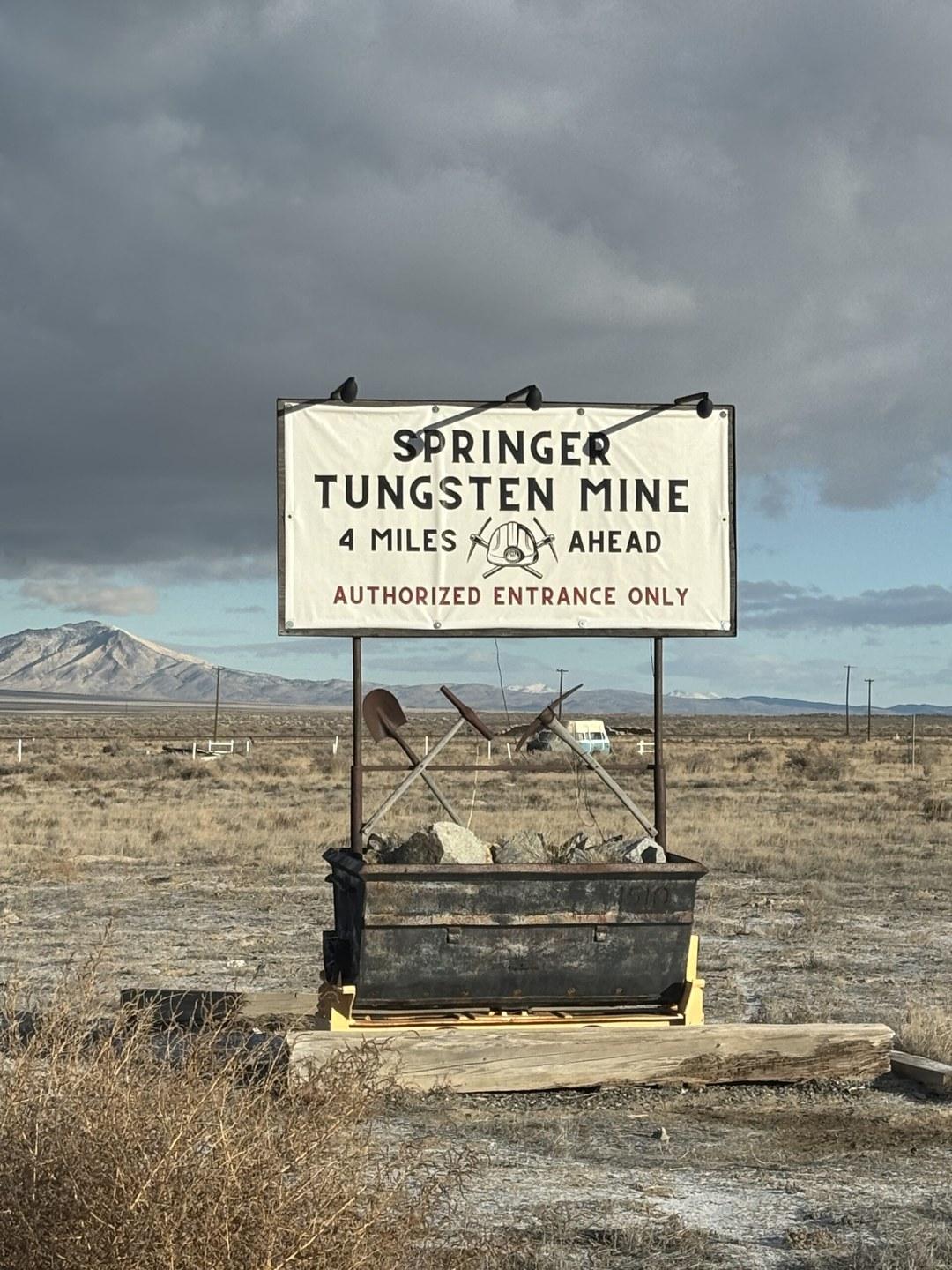
When the Season 1 tour runs Interstate 80 across northern Nevada, it will pass the Springer turnoff near Imlay, where a roadside sign — crossed picks over an ore cart — promises a tungsten mine four miles ahead. For 44 years that sign has pointed at a sleeping plant. Blue Moon Metals is the company that finally drove the four miles. This time, the drills and the millwrights get the next word.