
Treasure Hunter Chronicles. Every company in our purview has a story. This is Arizona Gold & Silver's.
The Captains
The treasure hunter here is the company — Arizona Gold & Silver Inc., a Vancouver-based explorer whose whole hunt runs on one Arizona fault system. But companies don't read veins; people do, and this hunt has an author. Greg Hahn is a Certified Professional Geologist with more than fifty years in the industry who, as vice president of exploration, led the modern re-examination of Philadelphia and read in its patented claims the high-grade Perry Vein the old miners had walked past. In January 2026 Hahn handed the day-to-day exploration to Dr. Lex Lambeck, the company's new senior vice president of exploration, and moved up to vice chair of the board — the discovery's geologist now guiding the hunt from the chair beside the map table. Mike Stark, president and chief executive, captains the company itself: the financings, the land deals, and the strategic investment from Australia's Evolution Mining that put the Philadelphia drills on a 24-hour rotation. Captains steer; they don't own the mountain. What matters for a long hunt is that the company holds both crafts at once — a geologist who has already found the vein, and a chief executive who can pay to chase it.
The Ground
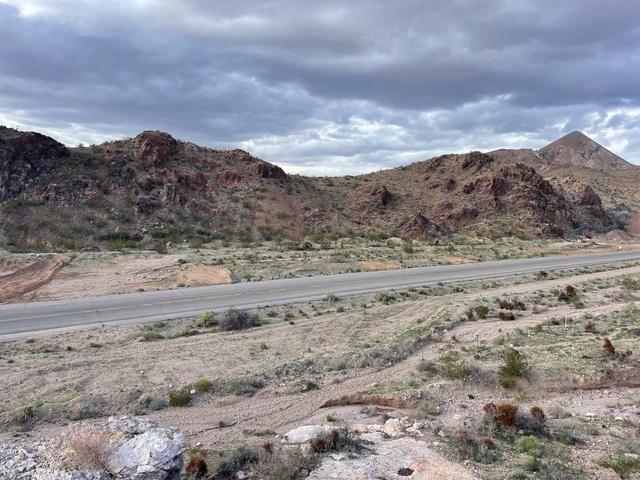
The Philadelphia Project covers some 4,300 acres in the Oatman district of Mohave County, northwestern Arizona — 100 percent controlled by the company, hard against the old highway corridor between Kingman and the Colorado River. The gold rides the Arabian Fault, a regional structure, in a system the company measures at three kilometres long. About half of that trend has been drilled. Four named targets carry the hunt: the Perry Zone, a high-grade vein inside a broad stockwork envelope that runs 40 to 80-plus metres thick and has been traced for more than 1,500 metres of strike; Red Hills, where a district-scale alteration footprint — the company compares its scale to AngloGold Ashanti's Silicon–Merlin system in Nevada — sits over a geophysical anomaly the drills are now testing at depth; and the Rising Fawn and Resaca patented claims, folded into the package in 2021. Paved road, a twelve-month drill season, and two historic processing sites within a short haul — the unglamorous infrastructure that decides whether a discovery can ever become a mine is already here.
The District
Philadelphia sits in one of the great American gold camps, and the camp's history is the property's dowry. Gold was first found in the Oatman district in 1863, by soldiers stationed at Camp Mohave on the Colorado River; John Moss made the first production from the Moss vein in 1863–64. The early surveys listed more than 85 mines in the district. The Gold Road vein was found around 1900 and the Tom Reed vein in 1901, but the district's thunderclap came in 1915, when the United Eastern orebody was located on the Tom Reed vein: by the time it was exhausted in 1924 it had produced some 550,000 tons of ore averaging about 1.1 ounces of gold per ton — roughly 616,000 ounces from a single orebody. The Gold Road mine ground on until 1942, producing about 1.5 million tons at a third of an ounce per ton. USGS compilations credit the district, from 1897 to 1942, with about 2.2 million ounces of gold and 0.8 million ounces of silver from 3.8 million tons of ore; the company, counting the wider camp, quotes two and a half million ounces and more. Then the Second World War shut American gold mining down, and the Oatman hills went quiet. The town of Oatman survives on the old highway — and, the town still tells it, on the burros in its streets, said to be the grandchildren of the miners' pack animals. Whether or not the bloodlines check out, the mines around it are real: the Moss Mine is an operating open pit again today, a few miles from Philadelphia's fence line.
The Mine the Highway Closed
Philadelphia's own story is stranger than the district's. The ground was discovered in the 1890s and mined as the Arabian-Philadelphia — a high-grade underground operation that, by the company's account, produced about 40,000 ounces of gold from some 80,000 tons of ore, at a cut-off grade of 0.4 ounces per ton. Ore was trucked eight miles to the Katherine Mill. What stopped it was not the vein running out. In 1934 the state highway came through the site and condemned further mining; the company's filings record that the mine was shuttered during the Second World War and allowed to flood, and it was never reopened. A highway did what low prices and worked-out ore usually do — it froze a producing mine in place, mid-story, with its lower levels underwater and its strike extensions untouched. In the 1980s, Meridian drilled a few holes above the highway. Then the file closed for another three decades. The old-timers had mined the vein they could see. The system the vein belongs to — thick, stockwork-hosted, bulk-tonnage in shape — was a kind of deposit their era had no use for and no tools to measure.
The Second Hunt
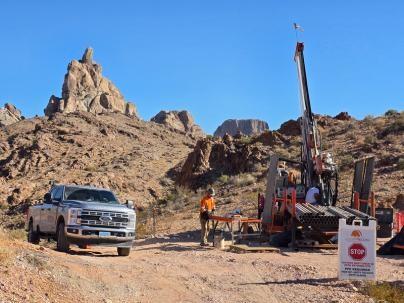
Arizona Gold & Silver began putting the pieces back together in February 2019, leasing eleven unpatented claims that cover most of the old Arabian-Philadelphia workings and their strike extension. In 2021 the company leased the patented claims themselves — Perry first, then Rising Fawn and Resaca — and drilling on the Perry claim that summer found what the flood and the highway had kept: a high-grade epithermal vein wrapped in a thick, lower-grade stockwork zone, increasing in grade with depth. The headline intercepts have stacked up since: hole PC25-156 returned 9.04 g/t gold and 34 g/t silver over 20.43 metres, inside 38.72 metres at 5.61 g/t gold; this September's infill drilling returned 90.71 metres at 1.45 g/t gold, including 9.94 metres at 5.58 g/t, and holes beneath Red Hills cut 43.59 metres at 1.48 g/t gold including 7.04 metres at 4.24 g/t. Metallurgy reported in June 2026 from a bulk sample ran as high as 99 percent gold recovery by agitation leach and 84 percent by heap leach. With Evolution Mining's strategic investment behind it, the company moved Philadelphia to round-the-clock drilling this year, stepping down-dip after the Perry Vein and testing the Red Hills anomaly; an amendment to expand the permitted exploration area by 200 acres and sixteen new drill pads is before the Bureau of Land Management. Philadelphia is the flagship, not the whole fleet: in Nye County, Nevada, the Silverton project pairs a Carlin-style gold system — past-worked by Newcrest — with surface antimony running as high as 7.95 percent, and in southern Arizona the Sycamore Canyon breccia carries surface samples up to 31 g/t gold and has never been drilled at all.
Now the honest ledger, because a Chronicle keeps one. There is no mineral resource at Philadelphia yet — not a small one, not a historic one the company will stand behind. The initial resource is the stated destination of the drilling now under way, and the company's conceptual exploration target for the Perry Zone is exactly that: conceptual. The grades quoted above are real intercepts from named holes, but intercepts are not a mine; the historic production figures come from the company's own account of a mine whose records predate modern standards; the district totals differ by source, as district totals from that era always do; and the BLM expansion remains an application, not a permit. What is true today is narrower and still considerable: a three-kilometre gold-silver system on a proven district's fault, a high-grade vein that thickens and enriches downward, metallurgy that cooperates, a strategic backer paying for speed, and drills turning day and night an hour from Kingman.
When the Season 1 tour crosses Mohave County it will drive the same highway corridor that closed Philadelphia in 1934 — past the Red Hills, where the rigs now run around the clock over a vein system the twentieth century buried twice, once under water and once under asphalt. Arizona Gold & Silver dug it back up. The drills get the next word.