Treasure Hunter Chronicles. Every company in our purview has a story. This is Bornite's.
- 8.08% copper equivalent over 71.0 feet — hole CC30, reported October 28, 2026: the strongest modern result yet off Bornite's historical core, inside 110 feet grading 5.87% CuEq, the 71-foot interval itself running 6.11% copper
- 6.17% CuEq over 170 feet — hole CC24, reported October 14, 2026, inside 190 feet at 5.59% CuEq: 2.88% copper, 0.045 oz/ton gold and 0.822 oz/ton silver across the full run
- 3.26% CuEq over 190 feet — hole CC26, with a second, deeper run of 270 feet at 1.27% CuEq beneath it
- Up to 28% higher — modern CuEq values against the historical assays in certain intervals of the first two holes; the company itself cautions the sample is too small to call the trend statistically significant
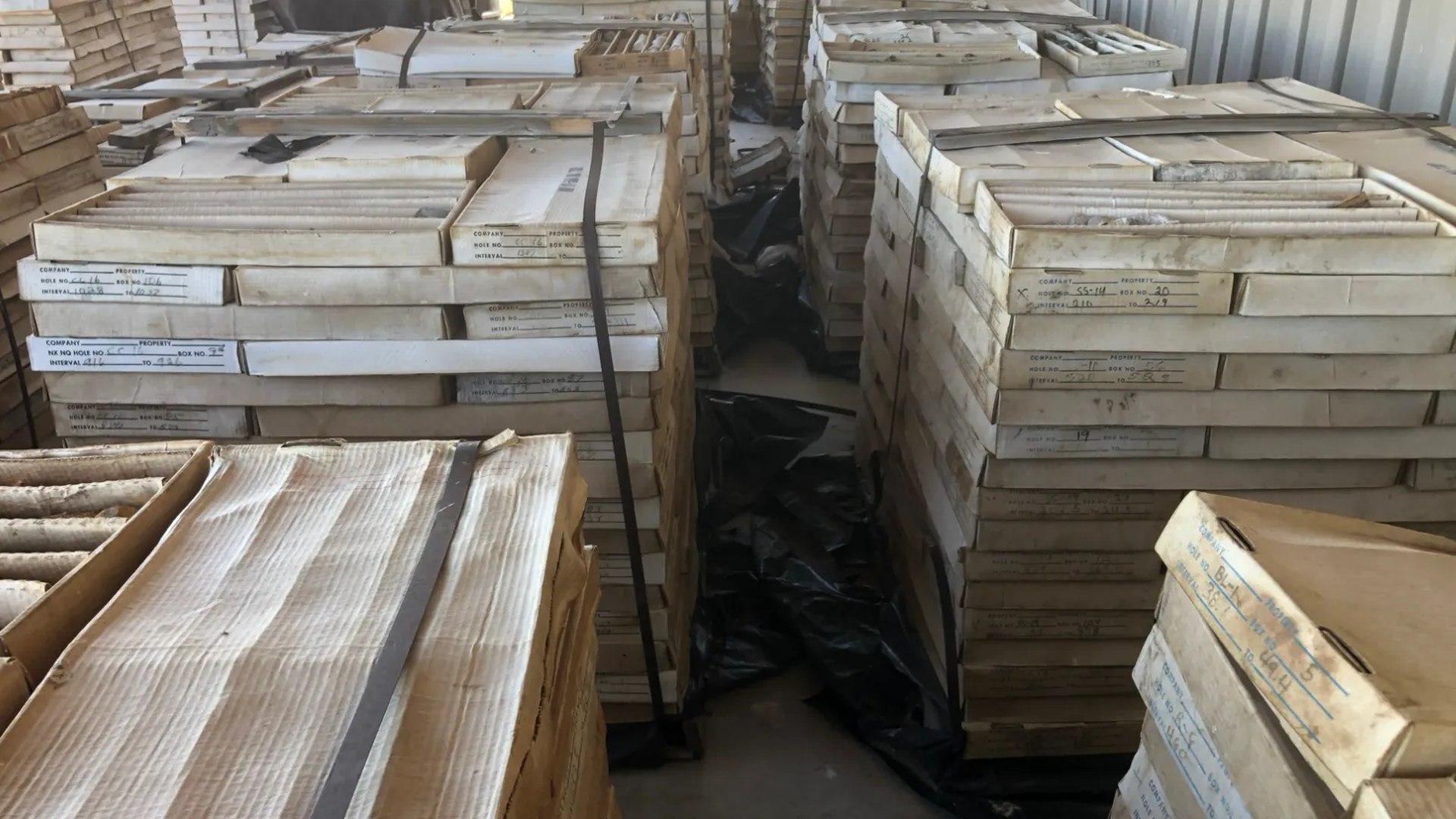
- 41,702 feet — of historical drilling completed at Bornite between 1976 and 1990. The core survived in storage; roughly 30 pallets of it were trucked to Reno in 2026, re-logged box by box, and are now being re-assayed
- 450 feet across and more than 1,000 feet down — the breccia pipe itself: a vertical, cigar-shaped body of broken rock cemented with bornite and chalcopyrite, its high-grade outer shell modelled at roughly 2.4% copper, open at depth
- 3.2 million tons at 2.2% copper — Plexus Resources' early-1990s estimate: 138.5 million pounds of copper, 54,000 ounces of gold and 1.7 million ounces of silver. A historical estimate, made before NI 43-101 existed — not a current resource
- US$100,000 — the total cash Ameriwest paid for a 100% interest in Bornite in November 2025: 34 claims, the historical database, and the core
- Four holes still in the lab — of the seven-hole re-sampling program. Three have reported, and all three carried long runs of high-grade copper
- Five more pipes to hunt — additional breccia-pipe-style targets the company has outlined from historical soil sampling and mapping around the known pipe
The Pipe in the Cedar Creek Valley
Fifty miles east of Salem, the Little North Santiam River cuts down out of the Oregon Cascades through some of the most loved forest in the state — the Opal Creek country, old growth and swimming holes, much of it burned in the 2020 Beachie Creek Fire and still closed to the public. North of the town of Detroit, along Forest Service Road 2207 in the glaciated valley of Cedar Creek, at about 2,200 feet elevation in the Willamette National Forest, there is a hole in the ground that is not a hole at all: a pipe.
The Bornite deposit is a breccia pipe — a roughly cylindrical, vertically standing body of shattered rock, about 450 feet in diameter, drilled from surface to more than 1,000 feet deep and still open at the bottom. The broken rock is cemented with copper minerals, principally bornite and chalcopyrite, deposited mainly along the pipe's margins. That geometry is the whole economics of the place in one picture: a high-grade outer shell — modelled by the company's consultants at roughly 2.4% copper — wrapped around a lower-grade interior averaging about 0.60% copper, with a third, sheeted-vein zone at about 0.9%. Small footprint. Very rich rock.
The pipe takes its name from the mineral that makes it. Bornite — Cu5FeS4 — is the "peacock ore" of every rock shop on Earth, tarnishing iridescent blue, purple and gold. In the Cedar Creek valley it is not a curiosity. It is the ore.
Ameriwest Critical Metals Inc. (CSE: AWCM; OTCQB: AWLIF; Frankfurt: 5HV), a Vancouver exploration company, owns 100% of it. What it bought, though, was not just a pipe. It bought a fifty-year-old argument about whether this particular piece of Oregon should ever be a mine — and a warehouse full of the evidence.
A District That Was Mining Before It Was Wilderness
The North Santiam country was mining country long before it was wilderness country. In the late 1800s and early 1900s, numerous small mines around Detroit dug copper, gold, silver and zinc out of these hills. Jawbone Flats — today the trailhead settlement of the Opal Creek Ancient Forest Center, the educational heart of the wilderness — started out as a mining camp.
The wilderness itself owes its existence, in part, to mining law. George Atiyeh, the man who led the fight to save Opal Creek's old-growth forest, used the mining laws to block logging and help create what became the Opal Creek Wilderness and Scenic Recreation Area — 36,000 acres of protected forest. And when the boundaries of that wilderness were drawn, the ground around the Bornite Project was deliberately carved out and left unprotected. The mapmakers of the 1990s knew the pipe was there. They left a door open for it.
Below the pipe, Cedar Creek runs into the Little North Santiam, and the Little North Santiam into the North Santiam River — the drinking water supply for Salem, Stayton and the towns of the Santiam Canyon. That hydrology is the reason this deposit has a second, parallel history written in water law, and it is where the story turns.
The Mine That Almost Was
Amoco Minerals discovered the Bornite deposit in 1975. Through the late 1970s and 1980s the pipe was drilled — 48 holes and some 41,702 feet of core by 1990 — and the grades kept saying the same thing: small, vertical, and rich.
In 1989, Salt Lake City-based Plexus Resources Corporation purchased the claims and took a serious run at building the mine. The work was thorough: years of exploratory drilling and study, an environmental assessment, a prefeasibility analysis by December 1992 built on metallurgical test work, and a plan for a highly mechanized underground mine of about 1,400 tons per day feeding an on-site flotation concentrator — roughly a decade of life, one year of construction, eight of mining and milling, one of reclamation, with 79 jobs at the planned operation. The project was approved by the Forest Service and adopted into the management plan for the Willamette National Forest. Plexus's own estimate of the prize: 3.2 million tons at 2.2% copper, with gold and silver riding along — 138.5 million pounds of copper in a pipe you could walk around in twenty minutes.
What stopped it was water. Oregon's Three Basin Rule, a 1976 law protecting the North Santiam, McKenzie and Clackamas rivers, prohibits new or increased wastewater discharge into those basins. The mine could not get a permit to discharge its treated wastewater, and without discharge there was no mine. The project stalled in the mid-1990s, Plexus merged into Kinross Gold, and in 2002 Kinross dropped the property. The claims were re-staked in 2004 by Idaho General Mines and then sat idle — through the copper booms, through the critical-minerals era, through the Beachie Creek Fire that burned over the site in 2020.
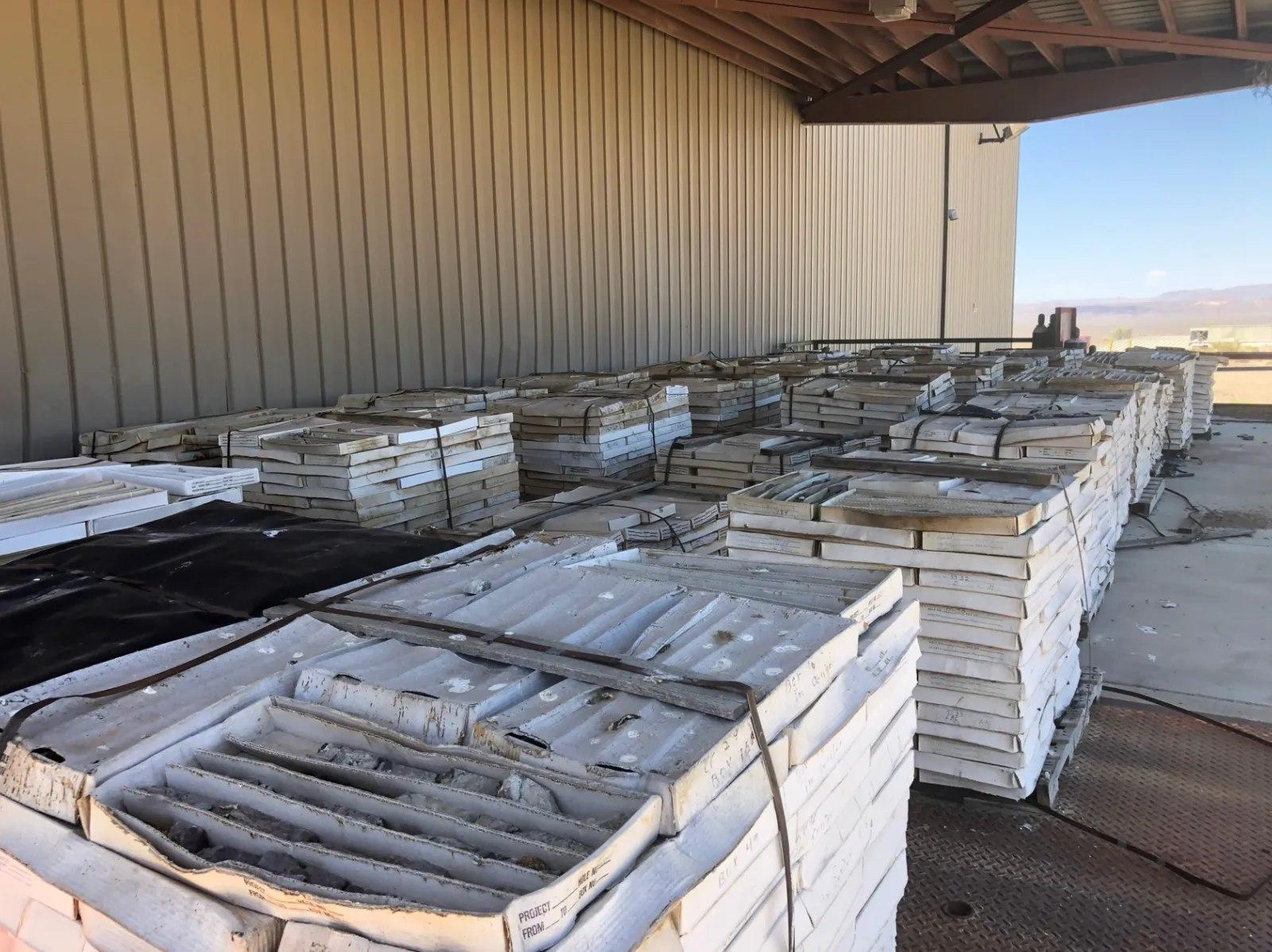
But the core never got thrown away. Prior owners preserved it — all of it, stored for decades at a facility at the Liberty Mine near Tonopah, Nevada. In the exploration business, that almost never happens. Core is bulky, storage costs money, and dead projects usually end with the boxes bulldozed. Bornite's evidence survived its obituary.
The Engineer Who Came Back
Here is the detail that turns this from a data story into a treasure hunt: the man who bought Bornite in 2025 had worked on it in the 1990s.
David Watkinson, P.Eng., Ameriwest's President and CEO, is a mining engineer — Queen's University, class of 1985, forty years in underground and open-pit mine development, with senior positions at Placer Dome, Kinross Gold and Thyssen Mining Construction along the way. He worked on the original Bornite project during the Plexus era. And then, by his own account to the Salem Statesman Journal, he spent years trying to buy it: "I tried to acquire it several times over the years and was never able to reach a deal that made sense."
In April 2025, Ameriwest signed a binding letter of intent. That August, the company changed its name from Ameriwest Lithium to Ameriwest Critical Metals — the pivot, announced in plain sight. On November 13, 2025, the acquisition closed: 34 unpatented mineral claims in Marion County, the historical technical information, and the core, for US$100,000 in cash and a US$15,000-a-year advance minimum royalty to one of the vendors. A deposit that a 1990s prefeasibility study was built around changed hands for the price of a house down payment — because what was actually for sale was not the copper. It was the verification problem. The copper only becomes real when somebody proves the old numbers under modern rules. That proof is the work of 2026.
The Core Starts Talking
Ameriwest moved methodically. APEX Geoscience Ltd. was retained in March 2026 to compile and digitize the historical record. In April, APEX delivered a preliminary 3D geological model — the high-grade shell, the interior pipe, the sheeted-vein zone, and expansion targets on the southeast and northwest flanks. In May, roughly 30 pallets of preserved core were relocated from Tonopah to APEX's secure facility in Reno for re-logging and photography; the re-logging of every available box was complete by August. In June, the company published the digitized historical database — and the historical numbers were as rich as advertised: hole CC11 with 110 feet of 10.831% CuEq, hole CC02 with 140 feet of 9.423% CuEq, hole CC03 mineralized for 980 feet at 1.453% CuEq. Historical numbers, though, are a claim, not a fact. The re-sampling program — quarter-core cut from the preserved half-core of seven historical holes, assayed by modern multi-element methods — was designed to test them.
"Bornite is an exceptional copper deposit with both higher-grade and lower-grade components. In the 1990s, Plexus was focused on developing a high-grade underground copper mine, concentrating on mining the high-grade shell of the deposit. Subject to exploration success and further economic analysis, with today's mineral prices, we expect that the interior pipe may also be minable." — David Watkinson, P.Eng., President and CEO, Ameriwest Critical Metals (June 3, 2026)
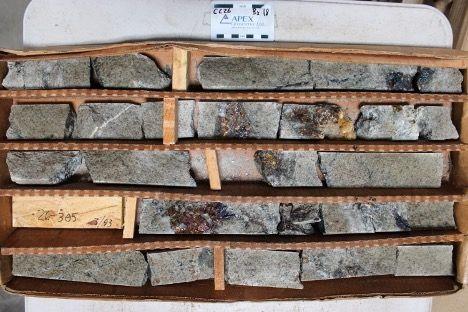
The first verdicts arrived on October 14, 2026. Hole CC24 returned 190 feet grading 5.59% CuEq, including 170 feet at 6.17% CuEq. Hole CC26 returned 190 feet at 3.26% CuEq, with another 270 feet at 1.27% CuEq deeper in the pipe. And the modern numbers did not merely confirm the old ones — in certain intervals they ran higher, with CuEq values up to 28% above the historical database, a trend the company is careful to call preliminary on a small sample.
"Reporting 190 feet grading 2.88% Cu, 0.045 ounce per ton Au, and 0.822 opt Ag (5.59% CuEq), including 170 feet at 3.16% Cu, 0.050 opt Au, and 0.909 opt Ag (6.17% CuEq), represents a strong start to our re-sampling program." — David Watkinson, P.Eng., President and CEO, Ameriwest Critical Metals (October 14, 2026)
Two weeks later, on October 28, hole CC30 raised the bar again: 110 feet grading 5.87% CuEq, including 71.0 feet at 8.08% CuEq — the included interval running 6.11% copper, with modern copper grades about 6% higher than the historical values over both intervals.
"An interval of 71.0 ft (21.6m) grading 6.11% Cu (8.08% CuEq) is a result that speaks for itself. When you consider that it sits within a broader 110.0-foot (33.5 m) interval grading 4.47% Cu (5.87% CuEq), these are impressive copper grades. This is now the third historical drill hole from which we have reported substantial copper mineralization through modern assaying, and CC30 has delivered the highest copper grade among the principal intervals we have highlighted to date." — David Watkinson, P.Eng., President and CEO, Ameriwest Critical Metals (October 28, 2026)
Three holes reported. Three holes confirmed — at grades most copper explorers never see at any width. Four holes remain in the lab queue.
The People
A Chronicle names its captains, and Bornite's is easy to identify.
David Watkinson, P.Eng., President, CEO and director — Ameriwest's chief executive since July 31, 2020, and the company's Qualified Person under NI 43-101: the man promoting the story is, again, the man who has to sign for the technical disclosure. His forty years run through Placer Dome, Kinross Gold, Thyssen Mining Construction of Canada and Vulcan Materials, and his history with this specific pipe runs back to the 1990s. His week is not spent only in Oregon — he also serves as President and CEO of Emergent Metals Corp. and, since November 2025, of Rise Gold Corp. — but Bornite is the project he chased for years before he could buy it, and the releases carry his name on the technical content.
Robert C. Hill, CFO since May 23, 2023 — a Chartered Professional Accountant with roughly 25 years in accounting, finance and senior management, formerly Vice President, Finance and Business Development at Haywood Securities. The board around them: directors James Gheyle and Saman Eskandari, independent director Bryson Goodwin (appointed as the Bornite acquisition closed), and Corporate Secretary Melissa Vettoretti. The technical program itself is executed with APEX Geoscience Ltd. of Edmonton and Reno — the firm that built the 3D model, re-logged the archive and selected the re-assay intervals.
It is a small crew for a fifty-year-old file: a chief executive who knew the deposit as a young engineer, a Bay Street-trained finance chief, and a contract geology shop in Reno with 30 pallets of other men's core.
More Than One Mountain
Bornite is the flagship now, but Ameriwest was born a lithium company — the name change in August 2025 marks the turn. The lithium portfolio is still there, and parts of it sit in very good neighbourhoods.
Deer Musk East, in Nevada's Clayton Valley, is the keeper: 283 placer claims covering roughly 5,600 acres of lithium brine exploration ground about five miles from Albemarle's Silver Peak operation — the only producing lithium mine in the United States. Ameriwest acquired it in January 2021 and has a NI 43-101 technical report on it; it remains early-stage, with the recommended first-phase work being the soil sampling, rock-chip sampling and geophysics its own technical report lays out. The company also holds a second Nevada lithium brine property in Edwards Creek Valley, and in Arizona the Thompson Valley property in Yavapai County — hectorite lithium clays at or near surface, where the company reports historic and recent sampling with grades it compares to the clay deposits of Clayton Valley.
What the company has been shedding tells the same story as what it is keeping. In August 2026 Ameriwest agreed to sell its Railroad Valley lithium brine property in Nevada to Pure Energy Minerals — 8,000,000 Pure Energy shares plus a 2.0% net smelter returns royalty — and a definitive agreement followed in November 2026. In September 2026 it agreed to sell the Xeno rare earth property in British Columbia, closing a $500,000 private placement at $0.26 a share with a strategic investor in connection with that transaction in October. The direction of travel is unmistakable: out of the scattered lithium-and-rare-earth portfolio, into one small, rich pipe of Oregon copper.
Where It Stands
Honesty is the house rule in this series, so here is the ledger, straight.
There is no current mineral resource at Bornite — none — and no mineral reserve, and the company says so itself in every release. The 3.2-million-ton, 2.2%-copper figure is a historical estimate from the early 1990s, made before NI 43-101 and CIM standards existed, uncategorized, and not to be relied on as current. The dazzling historical intercepts — 110 feet at 10.831% CuEq and the rest — are likewise historical data, unverified by a Qualified Person, which is precisely why the re-sampling program exists. The modern results are real, modern, laboratory assays — but they are assays of old core, verifying a historical database, not new drilling; the company itself notes that confirmation and infill drilling will likely be needed before the data can carry a current resource estimate, and that there is no assurance the verification work produces one. Four of the seven re-sampled holes have not yet reported. If they disappoint, this Chronicle's first act reads differently.
Then there is the ground itself, and the water under it. Bornite sits in the headwaters of Salem's drinking-water supply, on the boundary of a beloved wilderness that is still recovering from a 2020 wildfire, in a state with some of the strictest mining rules in the country, under a 1976 law — the Three Basin Rule — that killed this exact mine once already by denying it a wastewater discharge permit. Organized opposition exists and says so plainly: "We will advocate against this mine being built," Nathan Reynolds of the Opal Creek Ancient Forest Center told the Statesman Journal. The company has also staked 53 additional claims nearby, some of which critics say fall in areas withdrawn from mining in 1996; Watkinson says they protect the core ground and hunt for other pipes, and has acknowledged they may not all be valid. Ameriwest launched a formal community and stakeholder engagement program in June 2026 — early, by industry standards — and holds a Forest Service road-use permit to reach the site through the fire closure. But the captain's own timeline is the most honest line in the file: mine permitting in the United States traditionally takes ten to twenty years, and in Watkinson's words, "It won't happen overnight. This is just the start of a long process."
And the money: Ameriwest is a micro-cap explorer financing itself in small tranches — the most recent a $500,000 placement in October 2026. Everything in this Chronicle is early, and the distance from "the core verifies" to "a permitted Oregon copper mine" is measured in years of drilling, study, process and politics, any one of which can end the story the way the Three Basin Rule ended it in 1995.
Set against all of that: a high-grade copper system whose old numbers are, so far, checking out better than reported; a complete, preserved drill archive that gives this junior a decade's head start no amount of money could buy quickly; five additional pipe targets in the same camp; and a chief executive who has already spent one career decade on this deposit and came back for it. The pipe is small. The grade is the thesis. The verification is the story.
What Happens Next
The near calendar is written by the lab. First: assays from the remaining four holes of the seven-hole re-sampling program, completing the modern check on the historical database. On those results hangs the company's stated objective — deciding whether the verified database, the re-logged core and the 3D model are sufficient to support an initial current mineral resource estimate under NI 43-101, and what confirmation drilling is required to get there. In parallel, Ameriwest is designing and permitting an initial drill program at Bornite — new holes in a pipe that has not felt a drill bit since 1990 — and continuing the stakeholder engagement program it started in June. The Railroad Valley sale to Pure Energy Minerals, under definitive agreement since November, works toward closing.
But the larger story is the one the core boxes tell. A copper pipe was found in the Oregon Cascades in 1975 and drilled into a near-mine by 1992 — then stopped, not by geology, but by a water rule and a merger. The deposit sat out thirty years of history: a wilderness drawn around it, a wildfire over it, a critical-minerals age that arrived, at last, speaking its language. Through all of it, in a warehouse in the Nevada desert, 41,702 feet of drill core waited in labelled boxes — the whole argument, preserved. The engineer who had worked the project as a young man spent years trying to buy it, and when he finally did, for US$100,000, he did not start by drilling. He started by opening the boxes.
The treasure, as always, was never the point. The hunt was. At Bornite, the hunt begins with a saw, a quarter-core at a time — and so far, the old rock is telling the truth.