
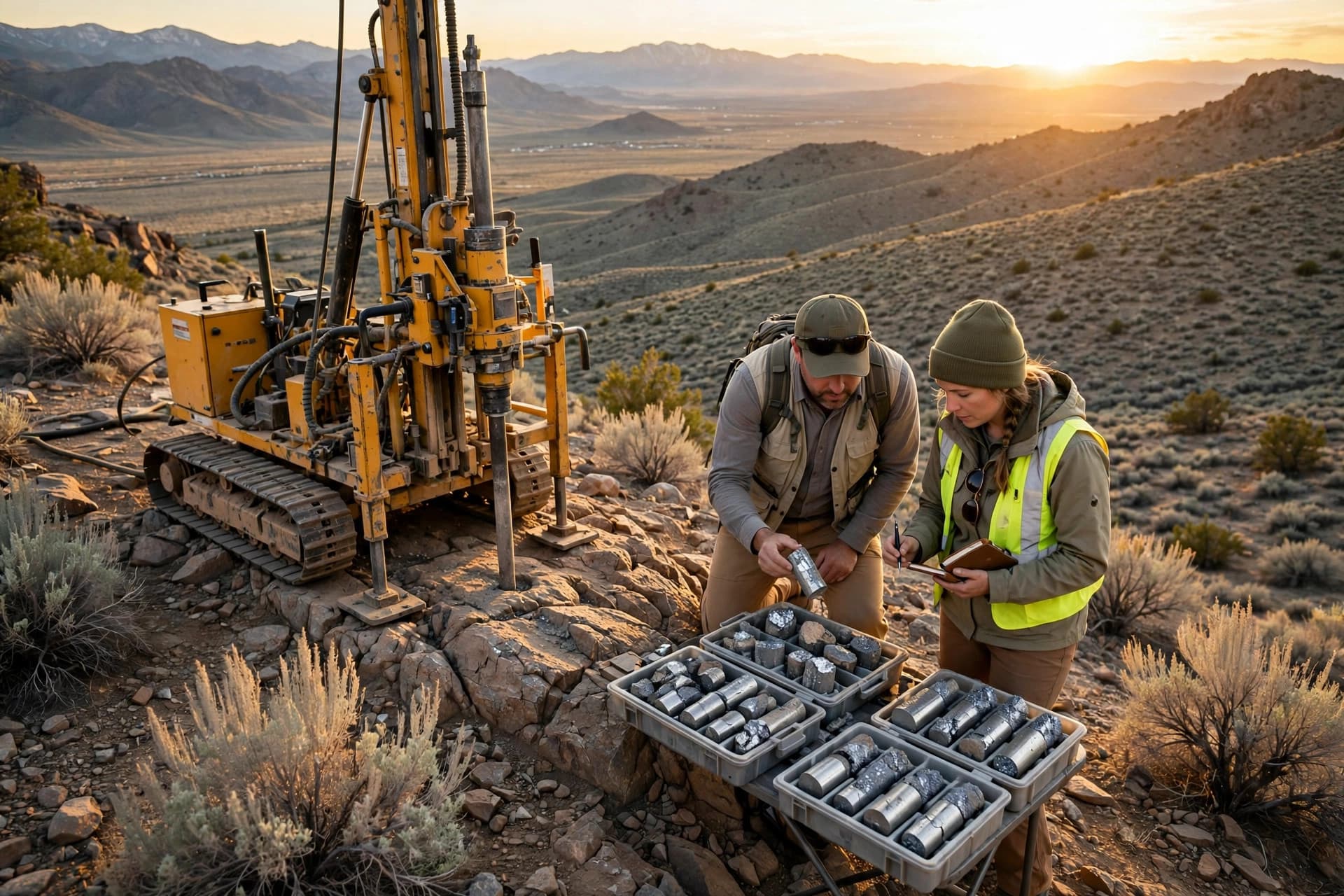
The drill has found a new pocket of the system at South Mountain. Thunder Mountain Gold reported on October 26 that its 2026 core program in Owyhee County, Idaho intersected new carbonate replacement deposit (CRD) mineralization at Kentucky Ridge, about 250 metres northwest and on strike of the known CRD zone — and that drilling at two other targets cut the porphyry-style rocks the company believes may be the engine behind the district's massive sulfides.
- New CRD step-out at Kentucky Ridge: hole SM26-062 intersected 22.28 metres grading 2.07% Zn and 9.00 g/t Ag, including 14.81 metres at 2.98% Zn and 11.9 g/t Ag, about 25 metres down-plunge from a surface gossan that channel-sampled 7.6 metres at 125 g/t Ag, 1.2% Pb and 1.7% Zn.
- Known zone extended toward surface: hole SM26-060 returned 2.38 metres at 29.2 g/t Ag and 0.455 g/t Au, extending DMEA Zone mineralization up-dip.
- Gold Breccia: hole SM26-054 returned 55.17 metres at 0.112 g/t Au from surface, including 3.0 metres at 0.657 g/t Au.
- Birthday porphyry confirmed, assays pending: two holes beneath a strong magnetotelluric (MT) anomaly cut five porphyry intrusive phases with intense sericite alteration and pyrite-biotite ± quartz veinlets with notable chalcopyrite. All Birthday assays are still pending.
- Program complete: 14 core holes totalling 2,670 metres (8,760 ft); assays received for 9 holes, results for 5 holes pending, including SM26-063 beneath the Kentucky Ridge intercept and all Birthday holes.
Two stories in one program
Ten of the fourteen holes chased the CRD itself — extensions of the known 800-metre zone of cigar-shaped massive sulfide bodies in the Laxey Marble, and new occurrences beyond it. Kentucky Ridge is the headline: company geologists read the SM26-062 intercept and the gossan above it as the possible upper expression of a new CRD body a quarter-kilometre from the known zone. Southeast step-outs SM26-058 and SM26-059 cut intensely altered marble and a felsic dike with elevated silver (6.74 m at 4.90 g/t Ag; 0.94 m at 6.32 g/t Ag), which the company reads as possibly the fringe of another body.
The other four holes tested the source question. At Gold Breccia, a target first identified in 2009, SM26-054's long low-grade gold run sits in breccia above granodiorite carrying porphyry-style textures and alteration. At Birthday, under basalt cover, the two completed holes cut five porphyry phases with the zoned alteration shells that form around mineralized porphyry systems. South Mountain is a historic producer — mining began in the 1860s, Anaconda developed it from World War II into the late 1960s, and historical smelter records cited by the company show about 53,642 tons shipped at average grades of 14.5% Zn and 363 g/t Ag — but those are historical figures, not a current mine plan.
The honesty box
The Kentucky Ridge intercept is a single step-out hole: one intercept does not make a CRD body, and SM26-063, drilled beneath it, has no assays yet. The Birthday "confirmation" is geological, not numerical — textures, alteration and visible chalcopyrite, with every Birthday assay pending; the company itself cautions that CRD or porphyry textures and sulfides do not necessarily indicate economic mineralization. The Gold Breccia gold grades (0.112 g/t over 55.17 m) are low-grade bulk intervals, not high-grade hits. The 2023 mineral resource estimate referenced in the release is a separate, earlier disclosure; nothing in this release updates it, and the historic Anaconda-era production grades are historical records, not compliant current resources. The Qualified Person who reviewed the release, the company's Senior VP of Exploration, is not independent of the company.
What to watch
The five pending assay sets — above all SM26-063 under Kentucky Ridge and the Birthday holes — then the IP survey and soil-grid results the company is using to lay out a planned 2027 drill program, and whether untested MT anomalies get holes of their own.