
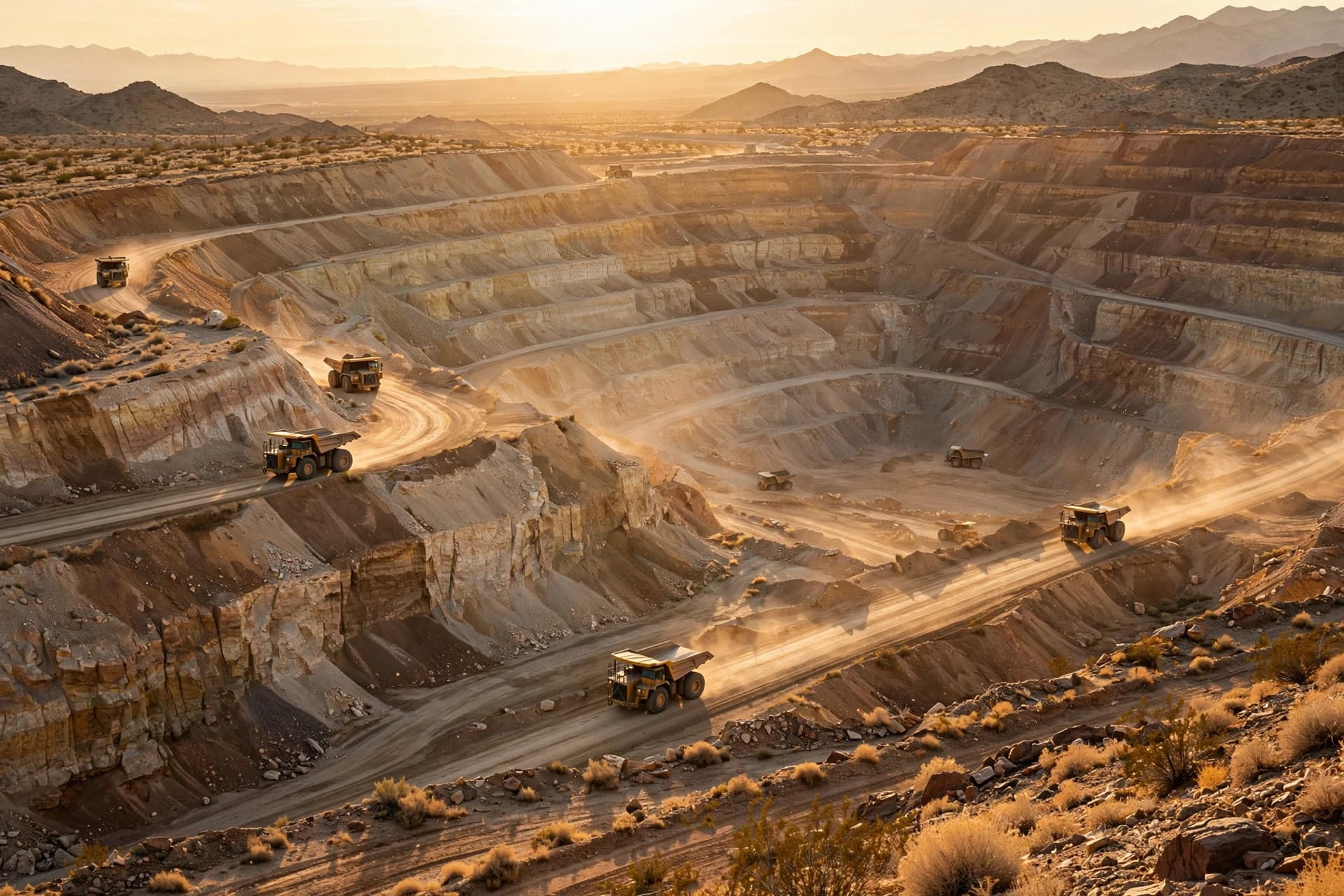
Nevada's Battle Mountain-Eureka trend got a longer runway this week. SSR Mining released an updated technical report summary for its Marigold complex in Humboldt County and, in a companion announcement, a deal to buy the company holding the Converse gold project a short haul away.
- Marigold's proven and probable reserves now total 4.6 million ounces of gold — about 359 million tonnes at 0.40 g/t — up 43% from 3.2 million ounces at year-end 2025.
- The plan runs 20 years in total, with 15 years of active mining. Average output is put at 231,000 ounces a year from 2027 to 2031, 201,000 ounces a year through 2040, and 169,000 ounces over the full life.
- The after-tax net present value at a 5% discount is $3.3 billion in the base case, using consensus prices averaging $3,948 an ounce. Reserves themselves were calculated at a much lower $2,200 an ounce, resources at $2,500.
- The plan folds in the Buffalo Valley deposit for the first time, with 0.7 million ounces of reserves and first production expected in 2029. Growth capital over the life of mine is $542 million, including Buffalo Valley and a larger mining fleet.
- Separately, SSR agreed to acquire Roxmore Resources for C$6.75 a share in cash, plus shares in a new exploration spin-out. Roxmore's Converse project sits about six kilometres west of Marigold.
What Converse would add
Converse is not yet a reserve. Its 2026 estimate, as cited by SSR, is a mineral resource: 103 million tonnes indicated at 0.65 g/t for 2.2 million ounces, plus 218 million tonnes inferred at 0.43 g/t for 3.0 million ounces. Inferred resources carry the lowest geological confidence and cannot be treated as reserves.
SSR says it would develop Converse as a contiguous part of the Marigold complex, using the same price assumptions as the Marigold report rather than the higher $3,000-an-ounce shell used in Roxmore's own preliminary assessment. On that basis it sketches 150,000 to 170,000 ounces a year for more than a decade, with first production targeted for 2033, initial capital of $800 million to $900 million, and no material spending until the early 2030s. It also estimates more than $200 million in life-of-mine synergies from operating the two together rather than separately — an estimate, not a realised saving.
The deal still needs Roxmore securityholder and court approval and is expected to close in the fourth quarter of 2026. Converse would then need federal permitting, including baseline studies and an environmental impact statement process.
Why this matters in Nevada terms
Marigold has been producing since 1989 and has already yielded more than five million ounces, according to the company. A reserve jump of this size, achieved while measured, indicated and inferred resources stayed broadly flat, is mainly a conversion story: material already known in the ground has been engineered into a mine plan. That distinction matters — reserves are the portion judged economically mineable in the study; resources are not.
Taken together, the report and the acquisition point the same direction: fewer, larger, longer-lived gold complexes on the Battle Mountain-Eureka trend, rather than a patchwork of short-life pits. Whether Converse joins that complex on the sketched timetable depends on the vote, the permitting path, and drilling to lift inferred material into higher-confidence categories.