
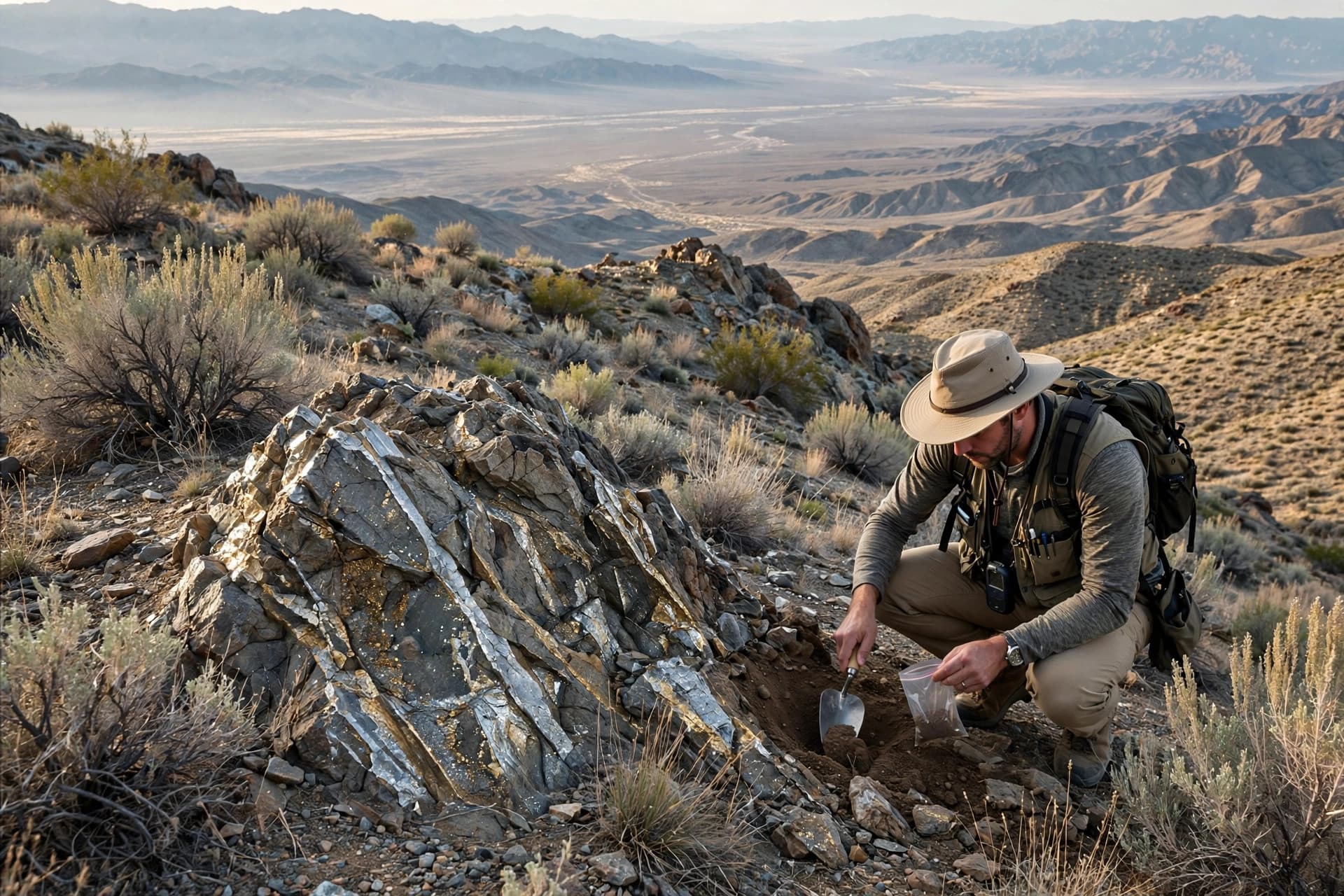
Sometimes the map is the news. On October 7, Silver47 Exploration (TSXV: AGA) reported results from a property-wide soil geochemical survey at its wholly owned Kennedy gold-silver project in Nevada — 2,924 samples over roughly 18 square kilometres, tightening a district-scale target picture ahead of first drilling.
- Strong gold and multi-element soil anomalies coincide with a roughly 15 km high-grade vein network, including a continuous ~1.3 km gold-in-soil anomaly along the Cricket-Accident trend.
- Previously reported selective vein samples in the northeastern vein field returned up to 39.4 g/t gold with 370 g/t silver (Cricket-Accident) and 19.5 g/t gold with 273 g/t silver at Danneburg, among others. Selective samples are not necessarily representative of mineralization across the vein field.
- Soil anomalies extend about 1 km north of the historic Gold Note mine — the district's principal historical producer — toward the Chromo, Hidden Treasure and Varrell targets, and about 600 metres northwest of the Danneburg veins. Both extensions are now priority follow-up areas.
- At Lamberson, a roughly 500 m by 600 m gold anomaly with a molybdenum-copper-bismuth-antimony pathfinder signature sits over broad pyrite and propylitic alteration, which the company interprets as a possible intrusion-related disseminated gold target alongside the high-grade veins.
- The soil data are being integrated with geological mapping, rock sampling and drone magnetics. A direct-current induced polarization (DCIP) survey is planned over the main corridors to rank targets for inaugural drilling.
A district learning to read itself
Kennedy sits 70 km south of Winnemucca. Most historical production came from the Gold Note mine, centered on high-angle quartz veins traced for over 350 metres. Silver47's bet is that the surface geochemistry now traces those vein systems beyond the old workings — and that Lamberson may be a second style of target entirely: broader, disseminated, and tied to alteration rather than just narrow veins.
That two-target thesis is what makes this more than a routine soil headline. Vein fields reward precision drilling; disseminated systems reward bulk-tonnage thinking. Having both in one 18 km² grid gives the company options when the DCIP results land and the first drill program is ranked.
One caveat, kept visible
Soil anomalies find targets; they do not find resources. No drilling has tested Kennedy under Silver47 yet, historical rock and dump samples have not been independently verified except as stated, and none of the grades cited here constitute a mineral resource. The next honest milestone is the IP survey and, after that, drill holes — the step where Nevada projects either graduate or go quiet.