
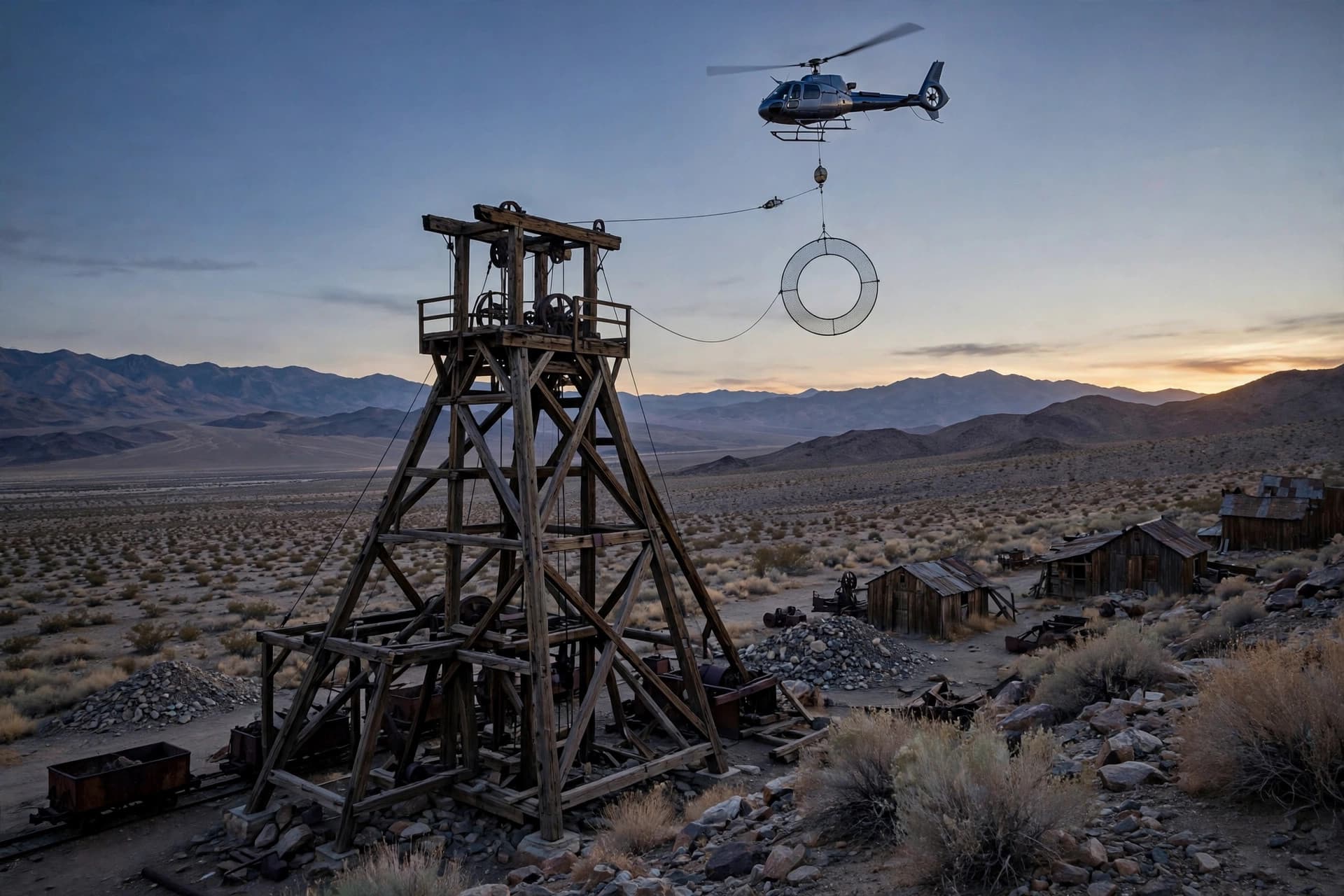
A survey flown last spring over one of Nevada's old silver camps has come back with a much bigger map. Silver One Resources reported the processed results of its May 2026 ZTEM airborne electromagnetic survey at the Candelaria project, and then staked the ground the results pointed to.
- Geotech's processing and 3D modelling identified seven additional silver targets and six possible copper-silver-gold porphyry targets, all flagged for follow-up work.
- Silver One staked 382 new claims covering 3,128 hectares (7,730 acres) next to the southwestern side of the property to secure those anomalies.
- Early field checks on the anomalies found old workings and alteration, with selected rock samples running up to 4.89% copper and 272 g/t silver. Selected samples are chosen specimens, not average grades.
- The company cites an existing Candelaria resource of 126.6 million ounces silver-equivalent measured and indicated (120.7 million ounces silver and 242,000 ounces gold) and 13.4 million ounces silver-equivalent inferred — figures from its earlier disclosure, restated in this release.
- A 25,000-metre drill program aimed at extending mineralisation beyond the current resource is already in progress, according to the company.
Two different kinds of target
The silver targets are the near-ground story: mostly east-west trending, low-resistivity zones interpreted as possible manto-style mineralisation — the flat-lying style Candelaria was historically mined for. One of them is described as the northeastern extension of the Mount Diablo and Northern Belle ground that is already being drilled.
The porphyry targets are a deeper, more speculative idea. They were picked out as resistive cores wrapped in conductive envelopes, ranging from a few hundred metres to one or two kilometres across. Historic geological work from 1990 had already suggested Candelaria's silver sat above a deeper intrusive system; the company says the new geophysics supports revisiting that idea. Support is not proof — none of the six has been drilled as a porphyry target yet.
More than half the property is covered by younger volcanic rock or transported material, so the company expects follow-up to lean on ground geophysics, soil sampling and stratigraphy before collars are chosen.
Keeping the categories straight
Candelaria is a past-producing project with a stated resource and a pre-feasibility study in progress — that part is established disclosure. The 13 new targets are geophysical interpretations backed by limited surface sampling. They extend the exploration search space considerably, and the claim staking shows the company acting on them, but a resistivity pattern is not a discovery. The drill program already under way, and any future drilling on the new southwestern ground, is what will test whether the patterns correspond to mineralisation at depth.