
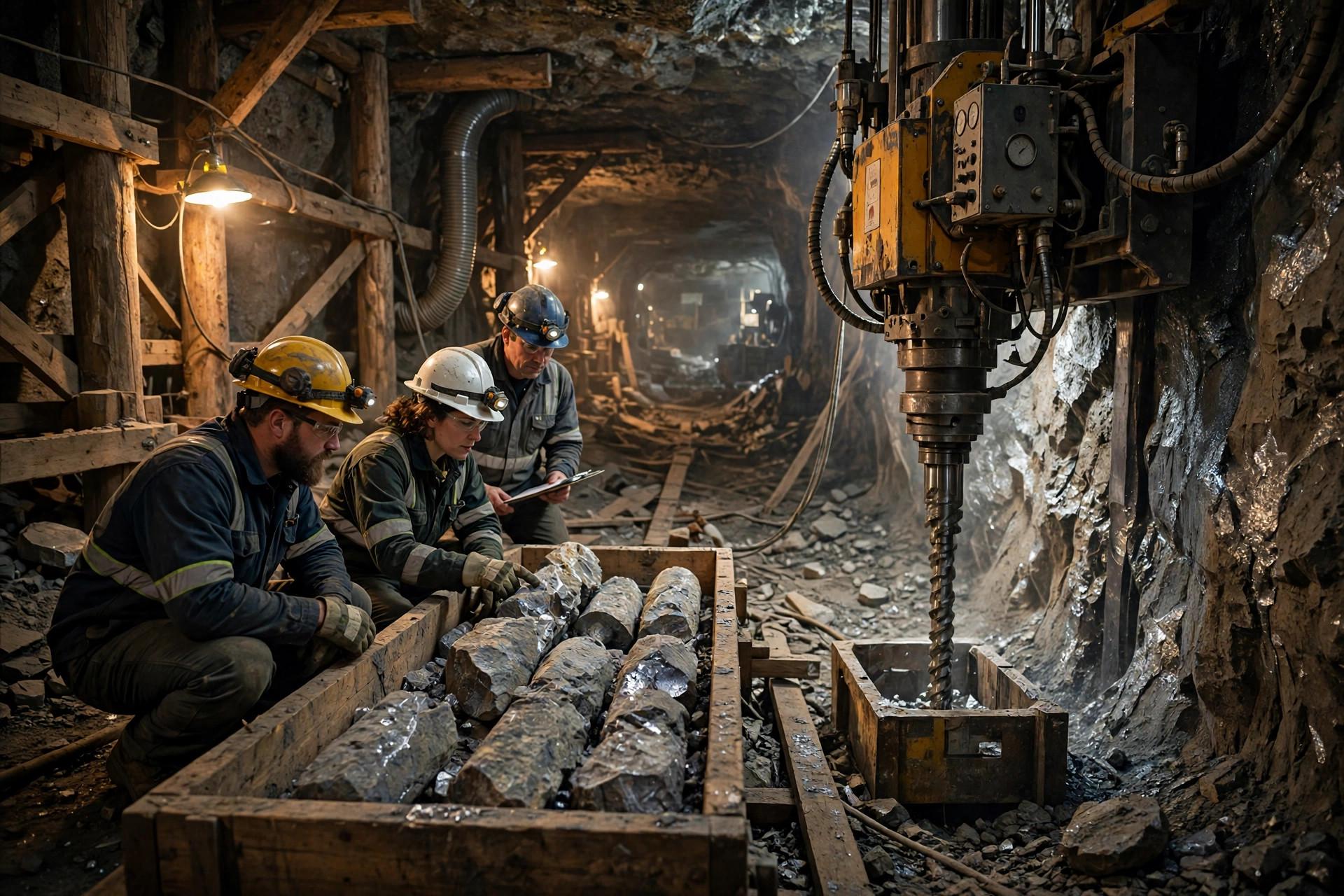
Butte is drilling underground again. Silver Bow Mining reported on November 11 that diamond drilling has commenced from a station inside its newly constructed Rainbow Decline at the Rainbow Block Project — the first underground exploration drilling in the historic Butte Mining District in more than three decades, following the portal and decline work that restored underground access earlier in 2026.
- The milestone: underground diamond drilling has commenced from a drill station in the Rainbow Decline at the 6,210-foot elevation, about 285 feet (87 metres) down the decline from the portal, using a KMN1.4 electric underground diamond core drill operated by NISS Drilling.
- The scale planned: about 30,000 feet of drilling from the Rainbow and Chief Joseph declines during the remainder of 2026 and 2027, principally for resource expansion and upgrading, with additional drill stations to be established as underground development advances.
- What one station can test: the initial station is positioned to target extensions of twelve mineralized veins beyond the current Rainbow Block Mineral Resource estimate — to the south the State, Badger, Edith May and Auraria veins, and to the north the Jessie, Rainbow Splay, Alice, Emily, Emily High-Grade, Rainbow, Boston and Jersey Blue veins.
- The follow-up targets: the Badger vein, where surface hole SBM26-03 returned 4.0 metres grading 994.2 g/t silver equivalent (AgEq), including 2.3 metres at 1,586.1 g/t AgEq (reported September 1), and the Emily vein, where SBM26-08 returned 11.2 metres at 312.7 g/t AgEq, including 3.6 metres at 462.7 g/t AgEq (reported November 5).
- The ground: Silver Bow holds approximately 4,210 acres of patented mineral claims and about 1,427 acres of surface lands across multiple claim blocks in the Butte district, including Rainbow Block. Qualified Person Phillip Nickerson, PhD, CPG, VP of Exploration, reviewed and approved the technical information.
From reopening portals to turning drills
The sequence in 2026 matters. In May the company began rehabilitating the Chief Joseph Portal and decline and received Montana Department of Environmental Quality authorization for the new Rainbow Decline, including about 6,000 feet of planned underground development intended to connect with the existing Lexington Tunnel level. By August, underground access through the Chief Joseph Portal had been restored. Drilling from the Rainbow Decline now moves the project from infrastructure to active underground exploration.
Chairman and CEO Travis Naugle put the geometry plainly: "from a single underground station, we can drill in virtually every direction to test twelve separate vein targets, each an extension beyond our current Mineral Resource estimate." VP of Exploration Phillip Nickerson added that underground stations let the company position holes to better intersect targeted structures and assess their geometry and continuity, with results to be integrated with surface data and geological models.
The company says underground drilling offers improved orientations, shorter holes to certain targets, and greater flexibility to test continuity and extensions — advantages that, if the drilling delivers, support more efficient resource definition.
The honesty box
No new assays are reported in this release. This is a commencement announcement: the 30,000 feet is a plan through the end of 2027, not completed drilling, and whether it expands or upgrades the resource depends entirely on results not yet obtained. The Badger and Emily grades cited are silver equivalents, not measured silver grades — AgEq here uses silver at $25.00/oz, gold at $2,500/oz, zinc at $1.31/lb and lead at $0.90/lb with an assumed 90% metallurgical recovery for each metal; the release states actual recoveries have not been established for those intervals and may differ. The current Rainbow Block resource referenced is an Inferred Mineral Resource — mineral resources are not mineral reserves and do not have demonstrated economic viability. All statements about expansion, upgrading and future development planning are forward-looking and subject to underground conditions, financing, permitting and geological uncertainty, including the possibility that drilling does not confirm interpreted vein continuity or grade.
What to watch
First assay results from the underground program; whether Badger and Emily mineralization repeats from underground orientations; drilling from the Chief Joseph Decline as a second platform; and any updated resource estimate that incorporates underground data.