
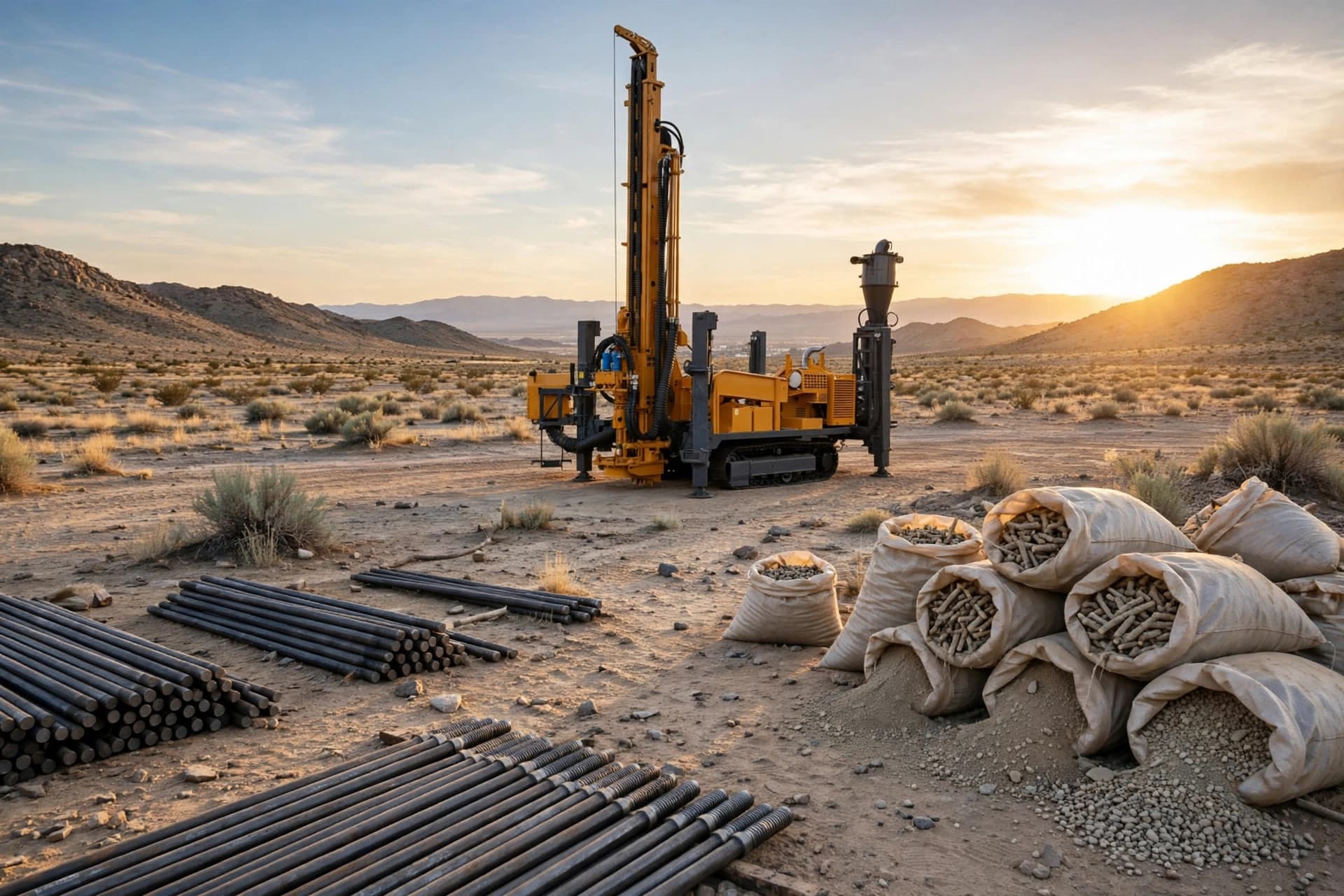
Gabbs is not a discovery story anymore. It is a definition story — hole after hole testing where a known gold-copper body ends. On October 28, P2 Gold reported that, at the Lucky Strike Zone, it mostly does not end where the company just drilled: six of seven new reverse-circulation holes expanded the zone to the south and southwest, and several finished still in mineralisation.
- GBR-135: 121.92 metres at 0.40 g/t gold and 0.13% copper from 71.63 metres downhole, plus 39.62 metres at 0.15 g/t gold and 0.07% copper from 193.55 metres — and the hole ended in mineralisation.
- GBR-137: 60.96 metres at 0.52 g/t gold and 0.22% copper from 59.44 metres, including 18.29 metres at 0.71 g/t gold and 0.29% copper, plus a footwall interval of 67.06 metres at 0.16 g/t gold and 0.09% copper — also ending in mineralisation.
- GBR-136: 96.01 metres at 0.39 g/t gold and 0.11% copper from 77.72 metres, with 88.39 metres of footwall mineralisation at 0.19 g/t gold and 0.07% copper beneath it.
- GBR-130: 85.34 metres at 0.34 g/t gold and 0.15% copper from 169.16 metres, ending in mineralisation.
- The one miss: GBR-134 was lost to ground conditions before reaching the targeted higher-grade mineralisation.
- The program so far: 114 RC holes since October 2025 — 71 at Lucky Strike, 43 at Sullivan, where the 2026 infill and expansion program is now complete.
A body that thickens the way it is being chased
The geology explains the drill pattern. At Lucky Strike, mineralisation sits within and below a tabular quartz monzonite unit — the main mineralised body — underlain by pyroxenite. The higher-grade gold and copper live in the monzonite, in a north-south corridor. Recent drilling has cut much thicker monzonite sections to the southwest, and the company says the higher-grade corridor appears to turn that way with it. The monzonite exceeds 150 metres in thickness in places, and the footwall pyroxenite mineralisation below it runs 20 to 60 metres — a combined package of more than 200 metres where both are present. The zone, P2 says, remains open in all directions.
The timing matters as much as the widths. Holes completed by the end of October will be included in the updated Mineral Resource estimate targeted for completion later this quarter, and that estimate will form the basis of a feasibility study expected in the first quarter of 2027. Drilling continues at Lucky Strike in the meantime.
The honesty box
These are broad, low-grade bulk-tonnage intervals — the headline gold grades here run from 0.28 g/t to 0.52 g/t (0.71 g/t in the best included sub-interval) with copper from 0.06% to 0.29% — and their value depends entirely on tonnage, recovery and cost, which a feasibility study has not yet established. All intervals are downhole lengths; the release states true thickness is to be determined. The production figures in the company's background material — a preliminary economic assessment outlining an average of 109,000 ounces of gold and 33 million pounds of copper a year over 14.2 years, and a feasibility-stage target of 150,000 ounces and 45 to 50 million pounds a year at a higher throughput — come from a PEA dated October 7, 2025, which is preliminary by definition and includes material that is not a reserve; the larger figures are targets for the study now under way, not results. Gabbs has no declared mineral reserve in this release.
What to watch
The updated resource estimate later this quarter — whether the southwest thickening converts into tonnes — and the Q1 2027 feasibility study that follows it.