
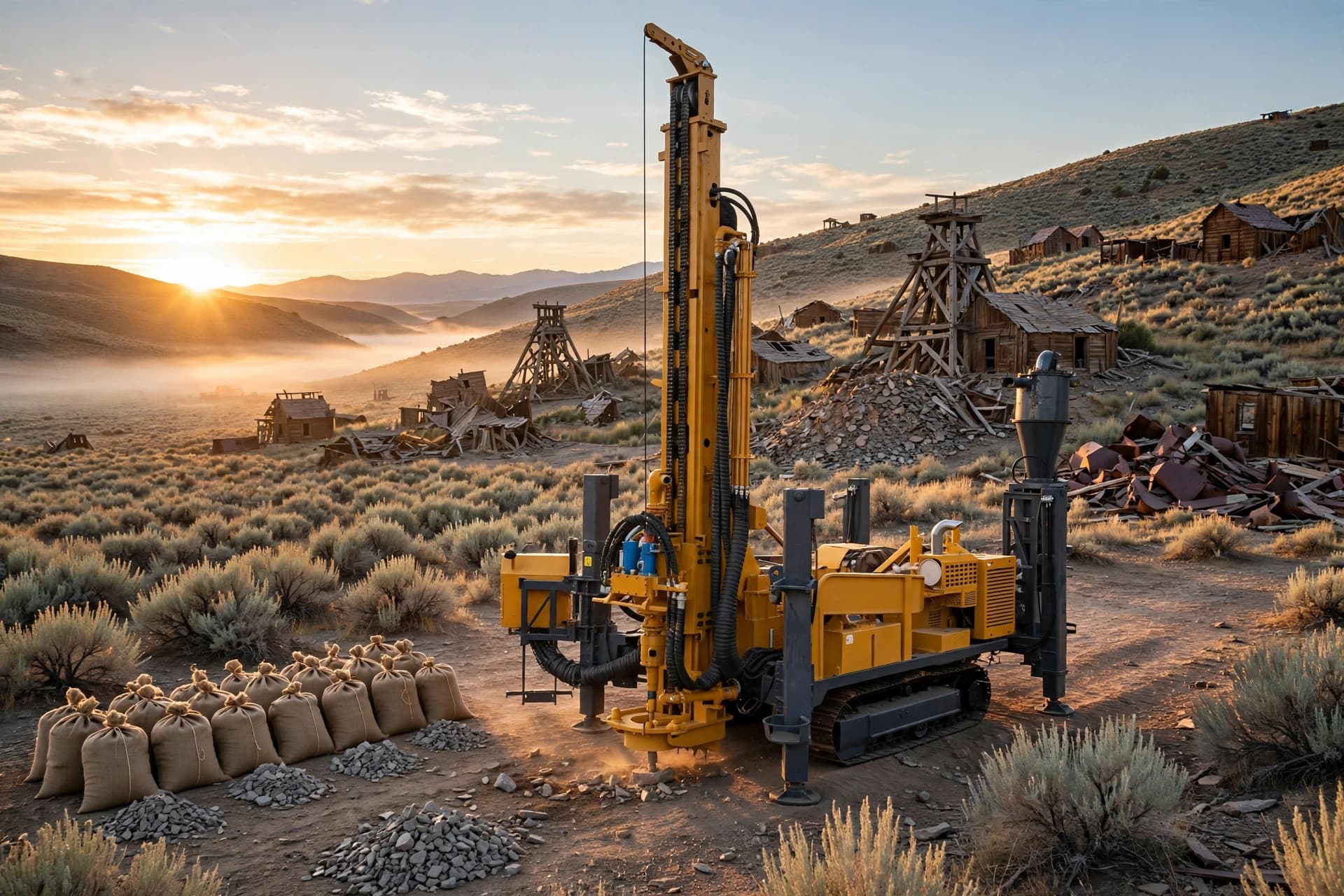
The Comstock District made its name on bonanza veins in the 1800s. Mackay Gold & Silver is testing something different on the district's east side — a broad, shallow oxide gold system along the Occidental-Brunswick Lode — and the second batch of assays from its first-ever drill program, released October 19, keeps the widths coming.
- Hole 26MGS0015 returned 97.5 metres at 1.48 g/t gold and 5.5 g/t silver, including 15.2 metres at 5.56 g/t gold and a 1.5-metre spike of 26.40 g/t gold.
- Hole 26MGS0014 returned 67.1 metres at 2.30 g/t gold and 8.7 g/t silver, including 35.1 metres at 4.07 g/t gold and 4.6 metres at 17.93 g/t gold.
- Hole 26MGS0013 returned 70.1 metres at 1.17 g/t gold and 7.8 g/t silver, including 7.6 metres at 5.22 g/t gold.
- The three holes sit on the same section at roughly 50-metre spacing. Mackay says thick mineralization is now defined continuously across the full 550 metres of strike tested at Occidental South, traced about 150 metres down-dip, and open along strike both ways and down-dip.
- 45 holes and 9,300 metres are complete in the planned 20,000-metre, 100-hole program; assays for 30 holes are still pending.
A different kind of Comstock target
The Occidental-Brunswick Lode runs about 5 kilometres, east of and parallel to the Comstock Lode itself, in the same geological setting. Mackay controls 4,747 hectares covering three of the district's past-producing lodes. The historical numbers attached to the district — an estimated 8.2 million ounces of gold and 192 million ounces of silver produced between 1859 and 1926 — are historical production figures, not a resource, and the bonanza grades of that era (the company cites averages of 35 g/t gold and 726 g/t silver) are not what this program is chasing. Occidental South is a bulk-tonnage oxide target: a roughly 1,000-by-400-metre gold-in-soil anomaly being drilled on 50-to-100-metre spacing.
Phase 1 pairs about 15,000 metres of shallow RC drilling at Occidental South with 5,000 metres of deeper diamond drilling at the Sutro Tunnel intersection. With the first kilometre of up-dip drilling done, the rigs have moved to an eastern line testing the zone up to 300 metres down-dip.
The honesty box
These are early holes — 15 of 100 planned — reported as drilled thicknesses, with true thickness estimated at 80% to 100% of drilled length, composited at a 0.1 g/t gold cut-off. Two of the eight holes in this batch stopped short of the target zone, and one returned no significant values. There is no mineral resource estimate at Occidental South, and drill intercepts alone do not establish one. The Qualified Person for the release is CEO Darwin Green, who the company notes is not independent.
What to watch
The 30 pending assay sets, and whether the eastern down-dip line keeps the zone alive at 300 metres down-dip — the step that decides whether Occidental South is a shallow oxide blanket or the top of something bigger.