
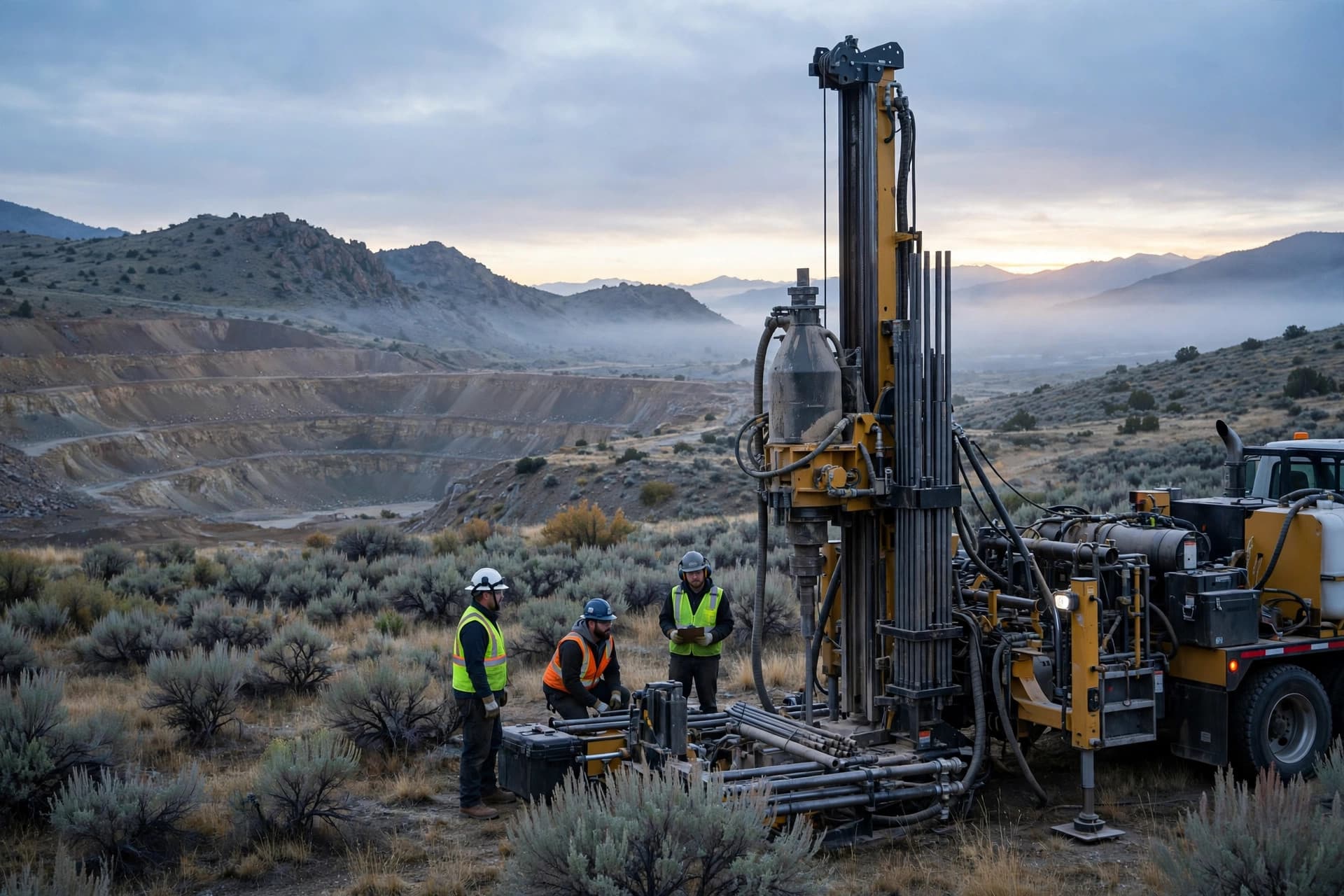
A maiden program usually answers one question and raises ten. Lodestar Metals' first drilling at Gold Run just answered its first one cleanly: all four prospects it tested in Nevada came back with significant gold or silver. The final piece, reported November 4, is Crown North — the broad, shallow one.
- LSRC-17: 71.6 metres grading 0.9 g/t gold equivalent (AuEq) (0.4 g/t gold, 35.2 g/t silver) from 19.8 metres down hole, including 10.7 metres grading 1.6 g/t AuEq (1.2 g/t gold, 23.6 g/t silver) from 19.8 metres.
- LSRC-18: 80.8 metres grading 0.6 g/t AuEq (0.3 g/t gold, 24.0 g/t silver) from 42.7 metres, including 30.5 metres grading 1.1 g/t AuEq (0.4 g/t gold, 46.0 g/t silver) from 93.0 metres.
- The program now complete: 18 RC holes totalling 2,820 metres; the two Crown North holes total 312 metres. Reported intervals are drill-hole lengths; true widths are estimated at 85–95% of reported intervals.
- The setting: Crown North sits immediately north of the historic Adelaide-Crown gold-silver deposit held by Nevada Gold Mines, with the Crown pit approximately 50 metres south of the Gold Run property boundary. The company cautions that mineralization on the adjacent property is not necessarily indicative of mineralization at Gold Run.
- The corridor idea: structural and geophysical work suggests a north-northwest corridor of approximately 650 metres linking Crown North and Robbers Knob — with the 400 metres between them largely untested and a high-priority target for the next programs.
- The other three prospects (previously reported): Robbers Knob — 16.8 m at 6.1 g/t gold and 41.1 g/t silver, including 3.0 m at 31.90 g/t gold and 181.6 g/t silver, plus broad oxide intervals; Black Diamond — 15.2 m at 102.2 g/t AgEq (79.5 g/t silver, 0.20 g/t gold), the project's first high-grade silver; Gomes — 4.6 m at 4.0 g/t gold and 15.6 g/t silver, including 1.5 m at 11.3 g/t gold.
Why Crown North changes the shape of the project
Robbers Knob gave Gold Run its high-grade headline; Crown North gives it width near surface. Two holes, both starting in mineralization within about 20–43 metres of surface and running 70–80 metres, is the geometry of a possible northern extension of the Adelaide-Crown system — the company notes the gold, silver and pathfinder geochemistry at Crown North shares characteristics with that historic epithermal system. Historical production at Adelaide-Crown is reported by the company at approximately 19,000 ounces of gold and 345,000 ounces of silver, with a historical intersection of 12.3 metres at 22.3 g/t gold and 28.5 g/t silver — historical figures, reported here as the company states them, not a current resource.
President and CEO Lowell Kamin: "Delivering significant gold and silver intersections at all four prospects in our first drill program is a great result for Lodestar… Our focus now is on bringing together the new drilling results with the historical exploration work, refining our geological model and planning the next phase of drilling as we work toward defining a potential resource at Gold Run."
Next steps are sequenced: Robbers Knob first — follow-up on roughly 300 metres of strike at the northern end of the corridor — then Crown North's depth and strike extensions, with Gomes, Black Diamond and Grindstone Flat in the longer-term queue. A 3D geological model integrating the maiden drilling, geophysics and historical data is under way.
The honesty box
This is a maiden, exploration-stage program with no mineral resource estimate — the company's stated longer-term goal is an initial NI 43-101 resource, which does not yet exist. The Crown North case rests on two holes; broad low-grade oxide intervals are not, by themselves, an economic deposit, and the gold-equivalent grades combine gold and silver on the company's stated basis. The Adelaide-Crown connection is an interpretation supported by geochemistry and structure, not yet by drilling between the two — the 400-metre gap is precisely the untested part.
What to watch
The 3D model and the 2027 program design; drilling in the untested Robbers-Crown gap, which either links the two ends into one system or separates them; and step-outs at Crown North testing whether the 70–80-metre widths hold along strike and at depth.