
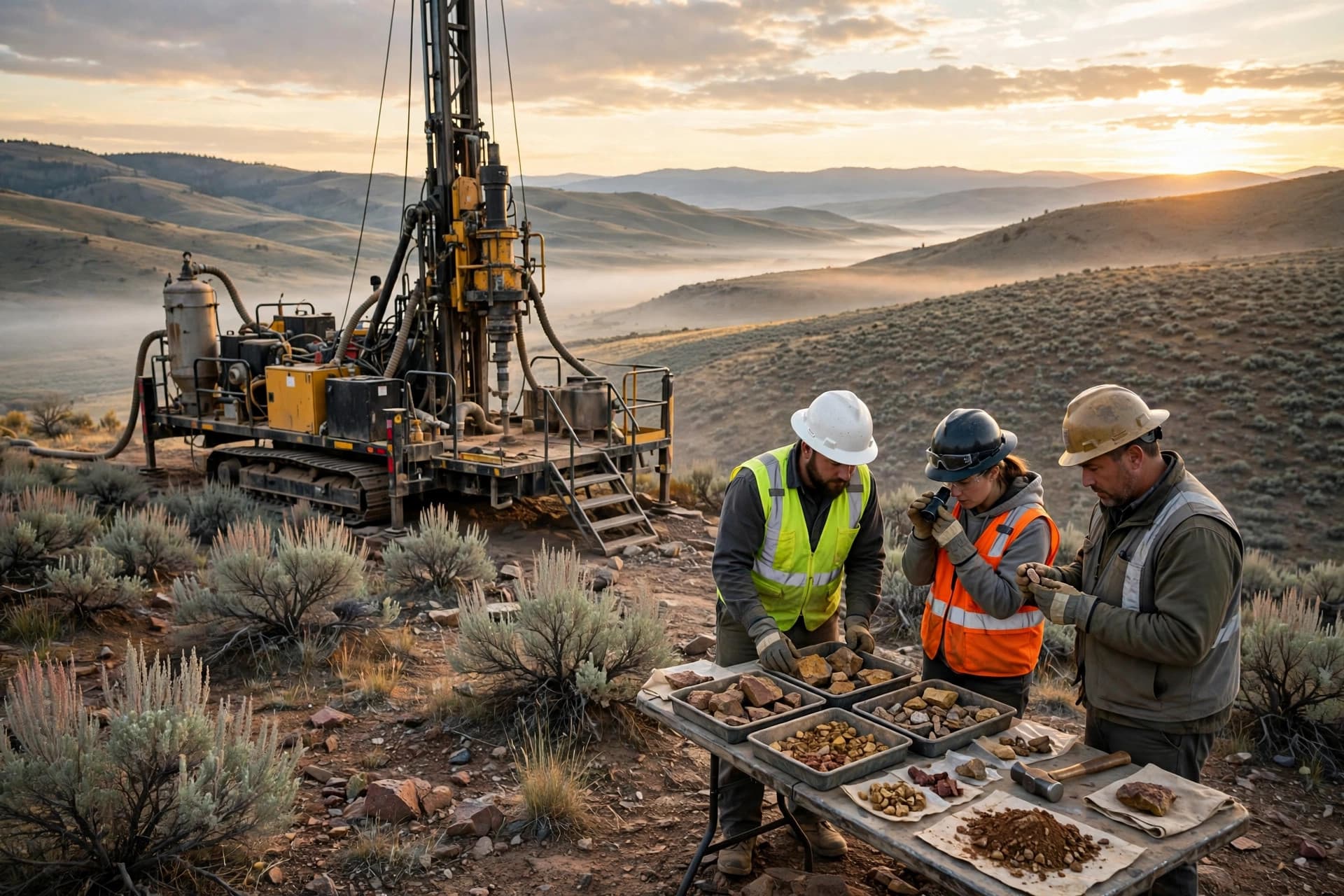
The first assays from Black Pine's big 2026 season are in, and they do two jobs at once. Liberty Gold reported on October 22 that step-out drilling has defined a northern extension to oxide gold mineralization at Rangefront, while separate drilling has found mineralized material throughout the project's legacy rock storage facilities — results the company says feed directly into detailed engineering for a future mine.
- A northern extension at Rangefront: drilling defined oxide mineralization over an area about 200 metres by 400 metres north of the current resource, with grades above the current reserve cutoff, and mineralization remains open to the north.
- Headline intercepts: LBP1347 returned 0.36 g/t gold over 144.8 metres, including 1.27 g/t over 18.3 metres; LBP1341A returned 0.42 g/t over 62.5 metres, including 0.63 g/t over 15.2 metres; and LBP1293 returned 0.30 g/t over 91.4 metres.
- Upgrade target: about 25 to 35 million tonnes of inferred material above resource cutoff has been targeted for a resource classification upgrade.
- Legacy rock storage (LRS): BP26BF_CD039 returned 0.86 g/t gold over 59.4 metres and BP26BF_A029 returned 0.29 g/t over 38.1 metres. The company is evaluating whether LRS material can be used as reserves in early mine years or as construction material.
- The results conclude the resource step-out phase (7,417 metres in 29 RC holes at Rangefront, all assays received) and the LRS characterization phase (2,848 metres in 73 RC holes) of a planned 50,000-metre 2026 RC program.
Why Rangefront matters for engineering, not just ounces
Liberty drilled Rangefront at indicated-resource spacing, and it also pinned down a faulted eastern margin to the mineralization. That boundary is a practical input: it helps fix where the feasibility heap leach pad can be designed. In other words, this round was as much about de-risking surface infrastructure as about adding mineralization — drilling between the current resource and the planned pad, and showing continuity north toward the M Zone.
The rest of the 2026 campaign is aimed at the early years of a future mine plan: drill-to-measured programs in the Discovery, J and Rangefront areas, step-outs in the F and M zones, and compliance drilling for geotechnical and hydrologic data. Completion of parts of that work is weather-dependent, and more results will be reported as assays arrive.
The honesty box
Intercepts are reported as drilled thickness; Liberty states true thickness is typically about 70% to 90% of the reported length (50% to 100% across holes). Grades are oxide-gold drill results, not a new resource or reserve: the 25–35 million tonne figure is inferred material targeted for upgrade, not material already reclassified. Cyanide-to-fire-assay ratios at Rangefront ranged from 61% to 98%, and in the LRS facilities from 8% to 98% — a wide range the company is still working to understand with additional testwork, and a reminder that grade alone does not settle recoverability. Black Pine is advancing through permitting toward a potential construction decision; no construction decision has been announced.
What to watch
The drill-to-measured results from Discovery, J and Rangefront, a future resource update incorporating the northern extension, and whether LRS material earns a place in the mine plan or in pad construction.