
Krait Critical Minerals is adding Nevada antimony ground. The company announced on October 21 that it has signed an option agreement with Sierra Antimony Corp. for a 100% interest in 17 contiguous unpatented federal mining claims — about 354 acres in Humboldt County, roughly a four-hour drive north of Reno — centred on workings that produced high-grade antimony ore in the 1920s through the 1940s.
- The deal: an exclusive option, dated October 19, 2026, to acquire a 100% interest in the property from arm's-length Sierra Antimony Corp.
- Cash consideration totals US$75,000, staged: US$5,000 within seven business days, US$20,000 within 30 days, and US$25,000 on each of the first and second anniversaries of the effective date.
- Share consideration: 150,000 common shares within 30 days, plus shares valued at CAD$200,000 on each of the first and second anniversaries.
- Sierra retains a 2.5% net smelter return royalty from commercial production; Krait can reduce it to 1.0% for US$2,000,000. The agreement sets no minimum exploration expenditure to exercise the option, and Krait may accelerate payments at its discretion.
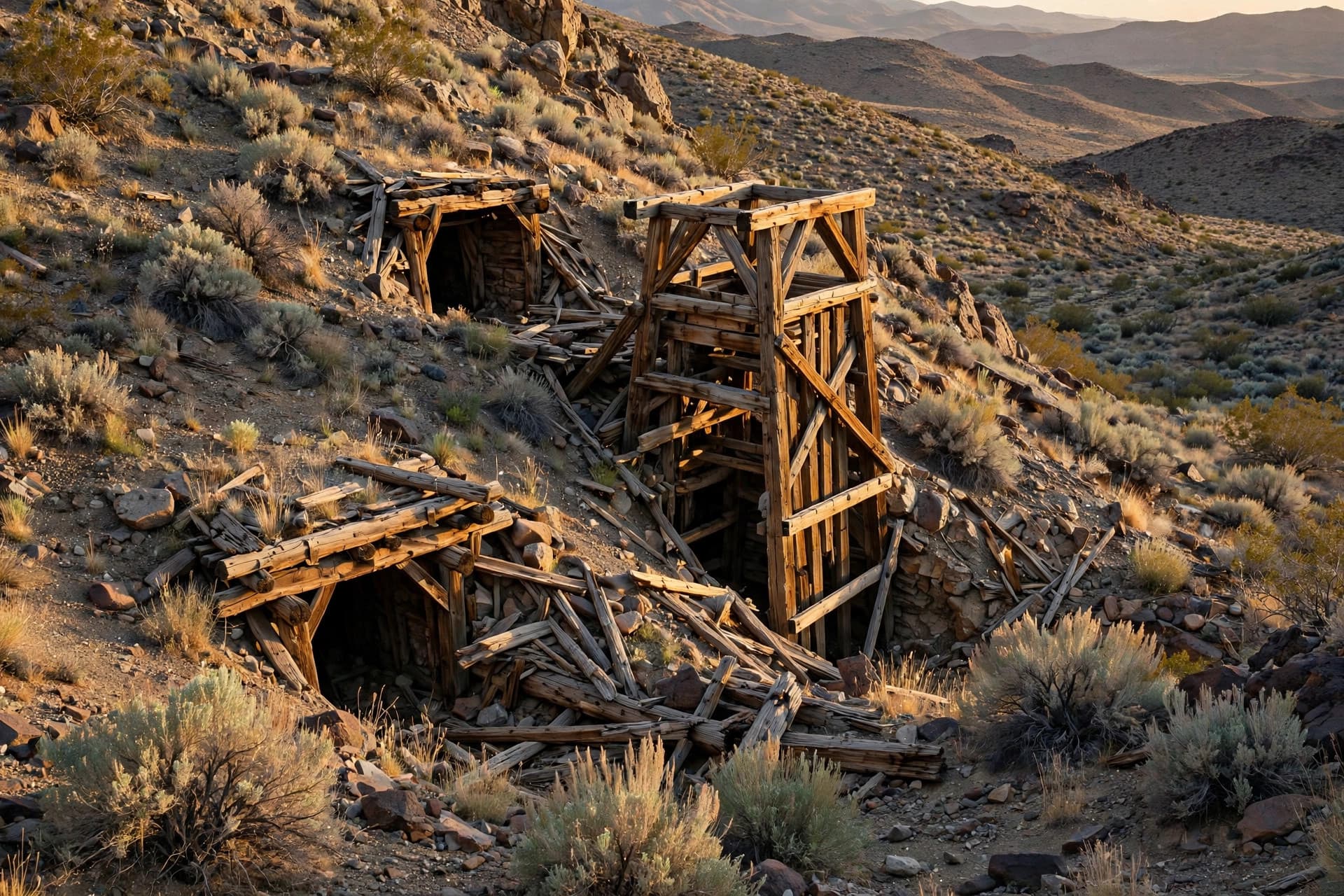
- Historical workings run along a 2.25-kilometre trend. Records in the U.S. Geological Survey's Mineral Resources Data System describe the Nevada King Mine workings on the property as four adits, two shafts and open cuts, with stibnite in quartz veins traced over 3,000 feet.
A very small, very old producer
The historical production the release cites is real but tiny, and the company is explicit about what it means. Government records report 30 tons of ore grading 50% antimony in 1927, 1.5 tons at 41% in 1941, and in 1942 a further 2 tons at 54% plus 5 tons with no grade reported. Those were selectively mined shipments of high-grade material, hand-sorted in an era when a few tons were a mine — not a measure of what remains in the ground. Government reports describe the broader mineralization as predominantly lower grade, generally below 3% antimony, in narrow veins, pods and lenses with localized high-grade pockets, plus disseminated mineralization in altered country rock.
Krait's stated next step is desk work first: a review of the available geological and technical information to identify prospective areas, with any mapping, sampling or geophysics subject to that evaluation, access, permitting and management approval. The Nevada property sits alongside the antimony interests in Washington State that Krait picked up with its September 16, 2026 acquisition of Nevada Hills Antimony LLC.
The honesty box
There are no current mineral resources or reserves on this property, and none of the historical figures have been independently verified. Krait's Qualified Person, J. Garry Clark, P.Geo., states in the release that he has not personally inspected the property and has not verified the historical sampling, production or shipment information through fieldwork or resampling — his review was limited to the published records and databases the release cites. The 50%-plus grades are historical, selectively mined shipment grades and, in the company's own caution, are not representative of in-situ mineralization. An option agreement is also not an acquisition: Krait earns the 100% interest only by making every staged payment and share issuance.
What to watch
Whether Krait completes the first payments and share issuance on schedule, and what its initial technical review produces — the first modern sampling on a property whose record stops in the 1940s.