
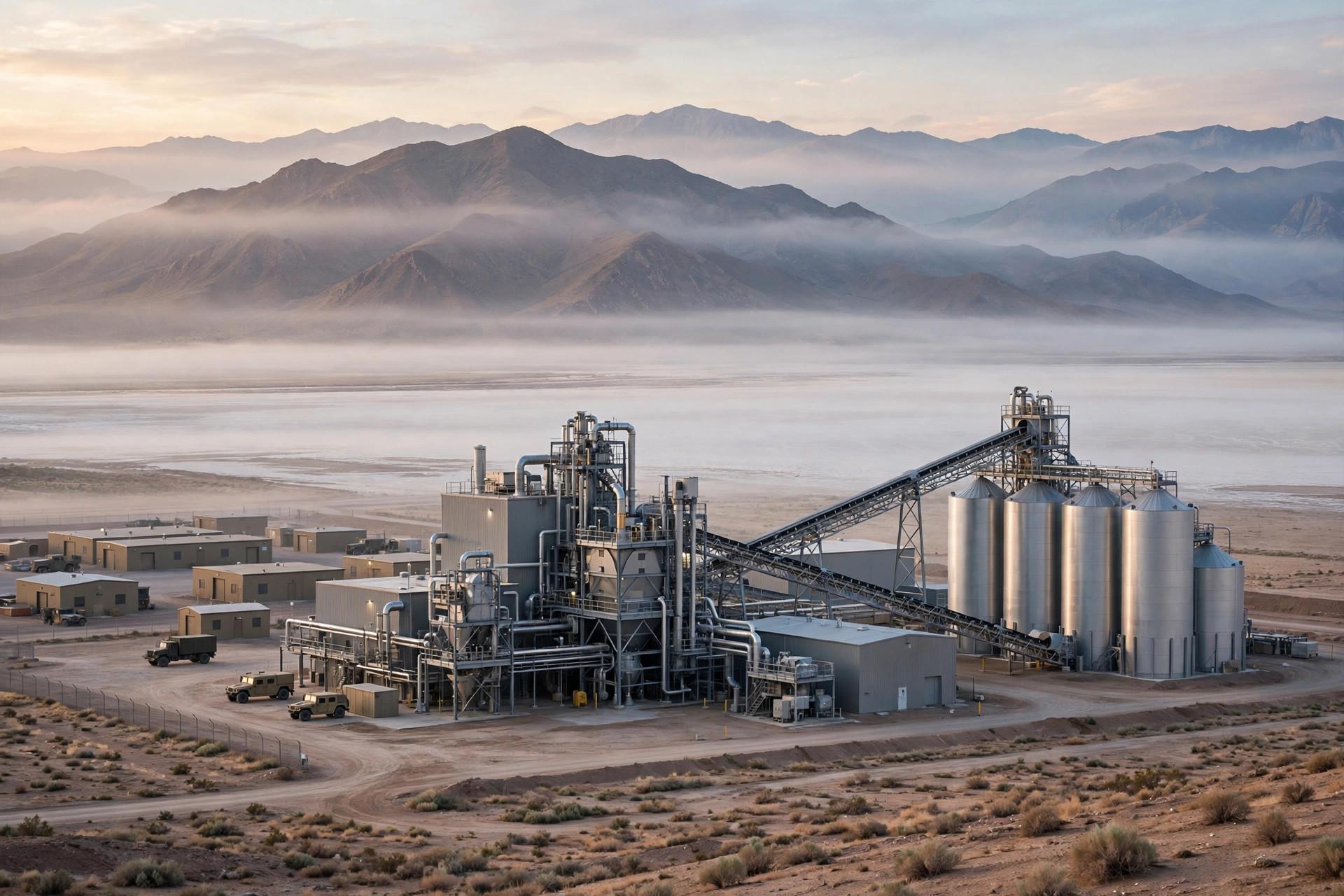
The mine is in Nevada; the factory the Army wants sits in Utah. Ioneer Ltd (ASX: INR) (Nasdaq: IONR) said on November 19 that it and the U.S. Army are "actively advancing" a term sheet for a proposed lease of approximately 50 acres at the Tooele Army Depot in Utah, where Ioneer plans a standalone plant to make defence-grade boron carbide from boron produced at its Rhyolite Ridge Lithium-Boron Project in Nevada.
- The step taken: Ioneer and the U.S. Army are actively advancing a term sheet for a proposed lease of about 50 acres at the Tooele Army Depot — Parcel TEAD-S 9 in the depot's South Area, per the company's September-quarter report.
- The plant studied: a pre-feasibility study completed in September by Fluor Corporation evaluated a commercial-scale facility producing about 10,000 tonnes per annum of 99.9% defence-grade boron carbide (B4C) for commercial sale, from boron produced at Rhyolite Ridge.
- The groundwork under way: the two sides have recently visited the site to map out environmental review requirements, and Ioneer says it has begun work toward federal permits, alongside feasibility work.
- The selection: Ioneer is one of four companies selected to partner with the U.S. Army on a domestic boron supply chain, following the conditional award announced in June 2026 for a long-term land lease at Tooele.
- The feedstock: Rhyolite Ridge, 100%-owned by Ioneer in Esmeralda County, Nevada, hosts what the company describes as the largest undeveloped boron Ore Reserve in the world outside Türkiye and the only undeveloped boron Ore Reserve in North America. The project closed a US$996 million U.S. Department of Energy loan in January 2025.
- The policy frame: the U.S. Government added boron to its list of critical minerals in November 2025. Boron carbide is a hard, light ceramic used in armour, among other defence and nuclear applications.
Why a boron plant on an Army depot matters
Boron rarely makes headlines next to lithium, but Rhyolite Ridge has always been a two-commodity project, and boron carbide is the highest-value end of the boron chain — a ceramic hard enough for body and vehicle armour. The Army's interest is not in the mine; it is in domestic processing. The June conditional awards put critical-mineral processing plants on underused Army land at four installations, and Tooele drew two of them: Ioneer for boron and REalloys for heavy rare earths. A signed lease at Tooele would give the Rhyolite Ridge boron stream a defence-linked domestic customer pathway that does not depend on the battery market that drives the project's lithium side — at a moment when Ioneer's strategic partnering process for Rhyolite Ridge itself, run with Goldman Sachs, has slipped to a Q4 2026 conclusion on counterparty approval timelines, per its September-quarter report.
The honesty box
Nothing has been signed. The November 19 announcement is that a term sheet is being advanced — the lease itself remains unsigned and conditional, and Ioneer disclosed no capital cost, no start date and no economics from the Fluor pre-feasibility study. The 10,000-tonne figure is the capacity the study evaluated, not a construction commitment. The plant also depends on its feedstock: boron from Rhyolite Ridge, a project that has its federal Record of Decision (October 2024) and its DOE loan, but whose final investment decision still awaits the outcome of the strategic partnering process. Permitting for the Tooele facility itself has only begun.
What to watch
A signed lease and its terms; the first capital-cost figure, whether from a feasibility study or the lease documents; federal permit filings for the Tooele site; and, in parallel, the conclusion of the Rhyolite Ridge strategic partnering process in Q4 2026 — the gate in front of the mine that would feed the plant.