
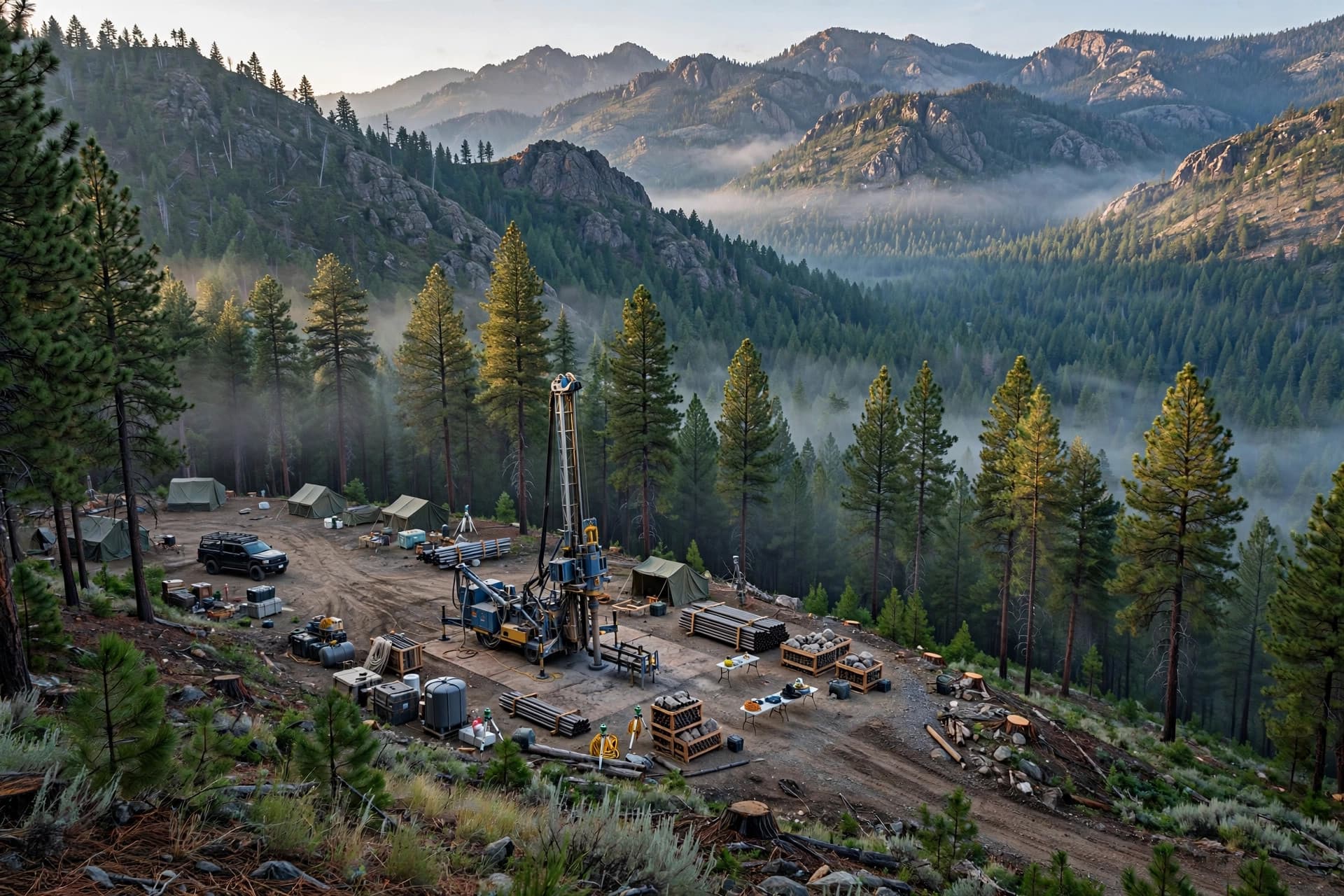
CuMo, in Boise County, is one of the larger undeveloped copper deposits in the United States — and, on its owner's numbers, one of the larger undeveloped molybdenum deposits anywhere. The updated study released October 14 is an attempt to make a very big project buildable in stages, and it replaces the project's 2020 assessment.
- The updated PEA puts after-tax NPV at an 8% discount rate at US$1.88 billion, with an after-tax IRR of 18.5%. Before tax, the figures are US$2.31 billion and 19.8%.
- Base-case prices are US$5.00/lb copper, US$25/lb molybdenum and US$50/oz silver.
- First-phase pre-production capital is US$1.17 billion, with a further US$658 million of expansion capital in year 5. Payback is put at 5.9 years from the start of production.
- Mine life is 46 years. Average annual production over the first 21 years is 41.6 million lbs of copper, 30.5 million lbs of molybdenum and 1.36 million oz of silver.
- On a by-product basis — molybdenum revenue credited against copper costs — the study reports negative C1 cash costs for copper of US$4.30/lb. Those are non-GAAP figures; see the caution below.
What changed from 2020
Three design changes drive the new numbers. The first-phase plant is smaller than the earlier concept. Ore would pass through XRF sensor-based sorting before it reaches the mill, so lower-grade material is rejected earlier. And the mine sequence has been re-ordered to reach higher-grade ore sooner. Together, the company says, those choices cut the capital needed to start production and shorten payback.
The project ground covers about 2,640 acres in Boise County — 126 unpatented federal lode claims and six patented claims — and the deposit also carries silver, rhenium and tungsten alongside the copper and molybdenum.
At spot prices quoted in the release for October 12 (US$6.76/lb copper, US$42.05/lb molybdenum, US$60.56/oz silver), the same model produces an after-tax NPV of US$6.24 billion and a 3.4-year payback. That is a sensitivity, not the base case, and it moves with prices in both directions.
The honesty box
As with every PEA, the limits matter as much as the headline. The study is preliminary, it rests in part on inferred mineral resources, no mineral reserves have been estimated, and the company has not made a decision to build CuMo. The negative copper costs are an accounting presentation: they exist because molybdenum credits are deducted from copper costs, not because copper can be dug up for free. The ore-sorting benefit at commercial scale is also still an assumption — the company says pilot-scale test work to validate it is part of the next phase of work.
What to watch
The full technical report summary, to be filed on Form 8-K and as an NI 43-101 report on SEDAR+; the pilot ore-sorting results; and the prefeasibility study, which the company says will be worked on mainly in 2027 with completion targeted for 2028.