
Fifteen holes, all assayed, and the last three did the same thing as the twelve before them: they found gold and silver starting almost at surface, east of where the historical resource stops. Iconic Minerals reported the final batch from its Phase 1 program at New Pass, in Churchill County, Nevada, about 150 miles east of Reno, on October 29.
- NP2611 — the best of the final three: 52 metres at 0.67 g/t gold and 9.56 g/t silver from surface (0 to 52 metres), including 27 metres at 1.10 g/t gold and 17.13 g/t silver from 18 to 46 metres. One 3-metre sample inside it, from 24 to 27 metres, assayed silver above the detection limit of 100 g/t.
- NP2619: 15 metres at 0.34 g/t gold and 1.48 g/t silver from 15 to 30 metres.
- NP2626: two split intervals — 9 metres at 0.28 g/t gold and 6.20 g/t silver from 3 to 12 metres, and 15 metres at 0.41 g/t gold and 1.58 g/t silver from 15 to 30 metres — separated by a 10-foot section from which no sample was recovered.
- The pattern: all three final holes intercepted grades above the company's stated cut-off of 0.01 oz/ton (0.34 g/t) gold within 50 feet of the drill collar, and the program extended mineralisation a maximum of about 200 feet (61 metres) east of known historical intercepts.
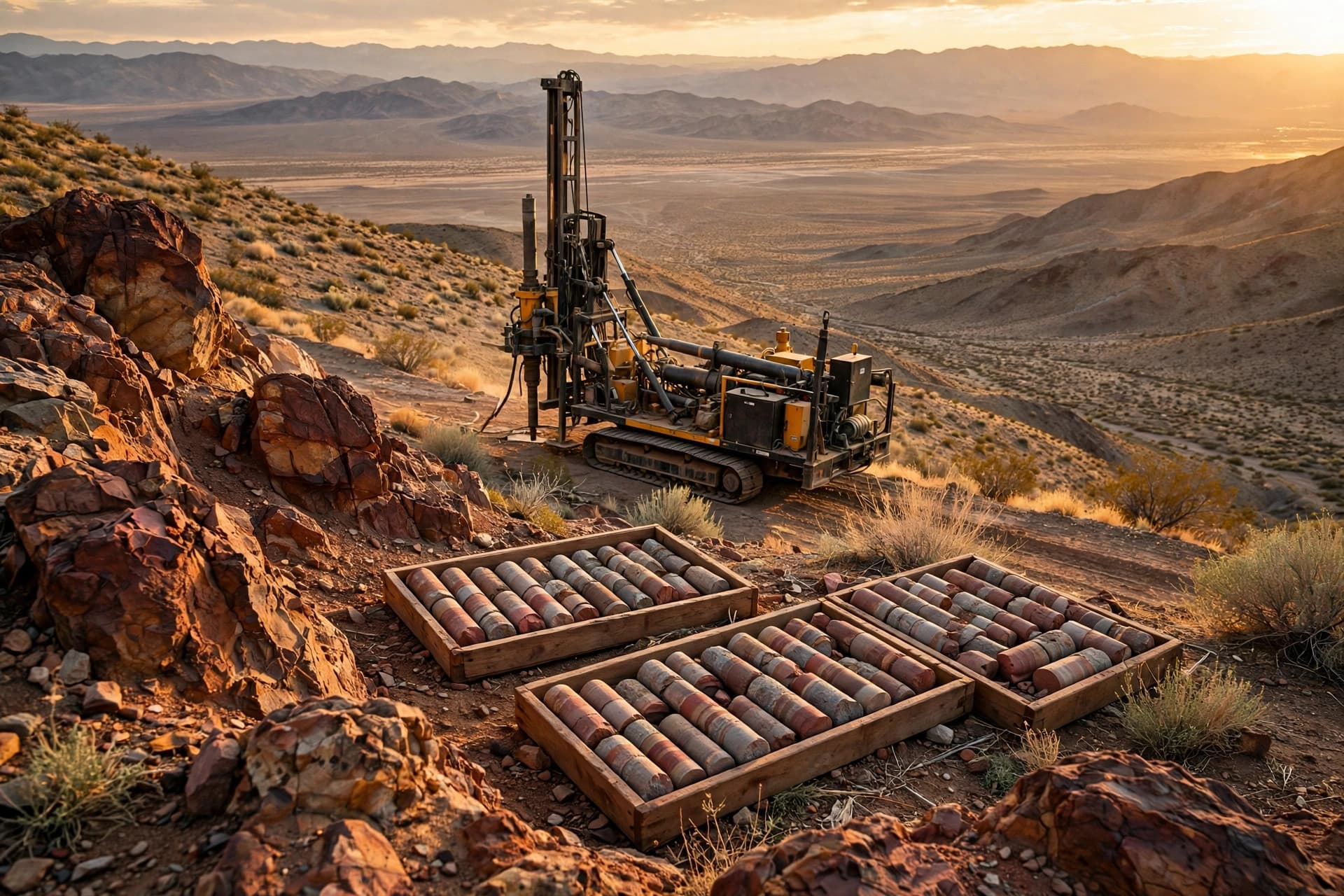
- The program: 15 core holes, all drilled at -45 degrees, testing up-dip extensions along about 1,900 feet (600 metres) of strike. Samples were 10-foot intervals of quarter HQ core, submitted to ALS Reno with standards, blanks and repeats.
A Carlin-type system that outcrops
New Pass is a classic Carlin-type system: gold and silver hosted mainly in silicified rock and jasperoid in decalcified limestone of the Triassic Lower Augusta Mountain Formation, along a major north-northwest structure on Nevada's Sulfur-Lovelock-Austin trend. The deposit outcrops at surface and has been drilled along about 0.8 miles of strike, to a deepest pierce point of roughly 1,000 feet. It remains open along strike in both directions and at depth, the company says.
President and CEO Richard Kern's takeaway was extension plus test work: the 15-hole program "has demonstrated that gold and silver mineralization extends significant distances to the east" and has provided material for metallurgical studies. All the drilled intervals in this batch were oxidised. Samples have been submitted for cyanidation extraction analysis to assess leachability, and on receipt of those results the company plans column leach tests on core from this program. Multi-element results will also be evaluated for potentially recoverable critical elements.
The honesty box
The historical figures behind New Pass need their label kept on. The deposit carries a historical inferred resource from a September 3, 2010 technical report by Paul D. Noland — 15,515,488 short tons at an average 0.75 g/t gold-equivalent, containing 341,750 gold-equivalent ounces (282,986 ounces of gold and 3,139,054 ounces of silver). The release itself states that a qualified person has not done sufficient work to classify that historical estimate as a current mineral resource or reserve, and Iconic is not treating it as current. There is no more recent estimate. All new intervals here are downhole lengths; true widths have not yet been determined, although the company notes the -45-degree holes were drilled approximately perpendicular to the dip of the host limestone. And no metallurgical recovery has been demonstrated yet — leachability testing is the next step, not a completed result.
What to watch
The cyanidation and column leach results — whether this near-surface oxide material actually leaches — and any follow-up drilling recommendation to keep pushing the system east.