
This is the decision Arizona copper has been waiting on. Hudbay Minerals and Mitsubishi Corporation announced on October 21 that they have formally approved the final investment decision to construct the Copper World project, about 50 kilometres southeast of Tucson — backed by a definitive feasibility study that lays out the mine plan, the money, and a first-production target in the second half of 2029.
- Final investment decision approved. Hudbay (70%) and Mitsubishi (30%, under a joint venture formed in January 2026) will proceed with construction and development of Copper World.
- The DFS outlines annual copper production of 102,000 tonnes over the first 10 years — an 11% increase on the 92,000 tonnes in the 2023 pre-feasibility study — at average cash costs of $1.65 per pound over that period.
- Base Case: a 15-year mine life on mineral reserves, requiring only state and local permits, with an after-tax NPV (8%) of $1.2 billion and IRR of 17% at a long-term copper price of $5.00 per pound, rising to $2.3 billion and 22% at $6.00 per pound.
- Initial growth capital is $2.07 billion ($1.84 billion net of the precious-metals stream deposit). Funding includes Mitsubishi's $600 million initial joint-venture equity investment, a $230 million Wheaton Precious Metals stream deposit, and about $650 million in anticipated project debt. Hudbay's own contributions are expected to be about $500 million — less than 25% of initial capital — and are not required until 2028.
- Proven and probable reserves: 390 million tonnes at 0.47% copper, with a strip ratio of 1.5. Measured and indicated resources total 1.2 billion tonnes at 0.40% copper, inclusive of reserves.
- The company cites more than 1,000 construction jobs, 500 permanent jobs and up to 3,000 indirect jobs, and $1.1 billion to $3.7 billion in total U.S. taxes over the project's life.
What gets built
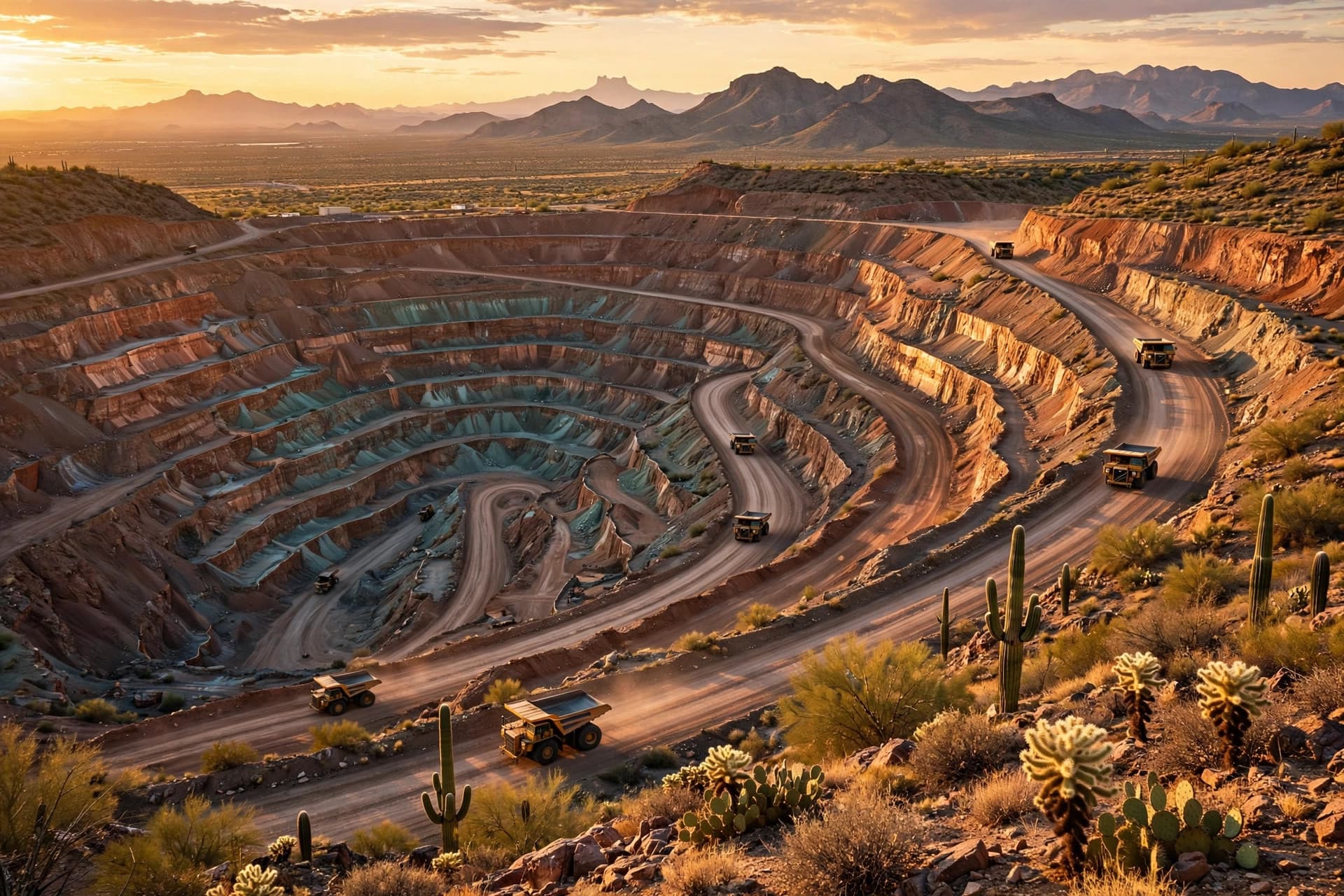
Copper World is planned as a conventional open-pit, shovel-and-truck operation with a flotation concentrator producing copper and molybdenum concentrates, built around four deposits discovered in 2021 plus the East deposit. The concentrator starts at 60,000 tons per day and expands to 90,000 tons per day in year five, with an in-pit crushing and conveying system added in year four — the change that lifts average production to 120,000 tonnes a year in years six to 10, from 84,000 tonnes in the first five years.
The study also keeps a second, larger future on the table. The Extension Case contemplates a 37-year mine life using measured and indicated resources, expanding onto federal lands in year 10 — subject to federal permits that the Base Case does not need — and holding production at 117,000 tonnes a year through years 11 to 20. At $5.00 copper, that case carries an after-tax NPV (8%) of $2.5 billion and an IRR of 19%.
The honesty box
The economics above are feasibility-study projections, not results: they rest on long-term copper prices of $5.00 to $6.00 per pound and on a technical report under NI 43-101 that Hudbay says it will file. The 15-year Base Case is the reserve case; the 37-year Extension Case uses measured and indicated resources — which are not reserves and have not demonstrated economic viability — and depends on federal permits not yet obtained. Mitsubishi's additional $423 million contribution and $1.02 billion total investment, reported separately by Reuters on October 21, are the company's own figures for its share of the joint venture. Construction has been approved; it has not yet produced anything, and first production is targeted, not scheduled with certainty, for the second half of 2029.
What to watch
The filed NI 43-101 technical report, the closing of the upsized $700 million credit facilities Hudbay expects in the fourth quarter, and the start of construction spending — with Hudbay and Mitsubishi's deferred equity contributions due from 2028.