
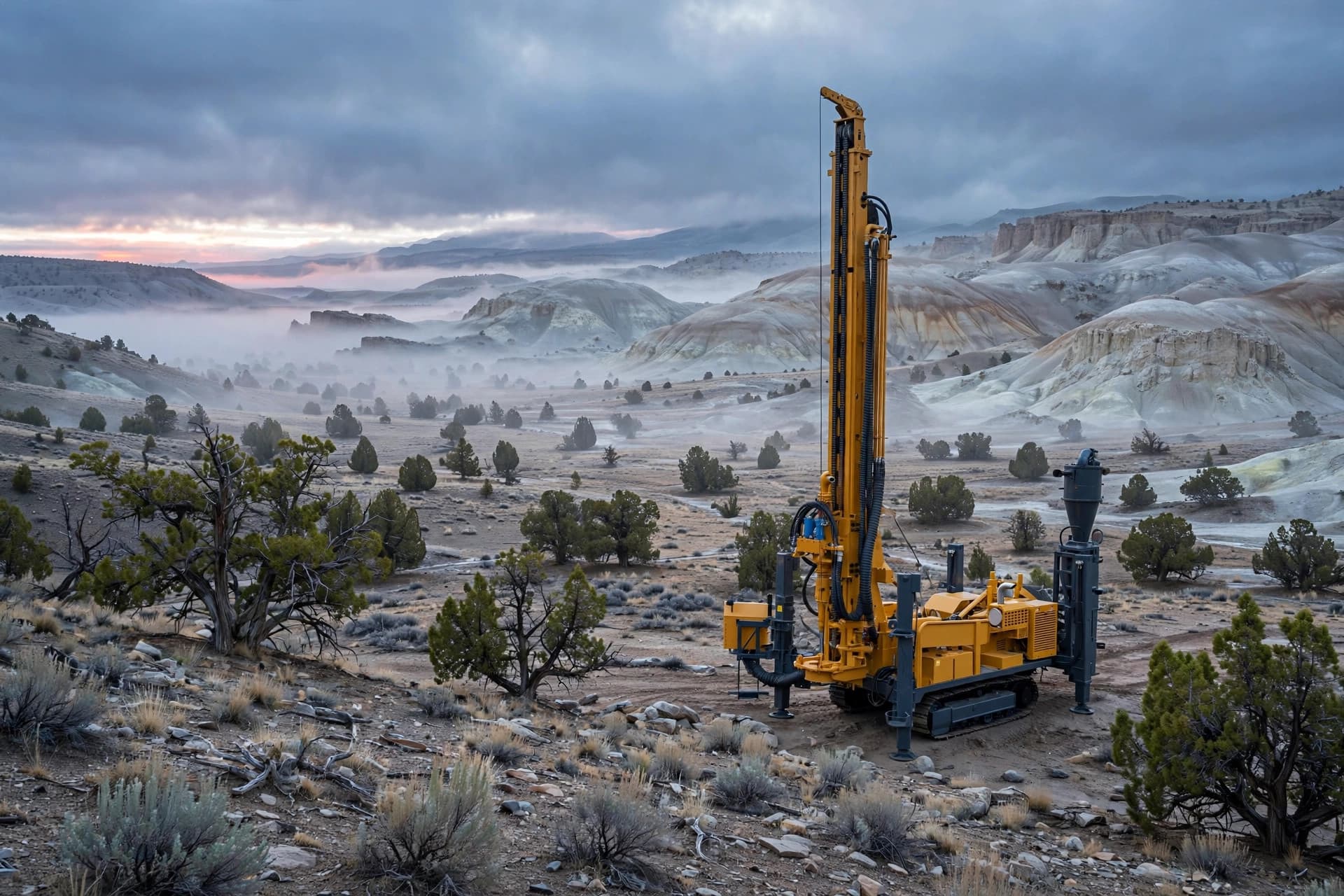
Some drill programs are about size. This one is about first answers. Headwater Gold announced on October 20 that drill permits are in hand for its Whiskey project in the Walker Lane gold belt of western Nevada, and that an initial reverse-circulation program — about 1,500 metres in 4 to 5 holes — is expected to start in late October.
- Drill permits received; drilling expected to commence in late October 2026.
- Planned program: approximately 1,500 metres in 4 to 5 RC holes, testing multiple high-priority targets defined by mapping, geophysics, surface geochemistry and re-analysis of historical drilling.
- Whiskey sits in the Walker Lane gold belt, 20 kilometres east of the Borealis Mine and near Headwater's Spring Peak project.
- At Rye East, drilling aims to validate a historical intercept of 0.85 g/t gold over 57.93 metres in hole RS-6, which reportedly ended in mineralization, and to test depth continuation.
- At High Proof, recent Headwater rock chip sampling returned 19.2 g/t, 18.5 g/t and 14.6 g/t gold — and the target has no known drilling.
- Headwater has consolidated 206 unpatented mining claims at Whiskey, including 134 claims it staked itself alongside the leased vendor claims.
Three targets, three different questions
Rye East asks whether the old drilling can be trusted and extended: the historical RS-6 intercept ran from 48.77 metres downhole and reportedly stopped while still in mineralization, along a series of rhyolite domes — the modern holes are angled to validate it and chase it deeper. Rye West tests a structurally controlled zone beside broad silicification, following up historical hole W-83-5, which returned 0.52 g/t gold over 10.7 metres and 0.57 g/t over 4.6 metres, with alteration minerals the company's geologists want to verify in fresh drilling.
High Proof is the genuine unknown. The high-grade surface samples come from structures in basement granite with an element signature — elevated tungsten, lead, molybdenum and silver alongside the gold — that Headwater compares to reduced intrusion-related gold systems elsewhere in the region. No drill has ever tested it. A scout hole there is a cheap, decisive experiment: either the grade continues at depth or it does not.
Headwater is funding Whiskey itself rather than through a partner. That is a notable choice in its own portfolio — its Spring Peak, Lodestar and Jupiter projects sit under earn-in agreements with Newmont, and others with OceanaGold and Centerra — and the company's stated logic is that a modest scout program can materially change what Whiskey is understood to be.
The honesty box
The Rye intercepts are historical results. Headwater's own release states they have not been independently verified, and validating them is an explicit purpose of this program — they should be read as targets, not as current results. The High Proof numbers are rock chip samples: selective surface grabs that show where gold occurs at surface, not drill widths or average grades. And 4 to 5 scout holes totalling about 1,500 metres is a first test, not a delineation program — whatever it finds, Whiskey will remain an early-stage exploration project with no mineral resource estimate.
What to watch
The late-October start, and then the first assays — above all whether the modern Rye East holes reproduce the historical RS-6 interval, and what the first-ever hole at High Proof cuts beneath those surface grades.